The battlefield has changed faster than most armies expected. What was once dominated by tanks, artillery, aircraft and missiles is now being reshaped by cheap drones, loitering munitions, first-person-view attack UAVs and coordinated drone swarms. From Ukraine to West Asia, small unmanned systems have proved that a low-cost aerial platform can threaten a tank, radar, ammunition dump, forward post or air-defence battery worth many times more. For India, which faces live threats across difficult borders, dense urban targets, high-altitude zones and strategic military installations, counter-drone warfare is no longer a specialised add-on. It has become a core requirement of national defence.
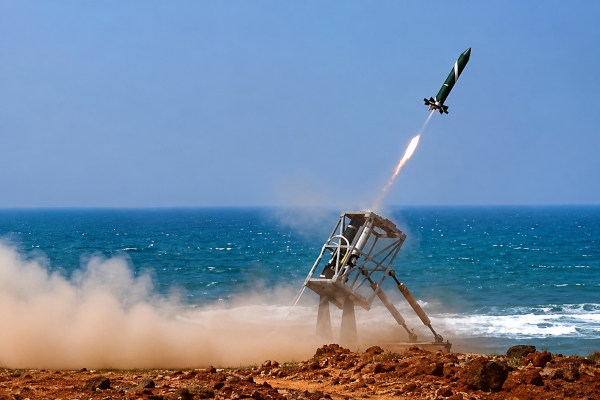
In this context, Bhargavastra has emerged as one of India’s most important indigenous counter-drone developments. Designed and developed by Solar Defence and Aerospace Limited, the system is being presented as a low-cost, hard-kill counter-drone platform built to neutralise individual drones as well as drone swarms. It was successfully tested at the Seaward Firing Range in Gopalpur, Odisha, in May 2025, in the presence of senior Army Air Defence officials. During the trials, rockets were fired in single mode and salvo mode, with two rockets launched within two seconds in one test, and all four rockets reportedly meeting the required launch parameters.
The name itself carries a civilisational echo. In Indian tradition, “Bhargavastra” is associated with the Bhargava lineage and the fearsome martial symbolism of Parashurama. For a modern military system, the name is apt: it suggests a compact but devastating weapon designed to strike quickly against a fast-moving threat. Unlike large air-defence missiles meant to intercept aircraft, cruise missiles or ballistic threats, Bhargavastra is aimed at the lower end of the aerial threat spectrum — small UAVs, swarm drones and loitering systems that can slip through conventional defences or overwhelm them through numbers.
The central idea behind Bhargavastra is cost-effective hard kill. Many counter-drone systems depend heavily on jamming, spoofing or electronic disruption. Those methods are useful, but they have limits. A drone using autonomous navigation, pre-programmed routes, inertial guidance or hardened communication links may not be easily jammed. A swarm may also contain too many targets to defeat through soft-kill measures alone. Bhargavastra addresses this gap by physically destroying drones using micro-rockets and guided micro-munitions, creating an inner defensive layer against threats that cannot simply be confused or disconnected.
The system is described as a two-layer counter-drone shield. The first layer uses unguided micro-rockets designed to defeat drone swarms through a lethal blast radius. Reports say these rockets can neutralise drone swarms within a lethal radius of around 20 metres. The second layer uses guided micro-missiles for more precise interception of selected targets, especially individual drones or higher-value aerial threats requiring pinpoint engagement.
This layered design is important because drone threats do not come in one form. A single quadcopter carrying explosives needs a different response from a coordinated swarm of cheap UAVs. A loitering munition diving onto a radar may demand precision. A mass of small drones heading toward an ammunition dump may demand volume fire. Bhargavastra’s use of both micro-rockets and guided micro-missiles gives it the flexibility to respond across this threat spectrum.
The reported performance envelope also makes it relevant for tactical air defence. Bhargavastra can detect small aerial threats from roughly 6 to 10 km away, while its engagement range is reported at up to 2.5 km. Its sensor architecture includes radar and electro-optical/infrared systems, helping operators detect, identify and track low-radar-cross-section targets. Business Today reported that the system’s Command-and-Control Centre uses advanced C4I technology and can be integrated with existing network-centric warfare infrastructure.
That integration is crucial. In modern air defence, no weapon should fight alone. A counter-drone system must ideally plug into a larger surveillance and command grid, receiving cues from radars, electro-optical sensors, radio-frequency detectors and battlefield networks. If Bhargavastra can operate as part of a broader layered air-defence architecture, it can protect forward bases, ammunition sites, radar stations, logistics nodes, airfields, headquarters, high-value convoys and border posts.
The system’s reported ability to fire a large salvo is especially significant. The Times of India reported that Bhargavastra can launch 64 micro-rockets in a single burst, allowing it to counter drone swarms rather than only isolated UAVs. This matters because the economics of drone warfare are brutal. An enemy can launch multiple cheap drones to force a defender to waste expensive missiles. A system like Bhargavastra tries to reverse that equation by using smaller, cheaper interceptors against smaller, cheaper aerial threats.
For India, this is not a theoretical problem. The threat environment has already moved in this direction. Pakistan-backed terror networks have used drones for arms and narcotics drops across the border. China has invested heavily in unmanned systems, swarm research and integrated reconnaissance-strike capabilities. The Russia-Ukraine war has shown how quickly commercial drones can become battlefield weapons. Even non-state actors now understand that cheap UAVs can create tactical and psychological effects far beyond their cost.
Bhargavastra therefore fits into India’s post-Operation Sindoor defence conversation. Operation Sindoor highlighted the growing role of non-contact warfare, drones, precision strikes, sensor networks and layered air defence. In such an environment, India cannot rely only on expensive long-range air-defence assets. Systems like S-400, MRSAM, Akash, QRSAM and fighter aircraft serve different roles in the air-defence ladder. Bhargavastra belongs closer to the tactical and point-defence end of that ladder, where the job is to protect specific military assets from low-cost drone saturation.
This distinction is important. Bhargavastra is not India’s “Iron Dome” in a literal sense, and it should not be confused with strategic air-defence systems. It is better understood as a counter-drone and counter-swarm hard-kill layer. Its value lies in plugging the dangerous gap between electronic countermeasures and larger surface-to-air missile systems. In other words, it gives commanders a weapon that is more kinetic than jamming but more economical than firing a large missile at a small drone.
The system also reflects a wider change in India’s defence industry. Solar Defence and Aerospace Limited, part of the Nagpur-based Solar group ecosystem, has already been linked with indigenous drone and munition developments. Reports around Bhargavastra place it within a growing private-sector defence manufacturing story, where Indian companies are no longer only component suppliers but are designing complete weapon systems for modern battlefield needs.
The private-sector angle is strategically important because counter-drone warfare evolves too quickly for slow procurement cycles. Drone designs, control links, autonomy levels, payloads and swarm tactics can change within months. A flexible domestic industrial base allows faster iteration, testing, production and customisation. If the armed forces identify a new drone threat, an Indian manufacturer can modify seekers, warheads, launchers, algorithms or sensor integration faster than an import-dependent model would allow.
Bhargavastra’s modularity also adds to its operational promise. Reports say the system can be configured with radar, electro-optical sensors, radio-frequency receivers and shooter units according to user requirements. It can also include a soft-kill layer with jamming and spoofing, creating a combined shield rather than a purely kinetic system.
This combined approach is the future of counter-UAS warfare. The best defence against drones will not be a single silver bullet. It will be a layered kill chain: detect through radar or RF sensors, classify through EO/IR, disrupt through jamming where possible, deceive through spoofing if feasible, and destroy through hard-kill interceptors when necessary. Bhargavastra’s importance lies in adding a credible hard-kill option to that chain.
The high-altitude dimension also matters. Reports say the system is designed for deployment across varied terrain, including high-altitude regions above 5,000 metres. This is highly relevant for India, where critical military deployments stretch from deserts and plains to mountains and high-altitude forward areas. Drone threats in the Himalayas are particularly difficult because terrain can mask movement, weather can complicate detection, and forward posts may have limited defensive depth.
At the same time, Bhargavastra should be assessed realistically. A successful trial is a major milestone, but operational deployment will require further validation. The system will have to prove reliability in heat, dust, humidity, cold, mountains, night conditions, electronic warfare environments and dense airspace. It will also need robust rules of engagement to distinguish hostile drones from friendly UAVs, birds, civilian drones and battlefield clutter. In counter-drone warfare, false positives can be dangerous, while slow reaction can be fatal.
The system’s future will also depend on production scale and cost per engagement. The entire logic of Bhargavastra rests on defeating cheap drones without using disproportionately expensive interceptors. If India can produce its micro-rockets and guided munitions at scale, the system could become a practical answer to saturation attacks. If costs rise too high, its advantage over existing air-defence weapons would narrow.
Another issue is integration. A counter-drone system must not become a stand-alone island. It should feed into and draw from the Army, Air Force and Navy’s broader air-defence networks. It must be able to receive external target cues, share engagement data, avoid duplication of fire and function within a joint command environment. This is especially important because future drone attacks may be coordinated with artillery, cruise missiles, cyber disruption and information warfare.
For the Indian Army, Bhargavastra could protect forward logistics sites, ammunition depots, brigade headquarters, radar detachments and air-defence units. For the Indian Air Force, it could provide point defence around air bases, fuel farms, aircraft shelters and radar installations. For the Navy, a navalised or port-defence version could help protect harbours, coastal infrastructure and ships at anchor from small UAV attacks. The same concept could also support protection of critical national infrastructure such as refineries, nuclear facilities, power stations and strategic communications sites.
The larger significance of Bhargavastra is that it shows India is beginning to treat drones not as a nuisance but as a battlefield class of threat deserving dedicated weapons. Earlier, armies could afford to think of drones mainly as surveillance platforms. That era is gone. A drone can now be a scout, bomber, missile, decoy, jammer, relay node or kamikaze weapon. A swarm can be used to blind radars, exhaust interceptors, attack logistics or create confusion before a larger strike.
Bhargavastra is India’s answer to that new reality. It is not glamorous in the way fighter jets or ballistic missiles are glamorous, but it may prove equally important in the wars of the next decade. The future battlefield will reward the force that can protect its sensors, bases, ammunition and troops from cheap aerial harassment. A military that cannot defeat drones will find its expensive platforms constantly exposed. A military that can destroy drone swarms cheaply will retain freedom of action.
In that sense, Bhargavastra represents more than a weapon test. It represents a doctrinal shift. India is building the lower layers of a modern air-defence ecosystem, where heavy systems protect against aircraft and missiles, medium systems defend formations and bases, and micro-munition systems defeat the small drones that slip through the gaps. The success of this approach will depend on how quickly India can test, refine, procure and deploy such systems across vulnerable theatres.
If Bhargavastra matures into a fielded, networked and mass-produced counter-drone platform, it could become one of the most practical additions to India’s tactical defence architecture. The wars of tomorrow may be announced not by the roar of aircraft, but by the faint buzz of drones approaching in numbers. Bhargavastra is designed for that sound — and for the new kind of war it represents.
You may also like
-
Sigma Advanced Systems Secures ₹174 Crore Export Order for 155mm Artillery Ammunition Subsystems
-
Bharat Electronics Secures ₹1,011 Crore in New Defence Orders for Radar, Communication and Sonar Systems
-
India’s 300 kW Laser Weapon Ambitions Could Strengthen Future Defence Against Cruise Missiles
-
Indian Army Seeks 360-Degree Laser Warning System with Automatic Smoke Protection for Tanks
-
DRDO Seeks Indian Industry Partners for Development and Production of R-59 Air-Launched Weapon System
