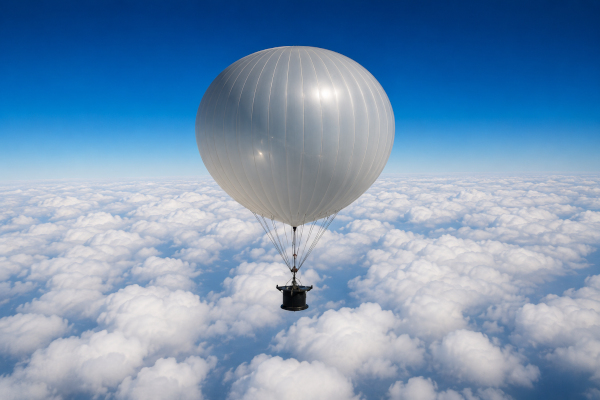
India’s private aerospace ecosystem has taken an important step into the emerging field of near-space infrastructure, with Red Balloon Aerospace successfully conducting a tethered trial of what it describes as India’s first indigenous super-pressure balloon system. The test, held at Indira Gandhi Stadium in Vijayawada, was designed to validate launch procedures, ground-team coordination, payload integration, safety protocols and overall system readiness before a full stratospheric mission.
A super-pressure balloon is not an ordinary weather balloon. It is a specialised high-altitude platform designed to maintain internal pressure greater than the surrounding atmosphere, allowing it to remain stable at high altitudes for longer periods. Such balloons operate in the stratospheric or “near-space” layer, roughly between conventional aircraft altitudes and satellite orbits. This makes them useful for missions where satellites may be expensive and drones may lack endurance.
The recent trial did not send the balloon freely into the stratosphere. Instead, it was a controlled, ground-anchored test in which the balloon remained tethered while engineers evaluated inflation, launch handling, payload integration, field execution and ground crew response. This kind of test is a necessary step before attempting a full-scale flight because high-altitude balloons face complex challenges involving material strength, pressure stability, thermal variation, wind conditions, payload safety and recovery.
Red Balloon Aerospace plans to use its VISTA platform as a reusable high-altitude stratospheric asset. According to the company’s own platform description, its technology stack includes high-endurance reusable envelope materials, autonomous and hybrid control systems, hydrogen or helium-powered lighter-than-air platforms and solar-array integration for power management. The company also lists HELIX airships and other tethered and data-inference platforms as part of its broader lighter-than-air technology roadmap.
The full mission, expected later in 2026, aims to place the balloon at an altitude of around 25 kilometres. At that height, super-pressure balloons can serve as persistent aerial platforms for telecommunications, rural connectivity, disaster monitoring, environmental observation, atmospheric research, surveillance and earth-imaging missions. Fortune India had earlier reported that the planned mission would carry a high-resolution imaging payload capable of delivering 25 to 75 centimetre resolution, along with other sensor capabilities.
The larger significance of this development lies in cost and deployment flexibility. Satellites are powerful but expensive, slow to build and difficult to modify once launched. Stratospheric balloons, by contrast, can be deployed more quickly, recovered after missions, repaired, upgraded and reused. This makes them attractive for countries like India, where near-space platforms could support both civilian and strategic requirements, including border monitoring, emergency communications, agricultural mapping, industrial inspection and disaster response.
The test also points to the growing maturity of India’s private aerospace sector. In recent years, Indian startups have moved beyond software and small components into rockets, propulsion systems, satellites, drones, sensors and now lighter-than-air stratospheric platforms. Red Balloon Aerospace’s trial shows that the next layer of aerospace innovation may not be only orbital; it may also emerge from the high-altitude zone between the sky and space.
For India, this is a field worth watching closely. A successful indigenous super-pressure balloon platform could give the country a low-cost, flexible and recoverable tool for communications, observation and research. The tethered Vijayawada trial is only an early milestone, but it signals that Indian startups are beginning to explore a domain that could become strategically important in the coming decade.
You may also like
-
India Advances Project-75(I) and Submarine Modernisation Plans to Strengthen Underwater Warfare Capability
-
Kokasa Launches to Build Indigenous Mission-Critical Systems for Su-30MKI, MiG-29 and T-72
-
Flying Wedge Defence Partners With Portugal’s Keydef to Manufacture Kaal Bhairava and YAMA Drones in Europe
-
ASEAN Diplomats Visit BrahMos Facility as India Showcases Defence Engineering Capabilities
-
India and UAE Agree to Expand Army Cooperation and Desert Cyclone Participation
