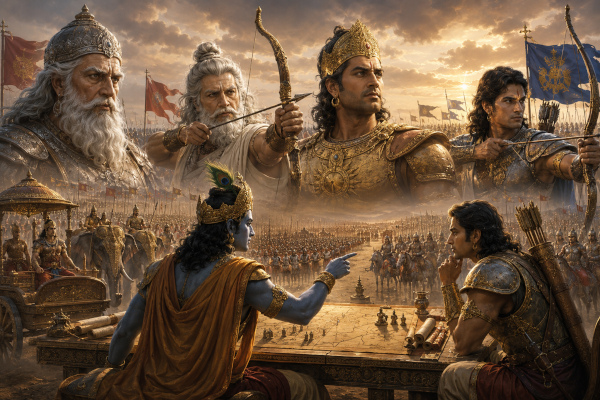
At Kurukshetra, command was visible before a single arrow flew. Standards rose above chariots, conches carried intent across the dust, elephants marked the heavy centre, cavalry guarded the flanks, and infantry held the living line of battle. The Mahabharata turns this battlefield into more than a clash of warriors; it becomes a study of command responsibility, moral pressure, political interference, tactical brilliance, alliance management and strategic clarity. The epic’s central narrative is built around the struggle for sovereignty between the Kauravas and Pandavas, while the Bhishma Parva places the Bhagavad Gita and the opening ten days of war inside the same military frame.
The command structure of the Mahabharata can be understood through three layers. The first is political command, represented by kings such as Dhritarashtra, Duryodhana and Yudhishthira. The second is military command, represented by generals such as Bhishma, Drona and Karna. The third is strategic counsel, represented most brilliantly by Krishna, whose authority comes from judgment, foresight and moral intelligence. Modern armed forces also separate political objectives, military operations and strategic advice, because battlefield success requires more than bravery; it requires purpose, hierarchy, discipline, intelligence and unity of effort.
Bhishma’s appointment as the first commander of the Kaurava army gave Duryodhana the strongest possible symbol of legitimacy. Bhishma was the elder of the Kuru house, a warrior of immense reputation, a master of statecraft and a figure whose personal discipline commanded respect across both sides. In modern military language, he gave the Kaurava coalition credibility, cohesion and morale. Troops can fight under fear, but they fight better under confidence; Bhishma gave confidence to an army whose political cause carried deep moral strain. The Mahabharata repeatedly presents Bhishma as a commander whose presence steadied the Kaurava side during the early phase of war.
Yet Bhishma’s command also shows the limits of professional excellence under political constraint. He had military ability, moral stature and battlefield experience, but the political objective belonged to Duryodhana. The commander’s heart and the ruler’s ambition moved in different directions. This is one of the epic’s finest defence lessons: a commander can arrange troops, inspire soldiers and win tactical encounters, while the campaign still suffers when the political aim lacks ethical strength. In modern terms, Bhishma represents the capable senior commander operating under a flawed national command direction.
Bhishma also understood the psychology of restraint. His reluctance to use the full violence of his power against the Pandavas created tension inside the Kaurava war council. Duryodhana wanted total destruction; Bhishma fought with the dignity of an elder bound by duty, affection and the memory of a shared lineage. This makes him a study in what modern military academies would call moral friction: the pressure created when orders, conscience, loyalty and battlefield necessity pull a commander in different directions.
The positive lesson from Bhishma is that military leadership requires legitimacy. Soldiers must believe in the person who leads them. Even opposing warriors honoured Bhishma because he embodied discipline, knowledge and sacrifice. Modern commanders gain similar authority through competence, fairness, personal courage, care for troops and visible accountability. Rank gives command; character gives command depth.
Drona’s command begins after Bhishma’s fall, and the tone of the war changes. The Mahabharata describes Drona’s formal investiture as commander of the Kaurava forces after Bhishma, accompanied by royal approval and martial ceremony. Drona was a military instructor, master of weapons, designer of formations and teacher of many warriors on both sides. His command therefore represents a shift from elder-statesman authority to technical and tactical expertise.
As a battlefield commander, Drona was formidable. He understood formations, sequencing, pressure points and the use of elite warriors. His period of command is associated with intense manoeuvre, complex battle arrays and aggressive attempts to break the Pandava structure. In modern comparison, Drona resembles the highly trained operational commander who knows doctrine, training systems and the mechanics of force employment. He was the professional tactician who could convert knowledge into battlefield pressure.
The tragedy of Drona’s command lies in emotional vulnerability and political capture. His loyalty to Hastinapura, resentment connected to old wounds, affection for Ashwatthama and dependence on royal patronage gradually narrowed his judgment. His genius served a cause whose moral direction he could sense but could barely escape. The Mahabharata uses Drona to show how technical brilliance becomes dangerous when the commander’s inner compass weakens under pressure.
Drona’s period also brings the Abhimanyu episode into sharp focus. The killing of Abhimanyu inside the Chakravyuha remains one of the epic’s strongest examples of tactical success carrying moral cost. Abhimanyu entered a formation whose exit he had yet to master; multiple senior warriors then overwhelmed him. The episode shows how battlefield advantage can damage the ethical legitimacy of the force that uses it. In modern defence terms, this becomes a discussion about rules of engagement, proportionality, treatment of isolated combatants and the long-term effect of conduct on morale.
Drona’s fall through the Ashwatthama episode gives another military lesson: information can break command faster than weapons. Once the report of Ashwatthama’s death reaches him, his emotional centre collapses. The story is often read morally, but it also has a defence dimension. Commanders are human nodes inside a war system. Their clarity, emotional balance and trust networks matter as much as their weapons. Modern armies invest in intelligence verification, command resilience and psychological conditioning because one false or ambiguous signal can shape battlefield behaviour.
Karna’s command begins after Drona’s death, and the Kaurava camp enters a more desperate phase. The Karna Parva opens in the atmosphere of grief, anxiety and depleted morale after Drona has been slain; the army looks for renewed energy through Karna’s leadership. Karna brings unmatched personal courage, fierce loyalty to Duryodhana and a burning desire to settle his rivalry with Arjuna. As a warrior, he is magnificent; as a theatre-level commander, his strengths are narrower.
Karna’s great defence lesson is that heroism and command are related but distinct. A brave warrior can dominate a duel; a commander must shape the campaign. Karna could inspire soldiers by personal example, yet his strategic imagination remained tied to the personal objective of defeating Arjuna. This narrowed the Kaurava effort. Modern command requires mission analysis, resource allocation, delegation, timing, reserve management, intelligence use and coordination across arms. Personal valour becomes one ingredient inside a far larger command recipe.
Karna also shows the danger of command driven by private grievance. His life carries humiliation, loyalty, generosity and pain, making him one of the epic’s most compelling figures. On the battlefield, however, a commander must rise above personal history and see the whole theatre. A modern corps commander or theatre commander cannot allow one rivalry, one sector or one emotional wound to dominate the operational plan. Karna’s story therefore teaches the importance of emotional discipline in senior command.
Still, Karna’s positive leadership value deserves recognition. He stood by his chosen ally, faced danger without hesitation and brought energy to a shaken army. Troops often rally around visible courage, and Karna possessed that quality in abundance. The limitation was strategic breadth. His life reminds modern readers that courage is precious, but courage must be joined with planning, institutional discipline and calm judgment.
Arjuna represents a different kind of military excellence: the warrior-scholar. He combines training, discipline, weapon mastery, humility before instruction and readiness to act under command. The Bhagavad Gita begins with Arjuna’s battlefield crisis, where he lowers his bow in grief after seeing teachers, elders and relatives arrayed for war. This moment makes Arjuna deeply human, and also makes him suitable for higher instruction. A soldier without reflection can become reckless; a reflective soldier without discipline can become paralysed. Arjuna moves through both danger zones and returns to action with clarity.
In defence terms, Arjuna is the ideal professional officer because he unites skill with doctrine. He understands weapons, movement, timing and target selection; he also accepts guidance from Krishna when the crisis becomes moral and strategic. Modern officer training seeks the same blend: technical competence, mental resilience, ethical reasoning, mission focus and obedience to lawful command. Arjuna’s greatness lies in teachability as much as talent.
The Gita’s battlefield setting turns Arjuna from a heroic archer into a model of disciplined action. Krishna teaches him to act with steadiness, self-mastery and devotion to duty. The famous teaching around action, equanimity and disciplined performance becomes highly relevant to military leadership, because combat places human beings under fear, grief, anger and uncertainty. A commander needs skill, but also inner order.
Arjuna also understands combined dependence. His chariot, horses, bow, divine weapons, charioteer, training and command relationships all form a warrior-system. This is strikingly modern. Today, a fighter pilot, tank commander, naval officer or drone operator performs through a system of sensors, platforms, crew, data links, logistics, command networks and rules of engagement. Arjuna’s Gandiva is powerful because Arjuna is trained, Krishna guides, the chariot moves, intelligence flows and purpose remains clear.
Krishna stands apart from all commanders because he shapes the war without serving as a conventional combatant. In the Udyoga Parva, he argues for a political path before war and presents peace as the first duty of wise statecraft. Once war becomes unavoidable, he becomes charioteer, counsellor, strategic analyst, morale restorer, psychological operator and timing specialist. He proves that the person who understands the war’s purpose may shape the outcome more deeply than the person who merely fights in it.
Krishna’s strategic brilliance begins before Kurukshetra. He reads personalities clearly: Duryodhana’s ambition, Yudhishthira’s moral hesitation, Arjuna’s sensitivity, Bhima’s force, Karna’s pride, Bhishma’s restraint and Drona’s emotional weakness. This is advanced strategic intelligence. Modern defence planning values the same ability through political assessment, adversary profiling, intelligence fusion and red-team analysis. A war is shaped by weapons, terrain and logistics, but also by temperament, ego, fear, legitimacy and morale.
On the battlefield, Krishna’s role resembles that of a strategic advisor embedded at the decisive point. He carries no conventional command rank over the army, yet his counsel influences the most important operational decisions. He guides Arjuna during moments of confusion, reads enemy intentions, identifies windows of opportunity and keeps the Pandava side aligned with the larger objective. In modern terms, he combines the roles of national security advisor, operational mentor, psychological analyst and moral philosopher.
Krishna’s difference from a warrior is crucial. A warrior asks, “How do I win this fight?” A war planner asks, “Which fight matters, when should it be fought, what political end does it serve, and what cost can be accepted?” Krishna repeatedly operates at this higher level. He understands that a battle can be won and a war still damaged by loss of legitimacy. He also understands that moral hesitation can allow injustice to survive. His greatness lies in balancing idealism with hard strategic necessity.
Modern military doctrine often separates leadership into direct, organisational and strategic levels. U.S. Army leadership doctrine, for example, discusses leadership across direct, organizational and strategic levels; modern combined-arms thinking also emphasises the employment of different capabilities together in one operational design. Through that lens, Arjuna is the direct battlefield leader, Drona is the tactical-operational commander, Bhishma is the senior institutional commander, Karna is the heroic combat commander under pressure, and Krishna is the strategic advisor who sees the whole system.
The Mahabharata’s command lessons remain valuable because they show that war is a human institution before it is a technical contest. Weapons matter, formations matter, courage matters, but command quality decides how all these strengths combine. Bhishma teaches legitimacy and the burden of conflicted duty. Drona teaches the power and danger of tactical genius. Karna teaches courage and the limits of grievance-driven command. Arjuna teaches disciplined professionalism. Krishna teaches strategic wisdom, political foresight and moral clarity.
A positive reading of this command hierarchy gives modern India a deep civilisational vocabulary for defence thought. The epic honours warriors, yet it places wisdom above rage, discipline above display, and purpose above mere violence. Kurukshetra becomes a military classroom where command failures and leadership brilliance are both preserved for later generations. The message is enduring: a strong army needs brave fighters, trained commanders, ethical discipline, political clarity and wise counsel at the centre.
Reference:
Britannica — Mahabharata overview
https://www.britannica.com/topic/Mahabharata
Sacred Texts — Mahabharata, Book 6: Bhishma Parva Index
https://sacred-texts.com/hin/m06/index.htm
Sacred Texts — Mahabharata, Book 6: Bhishma Parva, Section CXVIII
https://sacred-texts.com/hin/m06/m06118.htm
Sacred Texts — Mahabharata, Book 7: Drona Parva, Section VII
https://sacred-texts.com/hin/m07/m07007.htm
Sacred Texts — Mahabharata, Book 7: Drona Parva Index
https://sacred-texts.com/hin/m07/index.htm
Sacred Texts — Mahabharata, Book 7: Drona Parva, Abhimanyu-badha Parva, Section XLV
https://sacred-texts.com/hin/m07/m07045.htm
Sacred Texts — Mahabharata, Book 8: Karna Parva, Section I
https://sacred-texts.com/hin/m08/m08001.htm
Sacred Texts — Mahabharata, Book 5: Udyoga Parva, Section V
https://sacred-texts.com/hin/m05/m05005.htm
Sacred Texts — Mahabharata, Book 6: Bhishma Parva, Bhagavad Gita Chapter I
https://sacred-texts.com/hin/m06/m06025.htm
Sacred Texts / ibiblio — Mahabharata, Book 6: Bhishma Parva, Bhagavad Gita Chapter II
https://www.ibiblio.org/sripedia/ebooks/mb/m06/m06026.htm
U.S. Army — ADRP 6-22, Army Leadership
https://armyrotc.mst.edu/media/academic/armyrotc/documents/manualsadpadrpfmetc/ADRP%206-22.pdf
U.S. Army — FM 1, The Army: A Primer to Our Profession of Arms
https://apply.westpoint.edu/www/documents/FM%201%20The%20Army.pdf
You may also like
-
Sigma Advanced Systems Secures ₹174 Crore Export Order for 155mm Artillery Ammunition Subsystems
-
Bharat Electronics Secures ₹1,011 Crore in New Defence Orders for Radar, Communication and Sonar Systems
-
India’s 300 kW Laser Weapon Ambitions Could Strengthen Future Defence Against Cruise Missiles
-
Indian Army Seeks 360-Degree Laser Warning System with Automatic Smoke Protection for Tanks
-
DRDO Seeks Indian Industry Partners for Development and Production of R-59 Air-Launched Weapon System
