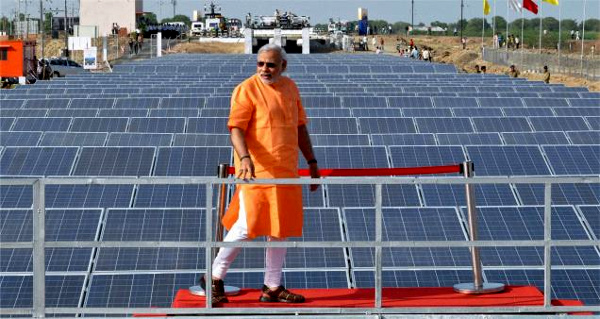
India’s power system has crossed another major stress-test moment, with Union Minister Pralhad Joshi saying the country successfully managed a record peak power demand of 256.4 gigawatts in a single day. According to News On AIR, the Minister said nearly 33% of this demand was met through renewable energy sources, underlining the growing role of clean energy in supporting India’s rapidly expanding electricity needs.
The figure is important because peak power demand reflects the highest electricity load that the grid has to handle at a particular point in the day. For a large and fast-growing economy like India, this is not just a power-sector statistic; it is a measure of industrial activity, urban consumption, summer cooling demand, rural electrification, digital infrastructure growth and the country’s ability to keep the grid stable under pressure.
Joshi said India’s power infrastructure has become “stronger, more resilient and future-ready,” linking the achievement to capacity addition, grid strengthening and the rising contribution of clean energy. News On AIR reported that the Minister described the milestone as part of India’s broader growth journey, where electricity demand is rising but the grid is increasingly supported by renewable energy.
The latest 256.4 GW figure comes close on the heels of another official milestone. On 25 April 2026, India had met an all-time high peak electricity demand of 256.1 GW without shortage, while also maintaining electricity exports to neighbouring countries, according to the Ministry of Power. That April record had already surpassed the previous all-time high of 250 GW recorded on 30 May 2024 and the 245.4 GW peak recorded on 9 January 2026.
What makes the latest claim particularly significant is the renewable energy share. If nearly one-third of peak demand was met through renewable sources, it shows that solar, wind, hydro and other clean sources are no longer marginal additions to India’s electricity system. They are becoming central to grid operations, especially during daytime demand peaks when solar generation can support heavy loads.
India’s power challenge is now two-fold. The country must keep adding generation capacity to meet rising demand, while also ensuring that renewable-heavy supply remains stable through better storage, transmission, forecasting and grid-balancing systems. The April 2026 record had already shown that India could meet historic peak demand without shortage, but analysts have also noted that higher summer peaks will require stronger storage capacity, flexible thermal operations and demand-side management.
The achievement also carries an economic signal. Reliable electricity is essential for manufacturing, data centres, railways, electric mobility, agriculture, households and urban infrastructure. A grid that can handle more than 256 GW of peak demand without major disruption gives confidence to investors and industries planning large-scale expansion in India.
The larger message is that India’s energy transition is entering a practical phase. The country is not merely adding renewable capacity for climate targets; it is increasingly using clean energy to meet real-time national demand. The record 256.4 GW peak, supported by nearly 33% renewable contribution, shows a power system moving from scarcity management toward scale, resilience and cleaner growth.
You may also like
-
India Advances Trade Diplomacy at G20 Ministerial in Milwaukee
-
Kokasa Launches to Build Indigenous Mission-Critical Systems for Su-30MKI, MiG-29 and T-72
-
Tata Projects and MDS Aero Partner to Build Advanced Aero-Engine Test Infrastructure in India
-
Flying Wedge Defence Partners With Portugal’s Keydef to Manufacture Kaal Bhairava and YAMA Drones in Europe
-
Armenia Conducts Live-Fire Exercise With Indo-French TRAJAN 155 mm Howitzers Manufactured in India
