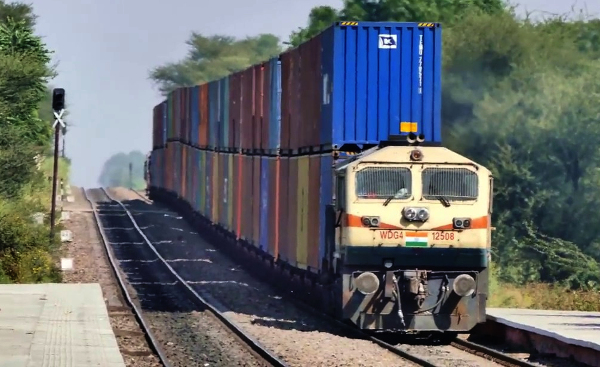
India has created a rare global benchmark in railway freight by becoming the first country to operate double-stack container trains under fully electric traction on high-rise overhead electrification. This achievement places Indian Railways and the Dedicated Freight Corridor network in a unique position in world logistics. Several countries run double-stack container trains. Several countries run electrified freight corridors. India brought both together at scale by designing a railway system capable of carrying two layers of containers under live overhead electric wires.
This is an engineering milestone, an infrastructure milestone and an economic milestone. It shows how India is trying to reduce logistics costs, move more cargo by rail, cut dependence on diesel haulage, improve port connectivity and support cleaner freight movement. In a country where industrial growth, exports, e-commerce, manufacturing, agriculture supply chains and port-led trade are expanding together, freight railway modernisation is directly linked to economic competitiveness.
The correct term for this achievement is double-stack container freight train, not ordinary double-decker freight train. A double-stack train carries containers in two vertical layers on specially designed wagons. This allows one train to move a much larger volume of cargo compared to a conventional single-stack container train. When such a train is hauled by electric locomotives under overhead equipment, it becomes a cleaner, more efficient and more complex form of freight transport.
The complexity comes from height. A normal electrified railway line uses overhead equipment placed at a standard height above the track. A double-stack container train needs much greater vertical clearance because containers are loaded one above another. In most countries, this creates a practical challenge. Either double-stack trains are kept on non-electrified routes and hauled by diesel locomotives, or special routes are built with clearances that avoid overhead wires. India chose a more ambitious path. It built high-rise overhead electrification so that electric locomotives could haul double-stack container trains without compromising cargo height.
This required a special High-Rise Overhead Equipment system. The contact wire had to be placed much higher than conventional electrification. The locomotives also needed high-reach pantographs that could collect current reliably from the elevated wire. Pantograph stability, wind effect, current collection, safe clearance, bridge design, signalling, track geometry and wagon profile all had to work together. This is why the achievement is a railway systems breakthrough rather than a simple train launch.
The first major milestone came in June 2020, when Indian Railways successfully began operations of double-stack container trains with high-reach pantographs in high-rise overhead electrification territory between Palanpur and Botad in Gujarat. This created a new world benchmark because it proved that double-stack freight could be combined with overhead electric traction. It was a decisive step for India’s green freight ambitions.
The next major milestone came in January 2021 on the Western Dedicated Freight Corridor. The Prime Minister flagged off the world’s first double-stack long-haul container train hauled by electric traction from New Ateli to New Kishangarh. The train was around 1.5 km long, showing that the system was designed not only for double-stack movement but also for heavy, long-haul, high-capacity operations. This made the achievement even more significant for large-scale logistics.
The Western Dedicated Freight Corridor is central to this story. It links the National Capital Region with western India’s major industrial and port zones. It connects production centres, logistics hubs, inland container depots and ports across states such as Haryana, Rajasthan, Gujarat, Maharashtra and Uttar Pradesh. The corridor is designed for faster freight movement, heavier axle loads, longer trains and time-bound cargo handling. Its double-stack capability gives India a major advantage in container movement.
The economic logic is straightforward. A double-stack container train carries far more cargo in one trip. This improves capacity utilisation, reduces the cost per container, lowers congestion on busy routes and reduces pressure on highways. For exporters and manufacturers, faster and cheaper freight can improve delivery schedules and reduce inventory costs. For ports, it helps faster evacuation of containers. For industries in inland states, it improves access to global shipping routes.
The environmental value is equally important. Road freight depends heavily on diesel trucks. Long-distance container movement by road increases fuel consumption, emissions, highway congestion and logistics delays. Electric double-stack freight shifts large cargo volumes from road to rail. Since India is also expanding renewable energy capacity, electrified freight corridors can become progressively cleaner as the electricity mix improves. This makes the system valuable for both economic growth and climate strategy.
The infrastructure design also supports India’s ambition to reduce logistics costs as a share of GDP. High logistics costs weaken manufacturing competitiveness. When cargo movement becomes faster, predictable and cheaper, factories can plan better, exporters can serve global markets more efficiently and supply chains become more resilient. Dedicated Freight Corridors separate freight traffic from passenger-heavy railway routes, allowing both systems to perform better. Passenger trains gain capacity on conventional routes, while freight trains gain speed and reliability on dedicated corridors.
The Western Dedicated Freight Corridor also supports the Delhi-Mumbai Industrial Corridor and port-led development. Industrial corridors require reliable freight movement for raw materials, components and finished goods. The ability to move double-stack containers electrically from inland logistics hubs to ports gives India a stronger base for manufacturing-led exports. It also strengthens the role of inland container depots and multimodal logistics parks.
The wagon design is another important part of the achievement. Double-stack operations require specially designed low-height container wagons that maintain stability while carrying stacked containers. These wagons must handle heavy axle loads, distributed loading, braking dynamics and safe operation at higher speeds. Indian railway institutions such as RDSO and DFCCIL played an important role in developing and approving these systems for freight corridor operations.
Electric locomotives add another layer of strength. India has been expanding high-powered electric locomotive capacity, including heavy-haul freight locomotives designed for demanding operations. Such locomotives provide strong haulage power, lower operating emissions at the point of use and better energy efficiency compared to diesel traction. When paired with long double-stack trains, they allow the railways to move large cargo volumes with fewer train paths.
This has direct implications for ports such as Mundra, Pipavav, Kandla and JNPT-linked routes. Western India handles a significant share of India’s containerised trade. Efficient rail evacuation from ports reduces container dwell time, improves terminal productivity and strengthens India’s export-import cycle. A fully electric double-stack freight system therefore becomes part of the larger maritime and trade infrastructure network.
There is also a strategic value in reducing fuel dependence. Diesel freight haulage requires imported fuel and exposes logistics costs to global oil price volatility. Electrified freight reduces this exposure. As India adds more solar, wind, hydro and nuclear power, railway electrification becomes a tool of energy security. Freight movement powered by domestic electricity is more stable and strategically safer than long-distance diesel dependence.
For the economy section, this development matters because logistics is the invisible backbone of growth. Every factory, warehouse, port, farm supply chain and export unit depends on transport efficiency. A country that moves goods cheaply and reliably gains an advantage in manufacturing and trade. India’s electric double-stack freight system is therefore more than a railway achievement. It is an economic productivity tool.
For the infrastructure section, the story shows how modern India is building integrated systems rather than isolated projects. The train, wagon, electric locomotive, high-rise OHE, dedicated track, signalling system, logistics hub, port connection and industrial corridor all work as one network. This systems approach is what makes the achievement important. The train is the visible symbol; the real achievement is the infrastructure ecosystem behind it.
The global comparison makes India’s achievement stand out. The United States has long used double-stack container trains, but many such routes depend on diesel locomotives because overhead electric wires create clearance issues. China has a vast electrified rail network and major freight capacity, but India’s high-rise OHE double-stack container operation created a distinct world-first category. India solved a problem that many large rail systems avoided by separating double-stack operations from overhead electrification.
This does not mean every Indian freight train is double-stack or every route can support such operations. The achievement applies to specifically designed high-clearance electrified routes, especially the Western Dedicated Freight Corridor and connected sections. The distinction is important because double-stack movement requires the right track, bridge, overhead wire, wagon and locomotive systems. India’s achievement lies in building and operating that specialised system successfully.
The benefits will grow as more corridor sections, logistics parks and port connections mature. Higher train speeds, heavier axle loads, longer rakes and better terminal integration can steadily improve freight economics. As cargo owners gain confidence in time-bound rail movement, more container traffic can shift from road to rail. This will support lower emissions, lower congestion and better logistics planning.
India’s electric double-stack freight achievement also supports the PM Gati Shakti vision of multimodal infrastructure. Rail, road, ports, warehouses, industrial corridors and digital logistics platforms are now being planned together. A high-capacity electric freight corridor fits perfectly into this model because it gives the country a powerful backbone for long-distance cargo movement.
The employment effect is also significant. Large freight corridors create work in construction, maintenance, signalling, electrical systems, locomotive operations, logistics parks, warehousing, terminal handling, engineering services and supply-chain management. Better freight infrastructure also supports manufacturing jobs indirectly by making production and exports more competitive.
The country is building logistics infrastructure that can match the needs of a larger economy. As India targets higher manufacturing output, stronger exports and deeper participation in global supply chains, freight rail modernisation will be a decisive factor. The electric double-stack container train is one of the clearest examples of how infrastructure can directly improve economic performance.
The achievement also strengthens India’s image as an infrastructure innovator. It is common to view Indian Railways through the lens of passenger movement, but the double-stack electric freight breakthrough shows a high-technology freight capability. It combines civil engineering, electrical engineering, rolling stock design, operations planning and logistics economics.
The long-term importance is even greater. India’s freight demand will continue to rise as urbanisation, consumption, manufacturing and exports expand. Highways alone cannot carry this load efficiently. A balanced system needs rail to handle bulk and container cargo at scale. Fully electric double-stack freight trains give India a cleaner and more productive way to meet this demand.
India’s first-of-its-kind fully electric double-stack freight train is therefore a symbol of the country’s infrastructure transition. It brings together green mobility, freight efficiency, port connectivity, industrial competitiveness and railway engineering. It proves that India can design solutions suited to its own geography and economic needs while setting a world benchmark.
In simple terms, one electric train carrying two layers of containers can replace a large number of truck movements, reduce logistics pressure, support exports and make freight transport cleaner. That is why this achievement deserves attention in both the economy and infrastructure sectors. It is a train story on the surface, but underneath it is a story about India building the logistics backbone of a larger, greener and more competitive economy.
You may also like
-
Vietnam Expands Business and Investment Links Across India’s Major Economic Hubs
-
India’s GST Collections Rise 14.7% to ₹2.04 Lakh Crore in September
-
SberIndia Lending to Indian Companies Quadruples as India-Russia Trade Finance Expands
-
India Manufacturing PMI Rises to Seven-Month High of 55.1 in September
-
Nothing and Optiemus Announce $100 Million Joint Venture to Expand Smartphone Manufacturing in India
