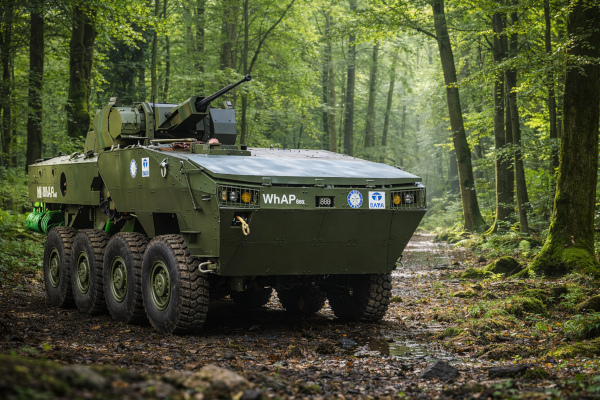
India’s Wheeled Armoured Platform, or WhAP 8×8, is one of the more important indigenous land systems to emerge from the country’s push for combat-vehicle self-reliance because it is not merely a protected troop carrier, but a modular battlefield architecture. Jointly designed by DRDO and Tata Advanced Systems, the platform was conceived around three linked ideas that now define modern wheeled combat vehicles worldwide: modularity, scalability and re-configurability. Tata describes it as India’s first amphibious wheeled infantry combat vehicle, while DRDO characterises it as an indigenously designed wheeled combat vehicle with strong mobility, protection and firepower parameters. That combination matters because WhAP is meant to serve as a common base for multiple mission sets rather than remain locked into a single static role.
Technically, the platform is impressive because its design tries to balance three things that usually pull in different directions: payload, survivability and amphibious mobility. DRDO’s current export compendium lists the vehicle as an amphibious 8×8 platform with hydrojets up to a gross vehicle weight of 24.5 tonnes, a fully automatic transmission, hydro-gas suspension, and an engine configurable at 600, 525 or 450 horsepower. The same document gives its dimensions as 7.9 m by 3.05 m by 3.2 m, with the hull roof at 2.3 m, and says the base platform weighs 21.5 tonnes with all-round 7.62 mm AP protection, rising to 24.2 tonnes with a BMP-II turret fit. Mobility figures are equally telling: 100 km/h on road, 35–40 km/h off road, and about 8 km/h afloat with hydrojets, along with a 30-degree gradient capability, 20-degree side slope, and 0.6 m vertical-step obstacle performance. In plain military terms, this is a vehicle shaped for long operational road moves, rough cross-country work, and riverine movement without surrendering the armor and weapon growth margin that many lighter amphibious vehicles struggle to preserve.
The real engineering strength of WhAP lies in survivability architecture rather than a single headline number. DRDO specifies a double-floor V-type mine-protection layout with shock-resistant seats and foot pads, which is significant because modern underbelly-blast mitigation depends as much on energy management inside the crew compartment as on raw hull thickness. The vehicle is also provisioned with an Instant Fire Detection and Suppression System, NBC protection, and HVAC, indicating that the design was treated from the outset as a combat system expected to operate in contaminated environments, high temperatures and closed-hatch conditions. On top of that, DRDO’s Defence Metallurgical Research Laboratory has separately developed an indigenous lightweight add-on composite armour package for WhAP, stating that it delivers STANAG 4569 Level II and III protection in conjunction with the vehicle structure, and that the armour is modular enough to let protection levels be altered later without redesigning the vehicle itself. That is an important detail because it shows WhAP is not a fixed-protection machine; it is a platform with an upgrade path.
Firepower is where the vehicle becomes more than an armored bus. DRDO states that the WhAP design can accept a 30 mm manned turret, a 30 mm remote weapon station, 7.62 mm or 12.7 mm RCWS fits, a 105 mm low-recoil gun, and anti-tank guided missiles. The export compendium also notes an integrated 30 mm in-service turret option and day-night fighting support through CCD, thermal imaging and laser range finding. The significance of this weapon flexibility is doctrinal: it allows one automotive base to spawn an infantry combat vehicle, an armored personnel carrier, a direct-fire support platform, or a missile-armed overwatch variant. The Morocco facility announcement from India’s Ministry of Defence further underlined that the WhAP family is being configured for infantry fighting, armoured personnel carrier, reconnaissance, command post, mortar carrier and ambulance roles, with options for manned or unmanned weapon stations. A platform that can move from troop-carrying to recon, command-and-control or direct-fire support without changing its basic chassis gives an army lower training burden, a simpler logistics chain and a much easier maintenance ecosystem. That is where WhAP begins to look less like a single vehicle and more like a land-combat family.
Operationally, the amphibious character is one of WhAP’s most consequential traits. India’s likely wheeled-combat operating spaces are not limited to highways and semi-desert tracks; they include canal networks, floodplains, river crossings, marshy ground and slushy sectors where conventional wheeled armor can lose tempo. DRDO explicitly says the vehicle can negotiate mud and slushy terrain with ease, while Tata says the platform has been tested rigorously in extreme climatic conditions and terrains, including performance evaluation of its amphibious capabilities. That makes WhAP especially relevant for Indian conditions where a wheeled vehicle must combine road speed with tactical water-crossing ability instead of being optimized purely for one environment. In military planning terms, that gives commanders a much more useful instrument for fast mechanised movement in sectors where bridges may be scarce, damaged or under observation.
The programme’s maturity is also visible in its derivative ecosystem. DRDO says the 7.62 mm and 12.7 mm RCWS variants, including the Infantry Protected Mobility Vehicle and the paramilitary WhAP variant, have already been inducted into the Indian Army and paramilitary forces. DRDO also states that its wheeled CBRN reconnaissance vehicle uses a second-generation indigenous 8×8 design that incorporates enhancements suggested by the Army during WhAP trials. That is a strong signal that the platform is evolving through user feedback rather than remaining a showpiece prototype. In good defence engineering programmes, the first version proves the architecture, later versions absorb operational lessons, and derivative systems exploit the same chassis to widen the manufacturing base. WhAP appears to be moving along exactly that path.
Strategically, WhAP matters because it shows India is beginning to build not just indigenous vehicles, but indigenous vehicle ecosystems with export potential. In September 2025, the Ministry of Defence announced that Tata Advanced Systems had opened a 20,000-square-metre WhAP production facility in Morocco for the Royal Moroccan Army, calling it the first such plant by an Indian private company in Africa. The official note described WhAP as a modern modular combat platform with a survivable monocoque hull, scalable ballistic and mine protection, independent suspension, central tyre inflation and a high-power engine. Exports alone do not prove battlefield superiority, but they do prove something else that matters in defence manufacturing: the design is stable enough, supportable enough, and politically credible enough to travel. For India, that is a serious milestone. WhAP therefore deserves to be seen as more than an indigenous armored vehicle. It is one of the clearest indicators that India is finally learning how to turn combat-vehicle design, protection science, platform modularity and industrial partnership into a scalable defence product.
Reference:
https://www.drdo.gov.in/drdo/en/offerings/products/wheeled-armoured-platform-whap-8×8
https://www.drdo.gov.in/drdo/sites/default/files/schemes_services/CompendiumProductforExport2025.pdf
https://www.tataadvancedsystems.com/wheeled-armored-platform
https://mod.gov.in/sites/default/files/RM-inaugurates-TASL%E2%80%99s-defence-manufacturing-facility-in-Morocco_0.pdf
You may also like
-
Exercise Tarang Shakti 2026 Concludes in Jodhpur, Showcasing India’s Air Power, Indigenous Defence Technology
-
Indian Navy Vice Chief Inspects Japan’s Mogami-Class Stealth Frigate as India-Japan Shipbuilding Cooperation Expands
-
Philippine Marine Wargames Reportedly Show BrahMos Can Penetrate Chinese Destroyer Air Defences
-
Safran Signs 18 Agreements with Indian Aerospace Suppliers, Expanding Make in India Manufacturing Partnerships
-
Indian Army’s Vajra Corps Certifies First Batch of Drone Operators, Strengthens Battlefield Surveillance
