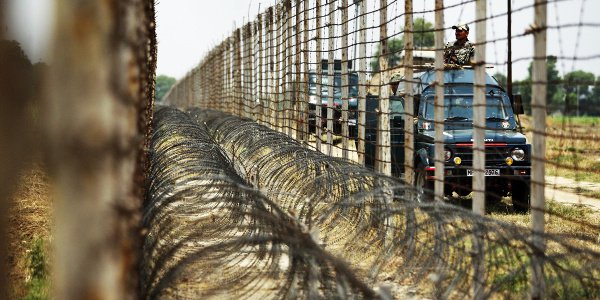
West Bengal has transferred around 32 acres of land to the Border Security Force for fencing and border-security infrastructure along the India-Bangladesh border. The state cabinet approved the handover of 31.905 acres at nine locations, along with additional proposals for permanent border outposts and fencing work in key border districts. The move clears a long-pending administrative hurdle and gives the BSF more ground support to strengthen vulnerable stretches of the international border.
The decision carries strategic importance because West Bengal shares India’s longest state-level border with Bangladesh. According to a Ministry of Home Affairs reply in Parliament, the India-Bangladesh border in West Bengal is 2,216.7 km long. Of this, 1,647.696 km had been covered by fencing, while 569.004 km remained to be covered by fencing and other border infrastructure works. Out of the remaining stretch, 456.224 km was assessed as feasible for fencing and related infrastructure.
The latest land transfer therefore fits into a larger border-management push. Fencing along the Bangladesh border is about more than putting up barbed wire. It creates a controlled boundary line, supports patrol movement, assists surveillance, reduces illegal crossings, restricts smuggling routes and gives border forces better visibility over sensitive ground. In areas where rivers, farms, settlements and narrow corridors complicate security, even a small land transfer can unlock major operational work.
The state government has also approved a proposal to transfer 1.53 acres in Malda, Murshidabad and Cooch Behar for setting up permanent border outposts at three locations. Another proposal covers 12.72 acres at 11 locations in Uttar Dinajpur to facilitate fencing work. These districts are central to border security because they include stretches where terrain, population density and cross-border movement require stronger physical infrastructure and closer monitoring.
A border outpost is the backbone of ground security. It gives BSF personnel a permanent base for patrols, observation, quick reaction, communication and coordination with local administration. When fencing, patrol tracks, floodlighting, surveillance towers and outposts work together, the border becomes easier to monitor and harder to exploit. This is the real significance of the land transfer: it converts security intention into physical capability.
The development also follows an earlier announcement that the West Bengal government had handed over 142.79 acres to the BSF for border outposts and barbed-wire fencing infrastructure. News on AIR reported that this was part of a decision taken in the state government’s first cabinet meeting on 11 May 2026 to transfer 600 acres within 45 days for border fencing and related infrastructure projects.
For India, the India-Bangladesh border has always required a special kind of management. It passes through agricultural land, riverine stretches, habitations and densely populated regions. Security here depends on a combination of physical barriers, local intelligence, humane border management, technology and coordination between central forces and state authorities. The transfer of land helps close gaps where pending ownership or administrative issues had slowed fencing work.
The move also has a strong internal-security dimension. Better fencing helps in checking illegal migration, cattle smuggling, narcotics movement, trafficking, fake currency networks and other cross-border crimes. A secured border reduces pressure on local police, protects border villages and gives security agencies a clearer framework for lawful movement through designated gates and checkpoints.
At the same time, border fencing must be implemented with care for local communities. Many families in border areas depend on farming, daily movement and access to land near the boundary. Proper compensation, consultation, access arrangements and coordination with villagers are essential for smooth implementation. A secure border works best when the people living near it see the infrastructure as protection rather than disruption.
This 32-acre transfer is therefore a practical administrative step with wider strategic meaning. It gives the BSF the land needed to expand fencing and outpost infrastructure, supports the Centre’s border-security plan and helps West Bengal address long-pending gaps along the India-Bangladesh frontier. In national-security terms, such decisions matter because strong borders are built through thousands of ground-level actions: land identification, transfer, fencing, patrol routes, surveillance posts and permanent deployment points.
India’s eastern border security will increasingly depend on this layered model. Fencing provides the line. Outposts provide presence. Surveillance provides awareness. Patrols provide control. Local coordination provides stability. The latest land transfer strengthens all these elements and moves West Bengal’s border infrastructure one step closer to a more secure and better-managed frontier.
You may also like
-
Indian Navy Vice Chief Inspects Japan’s Mogami-Class Stealth Frigate as India-Japan Shipbuilding Cooperation Expands
-
Philippine Marine Wargames Reportedly Show BrahMos Can Penetrate Chinese Destroyer Air Defences
-
Safran Signs 18 Agreements with Indian Aerospace Suppliers, Expanding Make in India Manufacturing Partnerships
-
Indian Army’s Vajra Corps Certifies First Batch of Drone Operators, Strengthens Battlefield Surveillance
-
India to Seek 35% Increase in Defence Modernisation Budget for FY 2027–28
