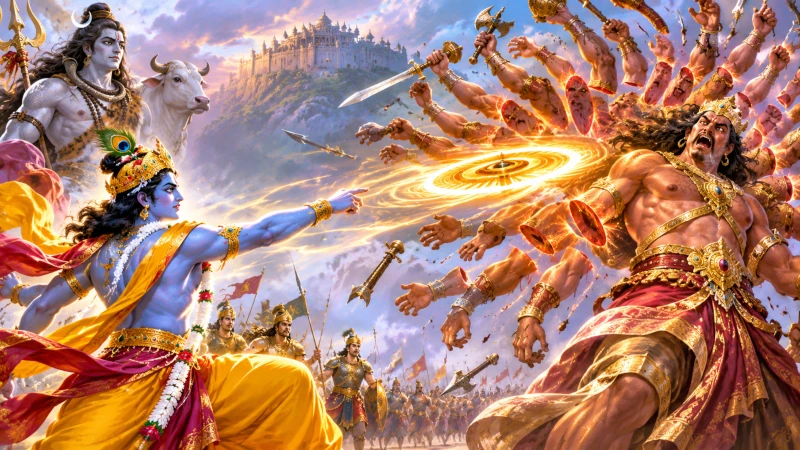
The confrontation between Krishna and Bāṇāsura, narrated in the tenth Skandha of the Bhāgavata Purāṇa, presents an extraordinary account of divine warfare involving overwhelming physical power, celestial weapons, battlefield adaptation and strategic restraint. Bāṇāsura possessed a thousand arms, enabling him to wield numerous weapons and discharge arrows simultaneously against his adversaries. Krishna, however, did not attempt to replicate Bāṇa’s numerical superiority but employed the Sudarśana Chakra to dismantle the very source of his extraordinary combat capability.
The episode illustrates a fundamental principle of warcraft: numerical superiority becomes less decisive when the advantage upon which it depends is neutralised. Equally significant is Krishna’s decision to spare Bāṇāsura after subduing his arrogance, demonstrating that the conclusion of warfare need not require the complete destruction of the defeated adversary.
The Strategic Background of the Bāṇa War
Bāṇāsura, the son of Mahābali and a descendant of Prahlāda, was a powerful ruler of Śoṇitapura and an ardent devotee of Śiva. His extraordinary physical strength and thousand arms had cultivated immense confidence in his own military capabilities. The conflict with Krishna arose following Bāṇa’s imprisonment of Aniruddha, Krishna’s grandson, who had entered into a relationship with Bāṇa’s daughter Uṣā.
Krishna mobilised the Yādava forces and marched towards Śoṇitapura to secure Aniruddha’s release. Bāṇāsura received military assistance from Śiva, resulting in a confrontation involving divine warriors, celestial weapons and powerful supernatural forces. Nevertheless, the immediate objective of Krishna’s campaign remained connected to the liberation of Aniruddha.
The campaign demonstrates the importance of maintaining clarity of strategic purpose even when an initially limited dispute develops into a confrontation involving considerably greater military power. Krishna’s eventual treatment of Bāṇāsura must therefore be understood in relation to the original cause of the conflict.
Bāṇāsura’s Thousand Arms: The Advantage of Numerical Superiority
Bāṇāsura’s thousand arms constituted an exceptional advantage within the Purāṇic battlefield narrative. They enabled him to employ numerous weapons simultaneously, generating an intensity of attack that an ordinary warrior could not reproduce. His extraordinary physical attributes became closely associated with both his martial reputation and his confidence in his own invincibility.
In Bhāgavata Purāṇa 10.63.31, Bāṇāsura returns to confront Krishna carrying numerous weapons and releasing arrows in anger. His continued reliance on his extraordinary physical capabilities reveals the extent to which his approach to combat depended upon this singular advantage.
Bāṇāsura’s military superiority was concentrated in an exceptional capability rather than distributed across several independent sources of strength. From the perspective of warcraft, the narrative illustrates the vulnerability that can accompany excessive dependence upon a single advantage, however formidable it may appear.
Krishna Refuses to Compete on Bāṇāsura’s Terms
Krishna does not respond by attempting to reproduce Bāṇāsura’s thousand-armed configuration or compete with him through an equivalent number of weapons. Instead, the narrative introduces the Sudarśana Chakra as the decisive instrument through which Bāṇa’s overwhelming physical superiority is overcome. The confrontation consequently shifts from a contest of numerical strength to one defined by the effectiveness of divine power.
Krishna changes the character of the confrontation rather than accepting the conditions under which Bāṇāsura possesses his greatest advantage. This represents the conceptual principle of asymmetric warfare, in which opposing capabilities need not be identical for one side to establish superiority.
The Purāṇic account does not provide a technical military doctrine or a detailed explanation of the Chakra’s operation. Nevertheless, its literary representation offers a compelling illustration of the distinction between the quantity of resources possessed by an adversary and their effectiveness in determining the outcome of a confrontation.
The Sudarśana Chakra and the Progressive Reduction of Bāṇa’s Strength
The decisive moment occurs in Bhāgavata Purāṇa 10.63.32, where Krishna employs the Sudarśana Chakra against Bāṇāsura as the latter continues discharging weapons.
Scriptural Reference
तस्यास्यतोऽस्त्राण्यसकृच्चक्रेण क्षुरनेमिना ।
चिच्छेद भगवान् बाहूञ्छाखा इव वनस्पतेः ॥
- tasyāsyato ’strāṇy asakṛc
cakreṇa kṣura-neminā
ciccheda bhagavān bāhūñ
chākhā iva vanaspateḥ *
Translation: As Bāṇāsura repeatedly discharged his weapons, Bhagavān severed his arms with the sharp-edged Chakra, as branches are removed from a tree.
The comparison with the branches of a tree conveys the progressive removal of Bāṇāsura’s extraordinary physical advantage. The very attribute that had established his martial reputation becomes the focus of the confrontation, eventually leaving him with only four arms.
The warcraft significance of this episode lies in the distinction between overcoming an adversary’s attacks and neutralising the capability upon which those attacks depend. Krishna’s action transforms the balance of the confrontation without requiring him to reproduce Bāṇāsura’s numerical strength.
Capability Neutralisation Rather Than Unrestricted Destruction
One of the most significant aspects of the narrative is Krishna’s decision not to kill Bāṇāsura. Although Bāṇa’s extraordinary martial capabilities are decisively subdued, his life is ultimately preserved. Krishna later explains that the removal of his arms was intended to overcome his false pride.
The narrative distinguishes capability neutralisation from the complete destruction of an adversary. Within its broader ethical framework, victory is measured not simply by the extent of destruction inflicted but by whether the purpose of the confrontation has been achieved.
The preservation of Bāṇāsura’s life also establishes that Krishna’s use of superior power is accompanied by restraint. His divine authority is expressed through both the ability to overcome resistance and the willingness to terminate violence when its purpose has been fulfilled.
Śiva’s Intervention and the Transition from Warfare to Diplomacy
As Bāṇāsura’s arms are being severed, Śiva approaches Krishna out of compassion for his devotee. Bhāgavata Purāṇa 10.63.33 marks the transition from direct confrontation to an appeal for mercy. Śiva subsequently offers prayers to Krishna and requests that Bāṇāsura be spared.
Śiva’s intervention illustrates the importance of mediation in creating a pathway from armed confrontation towards conflict termination. The episode demonstrates that battlefield superiority and diplomatic engagement need not be mutually exclusive, particularly when the principal objectives of the conflict can be secured without its continuation.
Krishna acknowledges Śiva’s appeal and agrees to preserve Bāṇāsura’s life. The confrontation thus concludes through a combination of decisive victory, recognition of existing relationships and reconciliation between the divine participants.
Honouring Previous Commitments Despite Military Superiority
In Bhāgavata Purāṇa 10.63.47, Krishna explains that he will not kill Bāṇāsura because of the assurance previously granted to Prahlāda that his descendants would be spared. Bāṇa’s defeat does not invalidate this earlier commitment, even though Krishna possesses the power to determine his fate.
The preservation of established commitments despite overwhelming superiority represents the principle that strategic authority must remain governed by ethical obligations. The narrative portrays Krishna as unwilling to allow the immediate circumstances of warfare to override a previously given assurance.
This dimension of the episode distinguishes the exercise of power from the arbitrary exercise of authority. Krishna’s adherence to his commitment to Prahlāda reinforces the theological importance of truthfulness, consistency and dharma even within the exceptional circumstances of divine warfare.
Four Arms Remain: Victory Without Annihilation
Bhāgavata Purāṇa 10.63.49 records Krishna’s declaration that Bāṇāsura will retain four arms, remain free from ageing and death, and become a principal attendant of Śiva. Bāṇa subsequently offers his respects to Krishna and presents Aniruddha and Uṣā before him. The original cause of the confrontation is thereby resolved, allowing Krishna and the Yādava forces to return to Dvārakā.
The termination of the conflict after the fulfilment of its purpose illustrates strategic restraint and the avoidance of unnecessary continuation of hostilities. Bāṇāsura’s survival demonstrates that the restoration of order can coexist with the preservation of the defeated adversary.
The outcome also represents a transformation in Bāṇa’s position. His extraordinary power no longer serves as a foundation for unchecked pride, while his relationship with Śiva is preserved. The Purāṇic narrative consequently presents reconciliation and the restoration of dharma as integral elements of victory.
Warcraft Principles Illustrated in the Bāṇa Episode
1. Asymmetric Superiority
Krishna’s employment of the Sudarśana Chakra demonstrates that superiority does not necessarily require matching an adversary’s numerical strength. The episode portrays the effectiveness of a qualitatively different capability against overwhelming physical power. Its conceptual significance lies in understanding that the balance of strength cannot be assessed through numerical comparisons alone.
2. Excessive Dependence on a Singular Advantage
Bāṇāsura’s dependence upon his thousand arms illustrates how an extraordinary strength can simultaneously become a source of strategic vulnerability. His confidence is closely connected to the possession of this exceptional attribute. Once that superiority is removed, the foundation of his perceived invincibility collapses.
3. Economy of Force
The narrative presents the achievement of a decisive objective through the application of superior capability rather than an equivalent accumulation of numerical strength. Krishna does not require a thousand arms to overcome Bāṇāsura’s thousand-armed advantage. The episode offers a literary illustration of the distinction between the quantity of available power and the effectiveness of its application.
4. Strategic Restraint
Krishna’s decision to spare Bāṇāsura demonstrates that the possession of overwhelming power does not justify its unrestricted application. The continuation of destructive action becomes unnecessary once the purpose of the confrontation has been achieved. Restraint therefore emerges as an expression of authority rather than an indication of weakness.
5. Diplomatic Conflict Termination
Śiva’s intervention demonstrates how mediation can facilitate the transition from military confrontation towards an acceptable resolution. His appeal provides an opportunity to preserve Bāṇāsura’s life while acknowledging Krishna’s victory. The episode brings together the complementary roles of military superiority, diplomacy and reconciliation.
6. Preservation of Strategic Commitments
Krishna’s adherence to his assurance to Prahlāda demonstrates the importance of preserving established commitments even after achieving decisive superiority. His earlier promise remains binding despite the immediate circumstances of the confrontation. The narrative places ethical consistency above the unrestricted exercise of victorious power.
7. Objective-Based Warfare
The liberation of Aniruddha and the subsequent termination of hostilities illustrate the importance of defining victory through the achievement of legitimate objectives. Krishna does not transform the conflict into an unlimited campaign against Bāṇāsura’s existence. The resolution preserves the distinction between correcting an injustice and pursuing destruction for its own sake.
Conclusion: The Discipline of Decisive Power
Krishna’s confrontation with Bāṇāsura represents one of the Bhāgavata Purāṇa’s most compelling illustrations of the relationship between superior capability, strategic restraint and dharmic responsibility. The Sudarśana Chakra overcomes Bāṇāsura’s extraordinary physical advantage, while Śiva’s intervention and Krishna’s earlier commitment to Prahlāda establish the ethical boundaries within which the conflict concludes. Victory is ultimately accompanied by liberation, reconciliation and the restoration of order.
The enduring warcraft lesson of the episode is that decisive power achieves its highest purpose when it is accompanied by clarity of objective, restraint and the wisdom to recognise when conflict must end. Krishna’s victory over Bāṇāsura is therefore not merely a demonstration of divine martial superiority but an illustration of the disciplined exercise of power. Within the theological framework of the Bhāgavata Purāṇa, the ultimate purpose of such power remains the preservation and restoration of dharma.
Scriptural References
Śrīmad Bhāgavata Mahāpurāṇa — Skandha 10, Adhyāya 62: The relationship between Uṣā and Aniruddha, followed by Aniruddha’s imprisonment by Bāṇāsura.
Śrīmad Bhāgavata Mahāpurāṇa — Skandha 10, Adhyāya 63, Ślokas 1–10: The Yādava expedition against Śoṇitapura and the commencement of the confrontation.
Ślokas 30–32: Bāṇāsura renews his attack, and Krishna employs the Sudarśana Chakra against his multitude of arms.
Ślokas 33–45: Śiva intervenes, offers prayers and appeals to Krishna on behalf of Bāṇāsura.
Ślokas 46–49: Krishna grants mercy, honours his commitment to Prahlāda and explains the purpose behind subduing Bāṇāsura.
Ślokas 50–53: Bāṇāsura submits, Aniruddha and Uṣā are brought before Krishna, and the victorious Yādavas return to Dvārakā.
The warcraft terminology employed in this article represents a contemporary interpretative framework applied to the Purāṇic narrative rather than explicit military doctrines stated in the original Sanskrit text.
You may also like
-
Indian Traditional Artisans Record ₹2.07 Crore in Sales at India International Trade Fair
-
India Strengthens Educational Infrastructure in Nepal’s Mustang District
-
Warcraft Purāṇas — The Bāṇa War: When Krishna and Shiva Confronted Each Other
-
India Reclaims Three Historic Bronze Antiquities from the United States and Netherlands
-
Warcraft of the Purāṇas: Krishna versus Bāṇāsura — Divine Alliances, Numerical Superiority and Strategic Restraint
