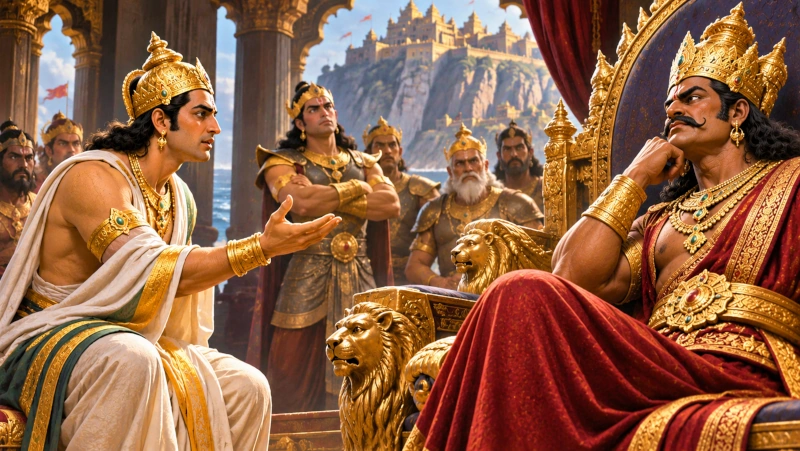
Diplomacy in the Rāmāyaṇa | Yuddha Kāṇḍa, Sargas 14–16
Introduction: When Loyalty Requires Opposition
One of the most important responsibilities of a political adviser is to tell a ruler what he needs to hear rather than what he wishes to hear. This principle emerges with exceptional clarity in the Yuddha Kāṇḍa of Vālmīki’s Rāmāyaṇa, where Vibhīṣaṇa, the younger brother of Rāvaṇa, repeatedly advises the ruler of Laṅkā to return Sītā and avoid a destructive confrontation with Rāma. His counsel represents a remarkable example of principled dissent within the highest levels of political authority, demonstrating that loyalty to a kingdom sometimes requires opposing the decisions of its ruler.
The episode presents a fundamental dilemma in statecraft. Should a minister demonstrate loyalty by supporting the ruler’s decisions, even when those decisions threaten the kingdom, or should he oppose policies that could endanger its security and survival? Vibhīṣaṇa chooses the latter course, placing the long-term interests of Laṅkā above personal allegiance to his brother. His arguments combine moral reasoning, military assessment, political responsibility and diplomatic pragmatism, while Rāvaṇa’s rejection of this counsel illustrates how a ruler’s inability to tolerate dissent can transform a manageable political dispute into a destructive military confrontation.
The Political Situation: Laṅkā Approaches War
Following Hanumān’s reconnaissance of Laṅkā, his discovery of Sītā in the Aśoka grove and the destruction caused during his subsequent confrontation with the Rākṣasas, Rāvaṇa understands that the conflict with Rāma has entered a dangerous phase. Hanumān’s successful penetration of Laṅkā’s defences demonstrates that the kingdom is not beyond the reach of its enemies. Rāma has also secured the support of Sugrīva and the Vānara forces, creating the possibility of a major military expedition against Laṅkā.
Rāvaṇa convenes his ministers and military commanders to discuss the approaching threat. However, much of the discussion is dominated by declarations of strength, confidence in Laṅkā’s military capabilities and assurances that Rāma’s forces can be defeated. Several commanders emphasise their previous victories and their ability to overcome powerful opponents, reinforcing Rāvaṇa’s conviction that his kingdom possesses sufficient military strength to withstand an invasion. The atmosphere of the royal court increasingly favours confrontation rather than a negotiated resolution.
Vibhīṣaṇa approaches the situation differently. He recognises that the immediate question is not whether Laṅkā possesses formidable warriors, but whether the conflict serves any legitimate strategic interest. Sītā’s abduction has created the dispute, and her continued detention provides Rāma with the reason to undertake military action. Vibhīṣaṇa therefore argues that the kingdom should address the underlying cause rather than prepare for a war whose consequences could threaten its survival. His central diplomatic argument is that a state should not enter a potentially ruinous conflict when the principal cause of hostilities can still be removed through a political decision.
Vibhīṣaṇa’s Counsel: Returning Sītā as a Diplomatic Solution
In Yuddha Kāṇḍa, Sarga 14, Vibhīṣaṇa urges Rāvaṇa to return Sītā before Rāma’s forces reach Laṅkā and the confrontation develops into a full-scale war. His recommendation is based on a realistic assessment of the military situation rather than fear of the approaching enemy. He warns that Rāma’s capabilities should not be underestimated and that neither Rāvaṇa’s personal strength nor the achievements of his commanders provide sufficient grounds for assuming that victory is assured.
Vibhīṣaṇa draws attention to the extraordinary power of Rāma’s weapons and cautions that even Laṅkā’s most celebrated warriors may be unable to withstand them. His warning directly challenges the optimistic assessments offered by the other members of the court, who largely rely upon their past military achievements and confidence in their own abilities. Vibhīṣaṇa recognises that the outcome of a future conflict cannot be determined solely by the reputation of one’s armed forces. It must be evaluated through an objective understanding of the opponent’s capabilities, intentions and determination.
Importantly, Vibhīṣaṇa does not merely predict military disaster. He proposes a specific political solution by advising Rāvaṇa to restore Sītā to Rāma, thereby removing the principal cause of hostilities. This recommendation offers Rāvaṇa an opportunity to preserve his kingdom without surrendering its sovereignty or political independence. Returning Sītā would require Rāvaṇa to reverse an unjust action, but it would also prevent the dispute from developing into a military confrontation that could endanger Laṅkā’s population, armed forces and ruling establishment.
The diplomatic significance of Vibhīṣaṇa’s proposal lies in his recognition that preventing war is often more beneficial than attempting to secure victory after hostilities have begun. His counsel demonstrates that diplomacy is not restricted to negotiations following military confrontation. It also involves identifying the political causes of a dispute and taking corrective action before those causes produce irreversible consequences.
The Responsibility of Ministers: Advice Must Serve the Kingdom
One of the most significant elements of Vibhīṣaṇa’s counsel appears in Yuddha Kāṇḍa, Sarga 14, Verse 22, where he explains the responsibilities of a competent minister. He argues that an adviser must carefully assess the strength of the opposing side, examine the military and political circumstances of his own kingdom, and offer recommendations that genuinely serve the ruler’s interests. The passage places considerable importance on independent judgment and the obligation to distinguish sound advice from statements designed merely to please those in authority.
Vibhīṣaṇa’s argument establishes that effective political consultation requires more than obedience or agreement. A minister who confirms every assumption of the ruler may enjoy personal favour, but such approval provides little protection against strategic mistakes. By contrast, an adviser who identifies weaknesses, challenges unrealistic expectations and recommends corrective action may face hostility while nevertheless serving the kingdom more faithfully. The essential purpose of counsel is therefore not to strengthen the ruler’s personal confidence, but to improve the quality of decisions taken on behalf of the state.
This distinction between personal loyalty and institutional responsibility is central to the episode. Vibhīṣaṇa does not oppose Rāvaṇa because he wishes to weaken Laṅkā or assist an enemy. He opposes the continuation of a policy that he believes will expose the kingdom to unnecessary destruction. His advice is directed towards preserving Laṅkā’s security, political stability and long-term interests, even though accepting it would require Rāvaṇa to acknowledge a serious mistake.
The Rāmāyaṇa thus presents constructive dissent as an essential responsibility of ministers and advisers rather than an act of political disloyalty. The episode recognises that disagreement within the government can serve an important corrective function, particularly when a ruler’s personal interests or emotions threaten to override the broader interests of the kingdom.
Indrajit’s Opposition: When Military Confidence Replaces Strategic Judgment
Vibhīṣaṇa’s intervention provokes a sharp response from Indrajit, Rāvaṇa’s son and one of Laṅkā’s most formidable warriors. In Yuddha Kāṇḍa, Sarga 15, Indrajit criticises Vibhīṣaṇa for displaying what he considers weakness and cowardice. He argues that the Rākṣasas possess extraordinary military capabilities and that even an ordinary warrior from Laṅkā should be capable of defeating Rāma and Lakṣmaṇa. His remarks reflect an overwhelming confidence in the kingdom’s military establishment and a belief that its previous achievements provide sufficient evidence of its ability to overcome the approaching enemy.
Indrajit supports his argument by recalling his own victories against powerful celestial opponents. Having demonstrated his strength in earlier conflicts, he sees little reason to regard the two human princes as a serious military threat. His response, however, exposes an important weakness in strategic reasoning: the assumption that past victories automatically guarantee success against a new adversary operating under different circumstances. Previous battlefield achievements may demonstrate military capability, but they do not eliminate the need for a fresh assessment of the enemy.
Vibhīṣaṇa rejects Indrajit’s reasoning and challenges his understanding of the situation. He argues that the young warrior’s confidence is not supported by a realistic appreciation of Rāma’s strength and that his judgment is affected by immaturity and excessive pride. Vibhīṣaṇa’s response is not an attack upon military courage itself, but a warning against allowing confidence to replace careful analysis. He recognises that a powerful army can still suffer defeat if its commanders underestimate their opponents or misunderstand the political circumstances surrounding a conflict.
The exchange reveals two competing approaches to national security. Indrajit evaluates the approaching war primarily through the reputation, courage and previous achievements of Laṅkā’s warriors, while Vibhīṣaṇa examines the actual capabilities of the adversary, the changing strategic situation and the possibility of avoiding unnecessary conflict. The military significance of this disagreement is that courage, experience and superior confidence cannot substitute for accurate intelligence, realistic threat assessment and sound political judgment. A kingdom may possess formidable armed forces and accomplished commanders, yet remain strategically vulnerable if its leadership refuses to examine the assumptions underlying its military plans.
Rāvaṇa’s Rejection: When Dissent Becomes Disloyalty
The confrontation reaches its decisive stage in Yuddha Kāṇḍa, Sarga 16, when Rāvaṇa responds to Vibhīṣaṇa’s continued opposition with anger and suspicion. Rather than examine the arguments presented by his brother, Rāvaṇa questions his intentions and portrays his advice as evidence of concealed hostility. The disagreement is no longer treated as a legitimate debate over the best course of action for Laṅkā. Instead, the adviser himself becomes the object of suspicion, and the ruler interprets criticism as a challenge to his authority.
Rāvaṇa’s reaction represents a serious deterioration in the process of political consultation. By shifting attention from the substance of Vibhīṣaṇa’s warning to his supposed motives, he avoids addressing the strategic questions that have been raised. The dangers posed by Rāma’s military capabilities, the consequences of continuing to detain Sītā and the possibility of preventing war remain unresolved. What changes is the atmosphere within the court, where offering contrary advice becomes increasingly dangerous.
This response illustrates a recurring problem in political leadership. When rulers begin to interpret disagreement as betrayal, ministers may become reluctant to communicate unfavourable information or challenge established assumptions. The resulting political environment rewards agreement rather than accuracy, encouraging advisers to reinforce the ruler’s expectations even when those expectations are disconnected from military or diplomatic realities.
Rāvaṇa’s failure is therefore not simply that he rejects one recommendation. His more serious failure is that he undermines the process through which truthful advice, alternative assessments and strategic warnings can reach the highest levels of government. Vibhīṣaṇa is not an external adversary seeking Laṅkā’s destruction, but a senior member of its ruling family who understands the kingdom’s strengths, weaknesses and political circumstances. Nevertheless, Rāvaṇa’s inability to separate criticism of policy from personal hostility prevents him from recognising the value of his brother’s counsel.
Vibhīṣaṇa’s Departure: The Strategic Cost of Rejecting Advice
Following Rāvaṇa’s harsh rejection, Vibhīṣaṇa concludes that he can no longer remain in his brother’s service. He leaves the royal court and departs from Laṅkā with four companions, bringing his attempts to influence Rāvaṇa’s policy from within the kingdom to an end. His subsequent arrival at Rāma’s camp and acceptance into Rāma’s alliance are narrated in the following sargas of the Yuddha Kāṇḍa.
Vibhīṣaṇa’s departure represents considerably more than a personal disagreement between two brothers. Laṅkā loses a senior political figure who possesses intimate knowledge of its ruling establishment, military organisation and internal circumstances. More importantly, the kingdom loses an adviser who has consistently advocated a diplomatic settlement and warned against the consequences of unnecessary war. The departure of such a figure further reduces the possibility of correcting the policies that have brought Laṅkā to the brink of confrontation.
The episode also reveals how the rejection of constructive criticism can produce consequences beyond the immediate decision under discussion. A ruler who repeatedly humiliates or threatens capable advisers may eventually drive them away from the political establishment. Their departure can deprive the government of valuable experience, independent judgment and institutional knowledge, particularly during periods of national crisis.
The strategic lesson is that silencing advisers does not eliminate the dangers they identify; it merely deprives the ruler of the information and judgment required to address those dangers. Vibhīṣaṇa’s departure demonstrates how political intolerance can weaken a kingdom from within even before the decisive military confrontation begins.
Diplomatic Significance: Dissent as an Instrument of Responsible Statecraft
Vibhīṣaṇa’s counsel offers several important principles concerning the conduct of foreign policy, the management of military crises and the responsibilities of political advisers. The first is that constructive dissent performs an essential corrective function within government. A ruler may possess the authority to determine policy, but the quality of that decision depends upon the information, assessments and arguments available before it is made. Advisers who challenge unrealistic assumptions can help identify neglected risks, expose weaknesses in military planning and prevent political disagreements from developing into avoidable conflicts.
A second principle concerns the importance of objective military assessment. Vibhīṣaṇa does not dismiss Laṅkā’s military strength, but he insists that its capabilities must be measured against those of Rāma rather than evaluated solely through previous achievements. Successful foreign policy requires an accurate understanding of both national capabilities and the strength, intentions and determination of potential adversaries. Military power becomes strategically dangerous when confidence in its effectiveness prevents leaders from recognising the limitations of their own position.
The third principle is that diplomacy should remain available before military escalation becomes irreversible. By recommending Sītā’s return, Vibhīṣaṇa identifies a political solution capable of addressing the central cause of the dispute. His advice does not imply that military action should be avoided under every circumstance. Rather, it demonstrates that political leaders must distinguish between unavoidable security threats and confrontations that can be resolved through legitimate corrective measures. The preservation of peace through an acceptable political settlement can be a greater strategic achievement than victory in an unnecessary war.
The fourth principle concerns the distinction between loyalty to an individual ruler and responsibility towards the kingdom. Vibhīṣaṇa’s opposition emerges from his concern for Laṅkā rather than hostility towards its people or institutions. He recognises that a minister’s duty is not fulfilled merely by supporting the ruler’s preferences, particularly when those preferences threaten the security of the state. Responsible counsel requires a willingness to communicate uncomfortable conclusions and to recommend policies that may be personally inconvenient to those in power.
Finally, the episode demonstrates that effective leadership requires the ability to receive criticism without treating it as an attack upon political authority. A ruler surrounded by intelligent and experienced advisers may still make disastrous decisions if disagreement is discouraged or interpreted as disloyalty. The existence of capable ministers is therefore insufficient unless their assessments are heard and seriously considered. The strength of a political system depends not only upon the authority of its leadership, but also upon its capacity to evaluate competing perspectives before making decisions involving war and peace.
Modern-Day Parallel: The Cuban Missile Crisis of 1962
A significant modern parallel to Vibhīṣaṇa’s counsel can be found in the decision-making process during the Cuban Missile Crisis of October 1962, when the United States discovered Soviet nuclear missile installations in Cuba. The discovery created one of the most dangerous confrontations of the Cold War, placing the United States and the Soviet Union in a direct strategic crisis with the potential for nuclear escalation. President John F. Kennedy convened a group of senior political, military and intelligence advisers to examine possible responses to the Soviet deployment.
The discussions produced sharply differing recommendations. Some advisers supported immediate military action, including air strikes against the missile installations and the possibility of an invasion of Cuba, while others warned that direct military intervention could provoke Soviet retaliation and escalate the crisis into a wider war. The disagreement required Kennedy to evaluate the potential effectiveness of military force alongside its diplomatic consequences, including the possibility that an apparently limited operation could trigger an uncontrollable confrontation between the two superpowers.
Kennedy ultimately chose to begin with a naval quarantine rather than immediate air strikes, while diplomatic exchanges continued between Washington and Moscow. The crisis was eventually resolved through negotiations that included Soviet agreement to remove the missiles from Cuba, an American commitment not to invade Cuba and a confidential understanding concerning the later removal of American Jupiter missiles from Turkey. The outcome demonstrated the importance of examining competing strategic assessments and preserving diplomatic alternatives during an exceptionally dangerous military confrontation.
The circumstances of the Cuban Missile Crisis were fundamentally different from those described in the Rāmāyaṇa, particularly regarding the origins and moral character of the respective disputes. Nevertheless, the two episodes illuminate an important principle of political decision-making. Whereas Rāvaṇa dismissed advice that challenged his assumptions, Kennedy’s deliberative process allowed competing assessments to influence the choice of an initial response. The broader diplomatic lesson is that informed disagreement can help leaders identify alternatives to escalation, understand the consequences of military action and preserve opportunities for a negotiated settlement.
Conclusion: The Courage to Advise and the Wisdom to Listen
Vibhīṣaṇa’s counsel to Rāvaṇa remains one of the Rāmāyaṇa’s most instructive episodes concerning the relationship between political authority, strategic judgment and ministerial responsibility. His warnings are neither an expression of personal weakness nor a rejection of Laṅkā’s interests. They arise from his understanding that the kingdom faces a dangerous confrontation whose principal cause can still be addressed through a political decision. By recommending the return of Sītā, he attempts to protect the kingdom from the consequences of a conflict that need not have occurred.
Rāvaṇa possesses military power, experienced commanders, formidable defences and considerable political authority. Yet these advantages are weakened by his unwillingness to recognise the validity of advice that contradicts his desires. His rejection of Vibhīṣaṇa demonstrates how personal pride and suspicion can prevent a ruler from appreciating strategic realities, even when those realities are presented by capable advisers who understand the kingdom’s circumstances.
Vibhīṣaṇa, by contrast, demonstrates that responsible political counsel requires intellectual independence, moral conviction and the courage to communicate difficult conclusions. He distinguishes between loyalty to a ruler and loyalty to the broader interests of the state, recognising that the latter may sometimes require opposition to the former. His conduct establishes that disagreement is not inherently destructive; when grounded in sound judgment and genuine concern for the kingdom, it can become one of the most valuable instruments of political stability.
The enduring lesson of this episode extends beyond the royal court of Laṅkā. Governments responsible for foreign policy, national security and military planning must ensure that alternative assessments receive serious consideration, particularly when decisions carry the possibility of war. The purpose of an adviser is not merely to reinforce the confidence of political leadership, but to improve the quality of its judgment through truthful analysis and responsible counsel.
Ultimately, Vibhīṣaṇa’s example affirms a fundamental principle of diplomacy and statecraft: the security of a kingdom is strengthened when rulers possess the wisdom to hear dissent, ministers demonstrate the courage to speak the truth, and decisions of war and peace are guided by strategic judgment rather than personal pride.
You may also like
-
The Battle for Amṛta: Devas and Asuras Clash After the Churning of the Ocean
-
The Debate Over Vibhīṣaṇa: Intelligence Assessment, Security Risks and Political Asylum
-
India and Singapore Strengthen Innovation and Education Cooperation Through Fourth Bilateral Hackathon
-
India–Philippines Development Partnership Focuses on Local Communities, Healthcare and Livelihoods
-
Piyush Goyal Visits Egypt to Strengthen Trade and Investment Ties as Bilateral Commerce Reaches $6.5 Billion
