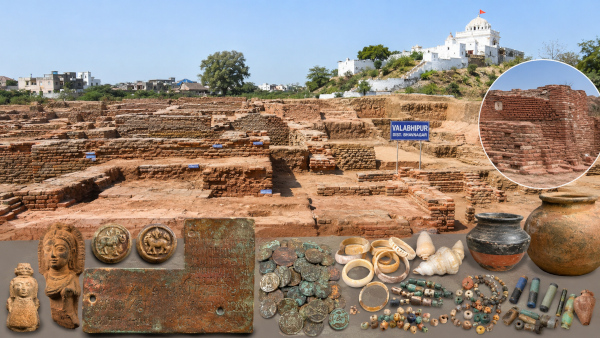
The recent archaeological discoveries at Valabhipur in Gujarat’s Bhavnagar district have brought fresh attention to one of western India’s most remarkable early medieval cities. Known in ancient records as Valabhi, the settlement was the capital of the Maitraka dynasty between the 5th and 8th centuries CE and a celebrated centre of learning, trade, craftsmanship and religious life. The latest excavations by the Archaeological Survey of India have revealed structural remains, copper coins, seals, sealings, shell bangles, copper plates, stone beads, terracotta objects, pottery, gaming pieces and evidence of specialised manufacturing, giving new material depth to the historical memory of this once-flourishing city.
Valabhipur occupies a special place in the cultural history of Gujarat. It stood at the heart of the Maitraka kingdom, which rose in Saurashtra after the decline of Gupta power. From this capital, the Maitrakas shaped political and cultural life across large parts of Gujarat and western India. Their rule is remembered through copper plate grants, inscriptions, coins, temples, educational patronage and religious donations. The new excavation evidence now adds another layer to that legacy by showing how the city functioned on the ground: how people lived, traded, worshipped, produced goods and connected with wider commercial networks.
The latest phase of excavation has revealed remains from multiple locations around Valabhipur, including the area near Darbargarh, the protected site near Mafat Nagar and Thapnath Mahadev Hill. Burnt brick walls, mud-brick features, stone-built structures and other architectural remains point to planned settlement activity and an urban environment with substantial construction. These discoveries support the view that Valabhi was a living city of administration, commerce and culture, rather than a name preserved only in texts and inscriptions.
One of the most striking aspects of the discoveries is the evidence of economic prosperity. Archaeologists have recovered copper coins, shell bangles, bead-making material, stone beads, semi-precious stones and bead polishers. These finds suggest that Valabhipur had active craft production and specialised artisanal activity. Shells and conches appear to have been used in bangle-making, while semi-precious stones and polishers point to bead manufacture. Such evidence indicates a skilled local economy capable of producing decorative, ritual and trade goods.
The presence of shell bangles with gold foil, pearl and gold ornaments, carnelian objects and other refined artefacts further points to a wealthy urban society with an appreciation for ornamentation, luxury and craftsmanship. A delicate carnelian intaglio bearing a deer symbol is particularly important because it reflects both artistic skill and the use of semi-precious material in high-value objects. These finds present Valabhi as a city with active workshops, affluent patrons and cultural sophistication.
Trade emerges as another major theme from the excavation. The reported presence of torpedo jars is especially significant because such vessels are associated with long-distance exchange across the Mediterranean and western Indian Ocean trading worlds. Valabhipur lies inland from the Gulf of Khambhat, yet its location near river systems such as the Ghelo and Kalubhar may have connected it to coastal and inland trade routes. This gives the city a strategic profile: an inland capital linked to maritime commerce, riverine movement and regional production networks.
The discoveries also highlight the administrative character of the Maitraka capital. Seals, sealings, coins and copper plates are all objects connected with authority, documentation, exchange and institutional life. Copper plate grants were among thThe recent archaeological discoveries at Valabhipur in Gujarat’s Bhavnagar district have brought fresh attention to one of western India’s most remarkable early medieval cities. Known in ancient records as Valabhi, the settlement was the capital of the Maitraka dynasty between the 5th and 8th centuries CE and a celebrated centre of learning, trade, craftsmanship and religious life. The latest excavations by the Archaeological Survey of India have revealed structural remains, copper coins, seals, sealings, shell bangles, copper plates, stone beads, terracotta objects, pottery, gaming pieces and evidence of specialised manufacturing, giving new material depth to the historical memory of this once-flourishing city.
Valabhipur occupies a special place in the cultural history of Gujarat. It stood at the heart of the Maitraka kingdom, which rose in Saurashtra after the decline of Gupta power. From this capital, the Maitrakas shaped political and cultural life across large parts of Gujarat and western India. Their rule is remembered through copper plate grants, inscriptions, coins, temples, educational patronage and religious donations. The new excavation evidence now adds another layer to that legacy by showing how the city functioned on the ground: how people lived, traded, worshipped, produced goods and connected with wider commercial networks.
The latest phase of excavation has revealed remains from multiple locations around Valabhipur, including the area near Darbargarh, the protected site near Mafat Nagar and Thapnath Mahadev Hill. Burnt brick walls, mud-brick features, stone-built structures and other architectural remains point to planned settlement activity and an urban environment with substantial construction. These discoveries support the view that Valabhi was a living city of administration, commerce and culture, rather than a name preserved only in texts and inscriptions.
One of the most striking aspects of the discoveries is the evidence of economic prosperity. Archaeologists have recovered copper coins, shell bangles, bead-making material, stone beads, semi-precious stones and bead polishers. These finds suggest that Valabhipur had active craft production and specialised artisanal activity. Shells and conches appear to have been used in bangle-making, while semi-precious stones and polishers point to bead manufacture. Such evidence indicates a skilled local economy capable of producing decorative, ritual and trade goods.
The presence of shell bangles with gold foil, pearl and gold ornaments, carnelian objects and other refined artefacts further points to a wealthy urban society with an appreciation for ornamentation, luxury and craftsmanship. A delicate carnelian intaglio bearing a deer symbol is particularly important because it reflects both artistic skill and the use of semi-precious material in high-value objects. These finds present Valabhi as a city with active workshops, affluent patrons and cultural sophistication.
Trade emerges as another major theme from the excavation. The reported presence of torpedo jars is especially significant because such vessels are associated with long-distance exchange across the Mediterranean and western Indian Ocean trading worlds. Valabhipur lies inland from the Gulf of Khambhat, yet its location near river systems such as the Ghelo and Kalubhar may have connected it to coastal and inland trade routes. This gives the city a strategic profile: an inland capital linked to maritime commerce, riverine movement and regional production networks.
The discoveries also highlight the administrative character of the Maitraka capital. Seals, sealings, coins and copper plates are all objects connected with authority, documentation, exchange and institutional life. Copper plate grants were among the most important records of early medieval India, often used to document land grants, royal orders and religious endowments. The rare copper plate recovered from the site has been sent for cleaning and deciphering, and its eventual reading may offer valuable information about the people, institutions and political world of ancient Valabhi.
Valabhipur’s religious importance is equally clear. The excavation has produced evidence associated with Hindu, Buddhist and Jain traditions. Finds linked to Lord Ganesha, Lajjagauri and Buddhist seals and sealings point to a society where multiple religious streams flourished side by side. Valabhi was historically known as a major centre of Buddhist learning, while Jain tradition associates the city with an important council that contributed to the preservation and organisation of sacred knowledge. The city’s religious landscape therefore reflects Gujarat’s long history of intellectual openness and spiritual diversity.
The educational reputation of Valabhi was one of its greatest glories. Chinese travellers such as Xuanzang and Yijing referred to the city in glowing terms, describing its prosperity and its standing as a centre of learning. Valabhi’s university was counted among the great seats of education in ancient India, often compared with Nalanda. It attracted scholars from across the subcontinent and produced students who entered public and administrative life. The new archaeological findings now help connect that textual memory with the material remains of a prosperous urban centre.
The pottery recovered from Valabhipur also carries valuable archaeological meaning. Red ware, red-slipped ware, micaceous red ware, black-slipped ware and painted ware help archaeologists understand chronology, food habits, production methods and everyday life. Pottery is one of the strongest indicators of cultural sequence in archaeology, and the range found at Valabhipur shows continuity, local craft traditions and a well-developed material culture.
Another exciting development is the work around Thapnath Mahadev Hill, where ancient brick and stone structures have been identified. The elevated position of the site suggests that it may have served an important function within the larger settlement landscape. Further excavation may clarify whether it had administrative, defensive, religious or observational significance. The discovery expands the archaeological map of ancient Valabhi beyond the central mound and shows that the city’s urban spread may have been wider and more complex than previously understood.
The importance of these excavations lies in the way they bring together history, archaeology and public memory. For generations, Valabhi has been known through inscriptions, coins, copper plates, literary references and accounts of travellers. The present discoveries give physical form to that reputation. Walls, coins, shells, ornaments, pottery, beads and seals together show a city of wealth, learning, faith, trade and craftsmanship. They make ancient Valabhi visible again.
For Gujarat, the findings are a matter of cultural pride. The discoveries confirm that Saurashtra was a major contributor to India’s early medieval civilisation. Valabhi stood as a capital, a centre of education, a commercial hub and a meeting ground of traditions. Its people created goods, participated in long-distance trade, supported religious institutions and lived within a sophisticated urban environment. The city’s story strengthens Gujarat’s place in the wider history of Indian knowledge systems, maritime commerce and regional state formation.
The excavation also has strong potential for heritage education and tourism. A carefully developed Valabhipur heritage circuit can connect archaeology, museums, Jain history, Buddhist learning, Maitraka inscriptions, local craft traditions and the wider coastal history of Bhavnagar district. With proper interpretation, conservation and public display, the discoveries can inspire students, researchers, travellers and local communities.
The ongoing work at Valabhipur is still unfolding, and future excavation seasons may reveal even more about the city’s layout, economy and cultural networks. Yet the discoveries already made are powerful enough to reshape the way modern India understands ancient Valabhi. They show that this Maitraka capital was a prosperous, learned and outward-looking city whose influence reached far beyond its walls.
Valabhipur today is emerging once again as a place of national historical importance. The soil of Bhavnagar is giving back the memory of a city that once linked scholarship with trade, governance with faith and craftsmanship with global exchange. The ASI excavations have opened a bright new chapter in the study of Gujarat’s ancient past and have restored Valabhi to its rightful place among India’s great historical cities.e most important records of early medieval India, often used to document land grants, royal orders and religious endowments. The rare copper plate recovered from the site has been sent for cleaning and deciphering, and its eventual reading may offer valuable information about the people, institutions and political world of ancient Valabhi.
Valabhipur’s religious importance is equally clear. The excavation has produced evidence associated with Hindu, Buddhist and Jain traditions. Finds linked to Lord Ganesha, Lajjagauri and Buddhist seals and sealings point to a society where multiple religious streams flourished side by side. Valabhi was historically known as a major centre of Buddhist learning, while Jain tradition associates the city with an important council that contributed to the preservation and organisation of sacred knowledge. The city’s religious landscape therefore reflects Gujarat’s long history of intellectual openness and spiritual diversity.
The educational reputation of Valabhi was one of its greatest glories. Chinese travellers such as Xuanzang and Yijing referred to the city in glowing terms, describing its prosperity and its standing as a centre of learning. Valabhi’s university was counted among the great seats of education in ancient India, often compared with Nalanda. It attracted scholars from across the subcontinent and produced students who entered public and administrative life. The new archaeological findings now help connect that textual memory with the material remains of a prosperous urban centre.
The pottery recovered from Valabhipur also carries valuable archaeological meaning. Red ware, red-slipped ware, micaceous red ware, black-slipped ware and painted ware help archaeologists understand chronology, food habits, production methods and everyday life. Pottery is one of the strongest indicators of cultural sequence in archaeology, and the range found at Valabhipur shows continuity, local craft traditions and a well-developed material culture.
Another exciting development is the work around Thapnath Mahadev Hill, where ancient brick and stone structures have been identified. The elevated position of the site suggests that it may have served an important function within the larger settlement landscape. Further excavation may clarify whether it had administrative, defensive, religious or observational significance. The discovery expands the archaeological map of ancient Valabhi beyond the central mound and shows that the city’s urban spread may have been wider and more complex than previously understood.
The importance of these excavations lies in the way they bring together history, archaeology and public memory. For generations, Valabhi has been known through inscriptions, coins, copper plates, literary references and accounts of travellers. The present discoveries give physical form to that reputation. Walls, coins, shells, ornaments, pottery, beads and seals together show a city of wealth, learning, faith, trade and craftsmanship. They make ancient Valabhi visible again.
For Gujarat, the findings are a matter of cultural pride. The discoveries confirm that Saurashtra was a major contributor to India’s early medieval civilisation. Valabhi stood as a capital, a centre of education, a commercial hub and a meeting ground of traditions. Its people created goods, participated in long-distance trade, supported religious institutions and lived within a sophisticated urban environment. The city’s story strengthens Gujarat’s place in the wider history of Indian knowledge systems, maritime commerce and regional state formation.
The excavation also has strong potential for heritage education and tourism. A carefully developed Valabhipur heritage circuit can connect archaeology, museums, Jain history, Buddhist learning, Maitraka inscriptions, local craft traditions and the wider coastal history of Bhavnagar district. With proper interpretation, conservation and public display, the discoveries can inspire students, researchers, travellers and local communities.
The ongoing work at Valabhipur is still unfolding, and future excavation seasons may reveal even more about the city’s layout, economy and cultural networks. Yet the discoveries already made are powerful enough to reshape the way modern India understands ancient Valabhi. They show that this Maitraka capital was a prosperous, learned and outward-looking city whose influence reached far beyond its walls.
Valabhipur today is emerging once again as a place of national historical importance. The soil of Bhavnagar is giving back the memory of a city that once linked scholarship with trade, governance with faith and craftsmanship with global exchange. The ASI excavations have opened a bright new chapter in the study of Gujarat’s ancient past and have restored Valabhi to its rightful place among India’s great historical cities.
You may also like
-
IISc Scientists Show How Strong Magnetic Fields Could Allow White Dwarfs to Exceed Chandrasekhar Limit
-
IIT Madras to Launch Global Mission to Map 100 Human Brains in 3D
-
3,898 Indian Scientists Feature in 2026 Global Top 2% Research Database; IISc Leads Indian Institutions
-
New Metal-free Porous Material can Help Produce Affordable Clean Energy
-
A Decade of Cosmic Flickering Reveals New Clues About A Rare Giant Binary Black Hole System
