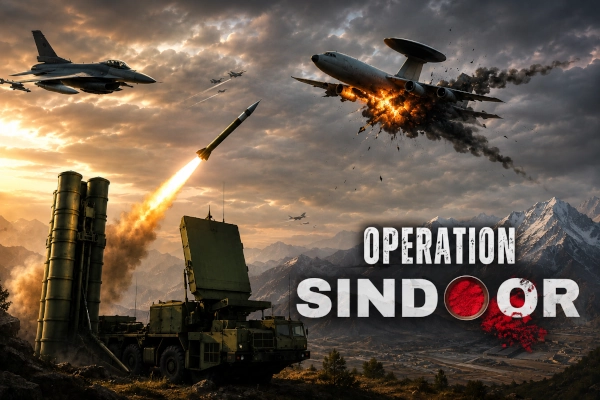
More than a year after Operation Sindoor, one of the Indian Air Force commanders directly responsible for operations on the western front has provided a detailed account of the losses India assesses it inflicted on the Pakistan Air Force during the May 2025 confrontation.
Air Marshal Jeetendra Mishra (Retd), who headed the IAF’s Western Air Command during Operation Sindoor, has said that India destroyed five Pakistani fighter aircraft in flight, while additional aircraft—including multiple F-16 fighters—were destroyed or damaged during precision strikes against Pakistani airbases.
Mishra’s disclosures, made during an extensive interview on the ANI Podcast with Smita Prakash on August 27, 2026, substantially expand on aircraft-loss figures previously announced by then Chief of the Air Staff Air Chief Marshal A.P. Singh. They also provide a rare operational perspective from the officer who commanded the IAF formation responsible for much of the air campaign against Pakistan.
The new account describes an operation in which India says it systematically attacked Pakistan’s surveillance architecture, command-and-control network, air-defence systems, airbases and combat aircraft before progressively gaining freedom to conduct deeper strikes.
The figures remain Indian military assessments, and Pakistan has disputed India’s claims regarding its aircraft losses. Nevertheless, Mishra’s account broadly corresponds with figures publicly presented by India’s Air Chief in 2025, strengthening the consistency of the Indian assessment over time.
Five Pakistani Fighter Aircraft Destroyed in Flight
Among the most important disclosures is the assessment that five Pakistan Air Force fighters were destroyed while airborne.
A targeting summary discussed during Mishra’s podcast appearance records five fighter-aircraft kills in flight, together with the destruction of a separate airborne early-warning or electronic-intelligence aircraft.
Mishra did not, in the material presently available from his interview, identify every one of the five fighters by individual type.
That distinction is important because some subsequent reporting has described the five aircraft as J-10Cs or F-16s. Mishra’s latest disclosure does not establish that particular composition.
Earlier statements by Air Chief Marshal A.P. Singh provide additional context. In August 2025, Singh announced that the IAF had at least five confirmed fighter kills and one large aircraft kill during Operation Sindoor. He said most of these engagements involved India’s long-range air-defence system.
In October 2025, Singh provided a more detailed assessment, saying Indian systems had evidence of five high-technology fighters of the F-16 and JF-17 class being destroyed in the air, in addition to an airborne early-warning or signals-intelligence aircraft.
Therefore, the strongest evidence currently supports the conclusion that the five airborne fighter losses claimed by India involved aircraft from Pakistan’s advanced fighter fleet, while it would be premature to assign a precise type to every kill without further official disclosure.
Additional F-16s Hit on the Ground
The airborne losses represented only one component of the damage India says it inflicted on the Pakistan Air Force.
Mishra’s targeting summary also records multiple F-16s destroyed on the ground, along with UAVs and other high-value aviation assets.
This corresponds closely with Air Chief Marshal A.P. Singh’s October 2025 assessment.
Singh said strikes against Pakistani airbases damaged three aircraft hangars at separate locations, and that available evidence indicated approximately four to five fighters—most likely F-16s—were inside one of the targeted facilities.
He separately distinguished those aircraft from the five fighters India said it destroyed while airborne.
This distinction means India’s overall assessment of Pakistani fighter losses during Operation Sindoor is considerably larger than the headline figure of five aircraft.
In October 2025, Singh indicated that Pakistan could have lost approximately 12 to 13 military aircraft when airborne and ground losses were considered together, although the precise total involved varying degrees of battle-damage assessment.
S-400 Engagement at 314 Kilometres
Perhaps the most remarkable part of Mishra’s latest account concerns the destruction of a Pakistani airborne surveillance aircraft at extreme range.
According to Mishra, Pakistan increasingly depended on its Airborne Warning and Control System, or AWACS, aircraft after Indian strikes degraded ground-based radars and command-and-control infrastructure.
He recalled that an airborne surveillance aircraft operating in connection with Sargodha was detected by India’s S-400 air-defence network on May 10.
According to Mishra, an S-400 operator requested permission to engage the aircraft.
Mishra authorised the shot.
The target, he said, was destroyed at approximately 314 kilometres.
Mishra described the engagement as the longest surface-to-air missile kill recorded in combat.
The exact aircraft variant has not been publicly established beyond the Indian description of it as an airborne radar or AWACS-type platform. Earlier IAF statements had cautiously described the long-range kill as either an AEW&C or signals-intelligence aircraft.
The significance of destroying such an aircraft goes far beyond the loss of a single airframe.
AEW&C aircraft operate as airborne radar and command centres. From altitude, they can detect aircraft at long distances, coordinate fighter operations, direct interceptions and provide commanders with a much wider picture of the battlespace than conventional ground radars alone.
Removing one from the battle can therefore degrade an opponent’s ability to understand and manage events across a large section of airspace.
Pakistan’s Fighters Forced to Remain Farther Away
Mishra said India’s S-400 deployment had another important effect even when it was not firing missiles.
Its engagement envelope forced Pakistani combat aircraft to remain considerably farther from Indian airspace.
He said Pakistani fighters were unable to approach within approximately 200 kilometres of India’s border without exposing themselves to the threat posed by the long-range system.
This illustrates one of the less visible functions of long-range air defence.
A surface-to-air missile does not have to shoot down an aircraft during every engagement to influence a battle. If the threat forces enemy fighters, surveillance aircraft or tankers to operate farther away, it can reduce the effectiveness of their sensors and weapons while limiting the geographical area from which they can operate safely.
Mishra said Pakistan was sufficiently concerned about the S-400 that it attempted to identify the locations of Indian batteries through intelligence operations during the conflict.
India Says Pakistani Radar Network Was Systematically Attacked
The S-400 engagement formed part of what Mishra described as a much wider campaign to weaken Pakistan’s ability to see and coordinate the air battle.
According to the former Western Air Command chief, India attacked a series of Pakistani ground-based radar installations, including American-origin AN/TPS-series radars, as well as command-and-control centres.
His targeting summary reportedly identifies six radar systems as having been destroyed and also records the loss of an LY-80 surface-to-air missile system.
Mishra characterised this process as progressively “blinding” Pakistan’s air-defence architecture.
The military logic is straightforward.
Modern air warfare depends on much more than fighter aircraft. Radars detect incoming threats, communication networks transmit information, command centres decide how to respond, and AEW&C aircraft extend radar coverage far beyond the horizon.
Destroying or suppressing these nodes can weaken the effectiveness of the entire force, even while many combat aircraft remain intact.
Two Command-and-Control Centres Targeted
Mishra’s targeting summary also records the destruction of two command-and-control centres, reportedly associated with Murid and Chaklala/Nur Khan.
These facilities were part of a wider set of Pakistani military targets struck as the confrontation escalated.
The Government of India subsequently confirmed that the Indian armed forces attacked 11 Pakistani military installations during the May 2025 operation.
The targets included Nur Khan, Rafiqui, Murid, Sukkur, Sialkot, Pasrur, Chunian, Sargodha, Skardu, Bholari and Jacobabad.
India described these attacks as a response to Pakistani attempts to strike Indian military infrastructure using missiles, drones and other long-range weapons.
The IAF also struck airbases including Chaklala/Nur Khan, Sargodha, Rafiqui, Rahim Yar Khan, Jacobabad, Sukkur and Bholari, according to later government documentation.
Transport or Tanker Aircraft Also Hit
Mishra’s assessment goes beyond fighter and surveillance aircraft.
The targeting summary presented during his interview reportedly includes one C-130 or IL-78-class aircraft destroyed on the ground.
The distinction between the two types is operationally important.
The C-130 is primarily a tactical transport aircraft, while the IL-78 serves as an aerial-refuelling tanker. Both are valuable assets, but they perform very different missions.
Mishra’s summary apparently does not conclusively identify which type occupied the targeted position.
Air Chief Marshal A.P. Singh had earlier said Indian battle-damage assessment showed evidence of a C-130-class aircraft being struck, providing independent continuity with the later account.
Another AEW&C Aircraft Reportedly Destroyed at Bholari
India’s assessment also indicates that the long-range S-400 engagement may not have represented Pakistan’s only loss among its valuable airborne-surveillance fleet.
Mishra’s summary reportedly records another AEW&C aircraft destroyed on the ground, associated with a hangar strike at Bholari airbase.
The cumulative effect would have been considerably more consequential than fighter losses alone.
Pakistan operates a comparatively small fleet of airborne warning aircraft. Unlike conventional fighters, these platforms cannot rapidly be replaced because of their cost, complex radar systems and specialised crews.
Losing even one can create a meaningful capability gap. Losing additional aircraft on the ground would compound that pressure.
Airbases and Hangars Became Direct Targets
India initially described Operation Sindoor as a calibrated strike against terrorist infrastructure following the April 22, 2025 Pahalgam terrorist attack.
The nature of the confrontation changed after Pakistan carried out retaliatory military actions.
Indian forces subsequently expanded their target set to include Pakistani military infrastructure.
The Government of India said that strikes were conducted against Pakistani airbases, radars, command facilities and other military installations after attempts were made to attack Indian bases and infrastructure.
Mishra’s targeting summary identifies hangars hit at several airbases, including Murid, Sukkur, Bholari and Jacobabad.
These strikes were important because aircraft inside hardened or semi-hardened shelters can remain vulnerable to sufficiently accurate penetrating weapons.
Rather than attempting to engage every Pakistani aircraft in aerial combat, India could therefore destroy aircraft while they were undergoing maintenance, refuelling, rearming or sheltering at their bases.
Runways at Sargodha and Rahim Yar Khan Damaged
Mishra’s operational summary also records runway damage at Sargodha and Rahim Yar Khan.
Runway attacks serve a different purpose from destroying aircraft.
A damaged runway can temporarily prevent fighters from taking off or landing, complicate sortie generation and force aircraft to relocate to other bases.
Even where repair teams can restore a runway relatively quickly, repeated or precisely placed strikes can disrupt the operational rhythm of an airbase at a critical moment.
India’s attacks therefore appear to have combined several complementary objectives: destroying aircraft, suppressing radar coverage, damaging command networks and reducing the ability of selected airbases to support combat operations.
BrahMos and Long-Range Precision Weapons
Operation Sindoor also demonstrated the growing importance of long-range precision weapons within Indian air-power doctrine.
Mishra’s ANI interview discusses BrahMos as part of the wider campaign, while official Indian accounts have highlighted the use of precision weapons and long-range strike capabilities against military infrastructure.
The ability to attack an airbase from well outside heavily defended airspace changes the traditional air-war equation.
Aircraft no longer necessarily need to fly directly over or even close to a target. Instead, they can release stand-off weapons from a safer distance while other assets provide targeting information, electronic warfare support and battle-damage assessment.
This makes the destruction of enemy radar and command networks even more valuable because it reduces the opponent’s ability to detect and respond to incoming weapons.
A Campaign Against the Air-Defence Network, Not Just Aircraft
Mishra’s account presents Operation Sindoor as something broader than a series of fighter-versus-fighter engagements.
India’s objective, according to his description, was progressively to dismantle the system that enabled the Pakistan Air Force to operate effectively.
Ground radars were attacked.
Command-and-control centres were targeted.
Air-defence systems were suppressed or destroyed.
Airborne surveillance aircraft were engaged.
Runways and aircraft shelters were struck.
Fighters were destroyed both in the air and on the ground.
Seen in combination, these actions represent a campaign against an integrated air-power network, rather than simply an effort to accumulate aerial kills.
That distinction is important in contemporary warfare.
An air force consists not merely of fighters but of the entire network required to detect threats, assign targets, refuel aircraft, communicate with formations, maintain aircraft and coordinate operations.
Attacking those supporting elements can produce effects that exceed the numerical loss of aircraft alone.
Women Fighter Pilots Flew Multiple Combat Missions
Mishra also disclosed new details about the role of women fighter pilots during Operation Sindoor.
According to him, women pilots flew more than one combat mission during the confrontation.
He said they participated in strikes against the Lashkar-e-Taiba complex at Muridke during the initial phase and later returned to attack Pakistani airbases and command-and-control targets during the expanded military campaign.
The disclosure provides one of the clearest acknowledgements yet of women fighter pilots participating directly in Indian combat strike missions during a major interstate confrontation.
Mishra Commanded the Western Air War
The source of the latest disclosures makes them particularly noteworthy.
Air Marshal Jeetendra Mishra was not analysing Operation Sindoor from outside the command structure.
He had taken command of the Western Air Command in January 2025 and was responsible for the formation during the May confrontation.
Western Air Command occupies a central position in any India-Pakistan air confrontation because its area of responsibility covers much of the strategically important western and northern airspace.
Mishra therefore had direct access to the operational picture, engagement information and battle-damage assessments generated during the conflict.
His comments should still be understood as India’s military assessment of events rather than an independently audited inventory of Pakistani losses. Nevertheless, they provide an unusually detailed first-person account from one of the senior commanders directly involved.
Earlier Air Chief Disclosure Supports Five-Fighter Figure
The five-fighter number did not first appear in Mishra’s August 2026 interview.
On August 9, 2025, Air Chief Marshal A.P. Singh publicly announced that India had confirmed at least five Pakistani fighter kills and one large aircraft kill during Operation Sindoor.
Reuters reported the announcement at the time, noting that Singh said electronic tracking data supported India’s assessment and that the S-400 had played an important role.
Singh later expanded the assessment during his October 2025 Air Force Day press conference.
He described:
five advanced fighters destroyed in the air;
one AEW&C or SIGINT aircraft destroyed at long range;
four to five fighters, most likely F-16s, hit on the ground;
a C-130-class aircraft hit;
another surveillance aircraft affected;
and damage to radars, command centres, hangars, runways and a surface-to-air missile system.
Mishra’s latest targeting summary therefore broadly reinforces rather than replaces the earlier IAF account.
No Evidence Yet That J-10C Was Among the Five
One important detail remains unresolved.
Pakistan operates Chinese-origin J-10CE fighters, and the aircraft participated in the wider 2025 confrontation according to Pakistan.
However, the Indian disclosures examined here do not establish that a J-10C was one of the five Pakistani fighters India says it destroyed.
The IAF’s most specific publicly available description from Air Chief Marshal Singh referred to the airborne losses as fighters of the F-16 and JF-17 class.
Therefore, claims describing the five Indian kills specifically as a combination of J-10Cs and F-16s go beyond what the available evidence presently supports.
Pakistan Rejects India’s Aircraft-Loss Assessment
Pakistan has consistently disputed India’s account.
Following Air Chief Marshal Singh’s August 2025 disclosure, Pakistani Defence Minister Khawaja Asif rejected the assertion that India had destroyed five fighters and another military aircraft.
Pakistan maintained that none of its aircraft had been destroyed and challenged India’s figures.
Pakistan’s Foreign Ministry has likewise rejected broader Indian descriptions of Operation Sindoor and maintains a sharply different account of the May confrontation.
The two countries therefore continue to present conflicting battle-damage assessments.
Unlike commercial aircraft losses or peacetime accidents, wartime aircraft losses can be difficult to independently verify when wreckage falls within military-controlled territory, damaged aircraft remain inside hardened facilities, or governments choose not to disclose fleet-status information.
This makes careful attribution essential.
The figures in Mishra’s account should therefore be described as Indian Air Force assessments or claims, even though they come from the officers who commanded and led the operation.
Operation Sindoor Changed After Pakistan’s Response
Operation Sindoor began in the early hours of May 7, 2025, following the Pahalgam terrorist attack in which 26 people were killed.
India initially struck what it described as nine terrorist facilities in Pakistan and Pakistan-occupied territory.
The conflict subsequently expanded as Pakistan and India exchanged drone, missile, artillery and air attacks.
According to the Government of India, Pakistan launched a major attempt to strike Indian airbases and military infrastructure during the night of May 9–10 using drones, missiles and other weapons.
India responded by attacking Pakistani military facilities across a broad geographical area.
The Government of India said 11 Pakistani military installations were struck within approximately three hours during this phase.
Military actions were halted later on May 10, 2025, following contact between the Directors General of Military Operations of India and Pakistan.
The Significance of the New Disclosure
Mishra’s August 2026 account matters because it helps connect several pieces of information released separately since Operation Sindoor.
The earlier official narrative established that India struck Pakistani airbases and military infrastructure.
Air Chief Marshal Singh subsequently provided overall aircraft-loss figures.
Mishra has now offered additional operational context explaining how Indian forces attempted to degrade Pakistan’s surveillance network, how the S-400 engagement unfolded, and how the different air and ground kills fit into the broader targeting campaign.
Taken together, India’s assessment indicates that Pakistani losses were not confined to five fighters.
India says those five represented only the fighters destroyed while airborne.
Separate strikes reportedly destroyed or damaged multiple F-16s on the ground, at least one additional AEW&C aircraft, a transport or tanker-class aircraft, UAVs, radar systems, command centres, a surface-to-air missile system, hangars and runways.
The exact number of destroyed Pakistani aircraft remains contested.
But the account now presented by Mishra reinforces a consistent Indian claim that Operation Sindoor evolved into a comprehensive campaign against Pakistan’s ability to detect, coordinate and conduct sustained air operations.
For India, the most consequential lesson may therefore extend beyond the number of aircraft destroyed.
Operation Sindoor demonstrated how long-range air defence, precision stand-off weapons, electronic warfare, surveillance, command networks and fighter operations can be integrated into a single air campaign.
And according to the commander who directed much of that campaign, the result was the destruction of five Pakistani fighters in flight, additional combat aircraft on the ground and some of the Pakistan Air Force’s most valuable airborne and ground-based support infrastructure.
References
1. ANI Podcast with Smita Prakash — Episode 444: “How India Blinded, Numbed & Paralysed Pakistan’s Air Force | Air Marshal Jeetendra Mishra,” 27 August 2026. Extended interview with the former Western Air Command chief covering planning for Operation Sindoor, the S-400 engagement, strikes against Pakistani air defences and command centres, BrahMos, drone warfare and women fighter pilots.
https://www.podbean.com/media/share/dir-nbp8d-309a2d5c
2. India Today — “Pakistan deployed spies to find S-400 systems: Air Marshal’s big Op Sindoor reveal,” 27 August 2026. Reports Mishra’s account of the destruction of Pakistani radars and command centres and the S-400 engagement against an airborne radar at 314 km.
https://www.indiatoday.in/india/story/pakistan-spies-india-s400-operation-sindoor-air-marshal-women-pilots-2980928-2026-08-27
3. The Economic Times — “Pakistan’s sleeper cells in India tried to locate S-400 defence systems during Operation Sindoor: Air Marshal Jeetendra Mishra (Retd),” 27 August 2026. Detailed coverage of Mishra’s comments on the S-400, Pakistani radar losses and airborne surveillance operations.
https://economictimes.indiatimes.com/news/defence/pakistans-sleeper-cells-in-india-tried-to-locate-s-400-defence-systems-during-operation-sindoor-air-marshal-jeetendra-mishra-retd/articleshow/133566701.cms
4. Akashvani News — “India Downed Five Pakistani Fighter Jets During Operation Sindoor: Air Chief Marshal A.P. Singh,” 9 August 2025. Records the Air Chief’s announcement of at least five confirmed Pakistani fighter kills and one large-aircraft kill.
https://newsonair.gov.in/india-downed-five-pakistani-fighter-jets-during-operation-sindoor-air-chief-marshal-a-p-singh/
5. Reuters — “India shot down six Pakistani military aircraft in May, air force chief says,” 9 August 2025. Independent reporting on Air Chief Marshal A.P. Singh’s five-fighter and one-large-aircraft assessment and Pakistan’s rejection of the claim.
https://www.reuters.com/world/asia-pacific/india-shot-down-six-pakistani-military-aircraft-may-air-force-chief-says-2025-08-09/
6. The Indian Express — “IAF chief details Pak losses: F-16s, JF-17s among aircraft taken out on ground, in air,” 3 October 2025. Detailed account of the Air Chief’s later battle-damage assessment, including airborne fighters and F-16s hit in hangars.
https://indianexpress.com/article/india/pakistani-fighter-jets-f-16s-destroyed-operation-sindoor-air-force-chief-10285337/
7. Press Information Bureau, Government of India — Operation Sindoor documentation, May 2025. Government account identifying 11 Pakistani military installations targeted during the later phase of the operation, including Nur Khan, Rafiqui, Murid, Sukkur, Sialkot, Pasrur, Chunian, Sargodha, Skardu, Bholari and Jacobabad.
https://www.pib.gov.in/PressReleasePage.aspx?PRID=2128747
You may also like
-
NIS Management Secures ₹6.24 Crore Surveillance Technology Contract for West Bengal Police
-
BEML Secures ₹75.58 Crore Export Order for Heavy Mobility Military Vehicles in Southeast Asia
-
Project Seabird Expands at Karwar as Indian Navy Inaugurates New Infrastructure with Over 90% Indigenous Content
-
DRDO Seeks Semi-Autonomous Guided Installation Vehicle and Specialised Pod Storage System
-
Indian Navy to Commission Indigenous Anti-Submarine Warfare Ship Mangrol on October 12
