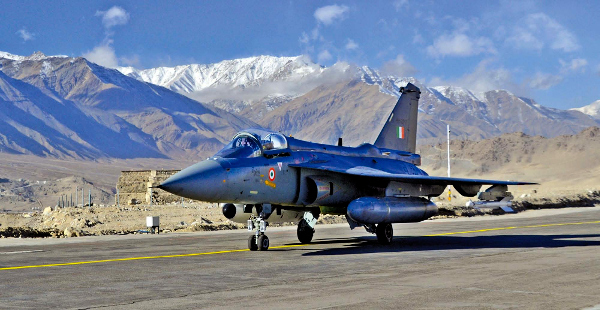
In modern air combat, survivability is no longer defined by speed, maneuverability, or weapons load alone. A fighter must first survive the electromagnetic battlespace before it can dominate the physical one. Radars search, track and guide; missiles home on emissions or reflected energy; hostile sensors build targeting pictures long before aircraft enter visual range. In that environment, the aircraft that cannot sense, classify, deceive, jam or evade electronic threats is operating half-blind. That is why the integration of Swayam Raksha Kavach into the LCA Tejas Mk1A is strategically important. The Ministry of Defence has explicitly listed Swayam Raksha Kavach alongside the UTTAM AESA radar and indigenous control-surface actuators as one of the advanced Indian-developed systems being integrated into the Mk1A fleet.
What makes Swayam Raksha Kavach significant is that it belongs to one of the hardest categories of combat aviation technology: the electronic warfare and self-protection layer. Official releases do not publicly describe its full architecture, frequency coverage, emitter libraries, jamming techniques, or interface logic, which is normal for a front-line fighter EW system. What is clear from the official record is that the Indian government considers it an advanced, indigenous capability important enough to be singled out in the 97-aircraft Mk1A contract announcement, and tied directly to the broader Aatmanirbhar push within the combat-aircraft program.
At the platform level, the Tejas Mk1A is intended to be the most advanced production variant of the current Tejas line, with new indigenous subsystems improving combat relevance and sovereign content. The September 2025 MoD contract release states that the aircraft will carry over 64 per cent indigenous content, incorporate 67 additional items beyond the earlier 2021 Mk1A contract, and include UTTAM AESA radar, Swayam Raksha Kavach, and control surface actuators. Deliveries for that 97-aircraft order are scheduled to begin in 2027–28 and continue over six years.
Technically, a fighter self-protection system like Swayam Raksha Kavach sits at the intersection of radar warning, threat assessment, electronic countermeasures, and survivability management. In operational terms, such a suite is meant to help the pilot detect hostile radar emissions, identify or classify the nature of the threat, assess urgency, and support countermeasures that reduce the aircraft’s vulnerability to tracking radars, engagement radars, and missile-guidance chains. That functional interpretation is consistent with the role of a self-protection EW suite on a modern fighter and with the MoD’s decision to highlight it as one of the key advanced indigenous systems on the Mk1A.
To understand why this matters, it helps to see the Tejas Mk1A as a network of interdependent combat subsystems rather than a simple airframe-plus-engine combination. The Mk1A is being fitted with indigenous digital flight-control advances as well. In February 2024, the Ministry of Defence announced the successful flight of the Digital Fly by Wire Flight Control Computer developed by ADE for the Tejas Mk1A. That computer uses a quadraplex PowerPC-based processor, a high-speed autonomous state-machine-based I/O controller, higher computational throughput and software compliant to DO-178C Level A safety requirements. This matters because survivability is not merely a function of a jammer or warning receiver in isolation; it depends on how rapidly the aircraft can sense threats, process them, present them to the pilot, and coordinate aircraft response.
The same logic applies to the pairing of UTTAM AESA radar and Swayam Raksha Kavach on the Mk1A. Officially, the two are mentioned together as advanced indigenous systems on the aircraft. That pairing is important because modern fighters rely on a balance between active sensing and electronic self-protection. AESA radars improve target detection, tracking agility, resistance to some forms of jamming, and multi-mode operation. But a radar-equipped fighter in contested airspace also needs an equally credible defensive electronic architecture to survive enemy surveillance and engagement networks. The fact that India is now integrating both an indigenous AESA radar and an indigenous self-protection suite on the same fighter marks a meaningful shift from assembling a platform to controlling more of its combat-critical electronics stack.
From a mission perspective, Swayam Raksha Kavach would be most relevant in the phases where a fighter is exposed to ground-based air defence radars, fighter intercept radars, or missile seekers. In real operations, that means ingress toward defended airspace, strike escort, defensive counter-air patrols, and even peacetime readiness in dense surveillance environments. A credible EW shield increases the aircraft’s odds of surviving long enough to exploit its radar, weapons and maneuverability. That is why self-protection suites are not luxury add-ons. They are part of the aircraft’s combat viability. This is also reflected indirectly in parliamentary reporting on the Tejas program, which describes the future Tejas Mk2 as being designed for dense and hostile air-defence environments and equipped with an integral Unified Electronic Warfare Suite for survivability. That broader official direction shows that India’s combat-aircraft design philosophy is increasingly treating EW as a core design pillar rather than an afterthought.
A useful way to think about Swayam Raksha Kavach is as part of India’s effort to reduce dependence on imported “black-box” avionics and survivability electronics. In fighter procurement, imported EW suites are often among the most tightly controlled technologies, with source code, mission data flexibility, reprogramming rights, emitter library control and future upgrade freedom all becoming strategic issues. By integrating indigenous systems like UTTAM and Swayam Raksha Kavach, India is not only increasing local content; it is improving the possibility of sovereign control over upgrades, threat databases, integration cycles, and mission tailoring. The official record does not spell all of that out, but it strongly supports the underlying point that these systems are being integrated specifically to deepen indigenisation and strengthen Aatmanirbharta in a critical combat platform.
Industrial depth is part of the story too. The September 2025 contract release says the Mk1A project is supported by nearly 105 Indian companies manufacturing detailed components, and is expected to generate about 11,750 direct and indirect jobs per year over six years. While the public release does not break out which firms support Swayam Raksha Kavach specifically, it does show that the Mk1A’s indigenous subsystem push is embedded in a larger domestic aerospace production base rather than an isolated laboratory effort.
There is also an operational doctrine angle. Electronic warfare is cumulative: the effectiveness of one fighter’s self-protection suite grows when it is supported by better mission planning, threat libraries, training, maintenance discipline, and a fleet architecture that knows how to fight in the electromagnetic spectrum. The Tejas Mk1A’s indigenous avionics progression, the DFCC milestone, the UTTAM integration path, and the formal inclusion of Swayam Raksha Kavach together suggest that the Indian ecosystem is moving toward a more integrated avionics-survivability architecture. That is an inference from multiple official program milestones rather than a line the government states verbatim, but it is a grounded one.
In strategic terms, that is the real meaning of Swayam Raksha Kavach. It represents India’s attempt to build its own electronic shield for a frontline fighter, inside a battlespace where survivability depends as much on software, signal processing and electromagnetic deception as on aerodynamics or missile carriage. A fighter that can see farther but cannot protect itself electronically remains vulnerable. A fighter that combines indigenous sensing, flight-control and self-protection layers begins to move closer to genuine combat autonomy. On that journey, Swayam Raksha Kavach is an important milestone.
Reference:
- Ministry of Defence / PIB – MoD signs Rs 62,370 crore contract with HAL for procurement of 97 LCA Mk1A aircraft for IAF
https://www.pib.gov.in/PressReleseDetailm.aspx?PRID=2171108 - Ministry of Defence PDF release – contract with HAL for 97 LCA Mk1A
https://mod.gov.in/sites/default/files/mod-contract-with-HAL_0.pdf - PIB – Digital Flight Control Computer for Tejas Mk1A flown successfully
https://www.pib.gov.in/PressReleaseIframePage.aspx?PRID=2007465 - PIB – Ministry of Defence year-end review 2025 mentioning LCA Mk1A, UTTAM AESA radar and Swayam Raksha Kavach
https://www.pib.gov.in/PressReleaseDetail.aspx?PRID=2210154&lang=1®=3 - DRDO news clipping citing parliamentary reporting on Tejas Mk2 and its integral Unified Electronic Warfare Suite
https://drdo.gov.in/drdo/sites/default/files/drdo-news/NPC18Dec2024.pdf - DRDO news clipping citing parliamentary reporting on Tejas Mk2 and integral Unified Electronic Warfare Suite
https://drdo.gov.in/drdo/sites/default/files/drdo-news/NPC21to23Dec2024.pdf
You may also like
-
Exercise Tarang Shakti 2026 Concludes in Jodhpur, Showcasing India’s Air Power, Indigenous Defence Technology
-
Indian Navy Vice Chief Inspects Japan’s Mogami-Class Stealth Frigate as India-Japan Shipbuilding Cooperation Expands
-
Philippine Marine Wargames Reportedly Show BrahMos Can Penetrate Chinese Destroyer Air Defences
-
Safran Signs 18 Agreements with Indian Aerospace Suppliers, Expanding Make in India Manufacturing Partnerships
-
Indian Army’s Vajra Corps Certifies First Batch of Drone Operators, Strengthens Battlefield Surveillance
