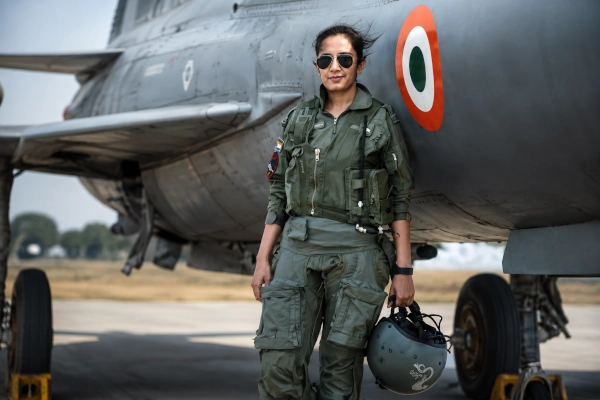
Squadron Leader Bhawana Kanth has added another landmark to the history of women in Indian military aviation by becoming the first woman fighter pilot of the Indian Air Force to successfully complete the Fighter Combat Leader course at the prestigious Tactics and Air Combat Development Establishment, or TACDE, in Gwalior.
The qualification places Kanth among a select group of Indian fighter pilots trained not merely to fly combat aircraft, but to understand, develop and lead sophisticated air-combat tactics.
TACDE is frequently described as the Indian Air Force’s equivalent of the US Navy’s famous “Top Gun” school, although “Top Gun” is not its official designation. The establishment is one of the IAF’s premier institutions for advanced operational and tactical training.
For Bhawana Kanth, the latest achievement represents another milestone in a career that has repeatedly broken barriers since women were first inducted into the IAF fighter stream a decade ago.
What Makes the Fighter Combat Leader Qualification Special?
Becoming a Fighter Combat Leader is very different from simply qualifying to operate a fighter aircraft.
A fighter pilot is trained to execute combat missions as part of a formation or package. A Fighter Combat Leader is expected to develop a much deeper understanding of how those aircraft, weapons, sensors and formations should be employed during complex combat situations.
The Fighter Combat Leader course runs for around 20 weeks and is reserved for a small number of highly experienced and capable fighter aircrew. Training focuses on advanced combat tactics and prepares graduates to return to their frontline squadrons as specialists in areas such as weapons employment, aerial manoeuvring and tactical mission planning.
A Fighter Combat Leader can therefore become an important tactical reference within a squadron — someone expected to understand not only how to fight an aircraft, but how several combat assets can be coordinated effectively against an adversary.
This is what gives Kanth’s achievement considerable operational significance.
She has crossed the threshold from being one of India’s pioneering women fighter pilots to becoming part of the IAF cadre entrusted with advanced fighter tactics and combat leadership.
TACDE: Where the IAF Sharpens Its Combat Doctrine
The Tactics and Air Combat Development Establishment occupies a special place within the Indian Air Force.
Its origins go back to 1971, when the Tactics and Combat Development and Training Squadron was established. It was redesignated TACDE the following year and subsequently evolved into a major centre for developing and refining operational tactics.
TACDE’s responsibilities extend well beyond pilot training.
The establishment helps develop tactical procedures, contributes to standard operating procedures and evaluates aircraft, radars and weapons before their wider operational integration.
Its courses bring together different elements of air warfare, including air-to-air combat, air-to-ground operations, electronic warfare and coordination with ground-based air-defence systems.
Apart from the Fighter Combat Leader course, TACDE also conducts specialised programmes such as the Helicopter Combat Leader and Master Fighter Controller courses.
Graduating from such an institution therefore signifies more than individual flying proficiency. It represents qualification in the tactical employment of air power.
From Bihar to the Fighter Cockpit
Bhawana Kanth’s journey began far from the combat aircraft she would eventually fly.
Hailing from Darbhanga in Bihar, Kanth studied engineering before joining the Indian Air Force.
Her career entered the history books in June 2016, when she was commissioned alongside Avani Chaturvedi and Mohana Singh as part of the IAF’s first group of women fighter pilots.
Their commissioning followed the government’s decision to experimentally open the fighter stream to women.
Until then, women officers had served as pilots in transport aircraft and helicopters, but the fighter cockpit remained closed to them.
Kanth, Chaturvedi and Singh therefore entered an environment in which there were virtually no earlier female fighter pilots to follow.
They were not simply joining another aviation branch. They were helping establish an entirely new pathway for women in the Indian Air Force.
Mastering the MiG-21 Bison
Bhawana Kanth subsequently trained on one of the most demanding aircraft operated by the Indian Air Force — the MiG-21 Bison.
The MiG-21 represented an especially challenging introduction to frontline fighter operations. It was a high-speed interceptor designed in an earlier era, with considerably less automation and pilot assistance than modern fighters.
Kanth nevertheless progressed through the demanding operational training required to fly the aircraft in combat conditions.
In May 2019, she achieved another historic milestone when she became the first Indian woman fighter pilot qualified to undertake combat missions by day on a fighter aircraft after completing the operational syllabus on the MiG-21 Bison.
That distinction was especially important.
Being commissioned into the fighter stream was one achievement. Becoming operationally qualified for combat was another.
Kanth had now demonstrated that women officers could progress through the same demanding fighter-training pipeline and become mission-ready combat aviators.
From MiG-21 to Sukhoi-30MKI
Kanth later transitioned from the MiG-21 fleet to the Sukhoi Su-30MKI, one of the principal frontline combat aircraft of the Indian Air Force.
Current reports identify her as a Su-30MKI pilot following her earlier service on the MiG-21 Bison.
The transition represents a major progression in combat capability.
The Su-30MKI is a large, twin-engine multirole fighter equipped for long-range missions, air superiority, interception and precision strike operations.
Moving from the relatively compact MiG-21 to the much larger and more sophisticated Su-30MKI requires pilots to master a substantially more complex combat system involving advanced radar, electronic warfare equipment, long-range weapons and multi-role mission management.
Kanth’s career consequently mirrors part of the technological evolution of the IAF itself — from the ageing MiG-21 generation towards modern networked multirole fighters.
Another First at the Republic Day Parade
Kanth also entered the record books during the Republic Day celebrations in 2021, when she became the first woman fighter pilot to participate in the Republic Day Parade.
The Government of India subsequently highlighted her participation and her continuing role as an IAF fighter pilot.
She has also been recognised with the Nari Shakti Puraskar, one of India’s prominent civilian honours recognising women’s achievements.
Each milestone has represented a different stage in her progression.
In 2016, she helped open the fighter stream.
In 2019, she demonstrated combat qualification.
Now, in 2026, she has entered the specialised domain of advanced tactical leadership.
What Does a Fighter Combat Leader Actually Do?
The title can easily be misunderstood.
A Fighter Combat Leader is not simply the pilot with the highest rank in a formation.
The qualification reflects specialised expertise in employing fighter aircraft under demanding operational conditions.
Modern air combat is rarely a simple one-versus-one dogfight.
A major mission can involve fighters, airborne warning aircraft, aerial refuellers, ground-based radars, electronic-warfare assets, surface-to-air missile systems, unmanned systems and long-range precision weapons operating simultaneously.
Pilots must understand not just their own aircraft but how these different capabilities interact.
Building the IAF’s Next Generation of Tactical Leaders
One of TACDE’s most important functions is ensuring that advanced combat knowledge does not remain confined to a few individuals.
Graduates return to operational formations and pass those lessons to other aircrew.
The result is a multiplier effect.
An experienced fighter pilot who completes FCL training can help improve the tactical proficiency of an entire squadron.
This is why the course carries considerable prestige within the fighter community.
Its graduates are expected to contribute to how frontline units understand weapons employment, manoeuvring, mission planning and evolving threats.
Kanth’s graduation therefore represents considerably more than another personal aviation record.
It means a woman officer is now part of the cadre helping shape frontline fighter tactics within the Indian Air Force.
Women Are Moving Beyond Entry-Level Combat Roles
Perhaps the most significant aspect of Bhawana Kanth’s achievement is what it says about the evolution of women in the IAF.
When the first three women entered the fighter stream in 2016, the immediate question was whether women could successfully complete fighter training and serve operationally.
That phase has passed.
Women fighter pilots are increasingly moving into more advanced roles and qualifications.
Kanth becoming a Fighter Combat Leader demonstrates that the progression is no longer merely about gaining entry into a combat cockpit.
It is now about experience, specialisation, instruction, tactical leadership and responsibility within frontline formations.
That represents a much deeper institutional change.
A Decade-Long Transformation
The timeline is striking.
2016: Bhawana Kanth, Avani Chaturvedi and Mohana Singh become India’s first women fighter pilots.
2019: Kanth becomes the first Indian woman fighter pilot qualified for day combat missions.
2021: She becomes the first woman fighter pilot to participate in the Republic Day Parade.
2026: Kanth becomes the first woman to complete the IAF’s Fighter Combat Leader course.
In barely a decade, a programme initially introduced on an experimental basis has produced a woman qualified at one of the highest levels of tactical fighter training in the service.
That progression may ultimately be more important than any single record.
References
The Times of India, 6 August 2026 — India gets its first woman ‘Top Gun’: Bhawana Kanth scripts IAF history — confirms Kanth as the first woman pilot to clear the FCL course and details TACDE’s role and the 20-week programme.
The New Indian Express, 6 August 2026 — Bhawana Kanth becomes IAF’s first woman fighter combat leader — confirms her FCL qualification, MiG-21 background, Su-30MKI conversion and earlier career milestones.
Press Information Bureau, Government of India — records Bhawana Kanth as an IAF fighter pilot and the first woman fighter pilot to take part in the Republic Day Parade in 2021.
Economic Times / India Today, May 2019 — document her becoming the first Indian woman fighter pilot qualified to undertake day combat missions on the MiG-21 Bison.
You may also like
-
Indian Navy Vice Chief Inspects Japan’s Mogami-Class Stealth Frigate as India-Japan Shipbuilding Cooperation Expands
-
Philippine Marine Wargames Reportedly Show BrahMos Can Penetrate Chinese Destroyer Air Defences
-
Safran Signs 18 Agreements with Indian Aerospace Suppliers, Expanding Make in India Manufacturing Partnerships
-
Indian Army’s Vajra Corps Certifies First Batch of Drone Operators, Strengthens Battlefield Surveillance
-
India to Seek 35% Increase in Defence Modernisation Budget for FY 2027–28
