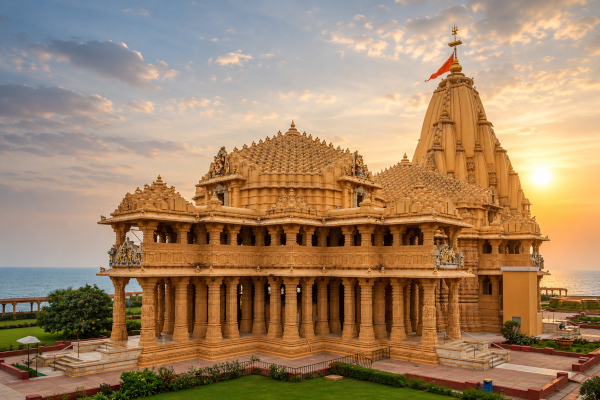
Standing majestically on the shores of the Arabian Sea at Prabhas Patan in Gujarat, the Somnath Temple is far more than a place of worship. It is one of the most powerful civilisational symbols in Indian history — a temple whose story spans mythology, maritime trade, invasions, destruction, reconstruction, political revival, and cultural resilience over more than a thousand years. Revered as the first among the twelve Jyotirlingas of Lord Shiva, Somnath occupies a sacred place in Hindu spiritual tradition and an equally important place in India’s historical memory. For centuries, Somnath stood as one of the wealthiest and most celebrated temples of the Indian subcontinent. Its location along the western coast connected it to ancient maritime trade networks extending toward Arabia, East Africa, and the Mediterranean world. Pilgrims, merchants, ascetics, kings, and travellers visited the shrine, transforming it into both a sacred centre and a prosperous economic hub. Yet Somnath’s greatest historical significance lies not merely in its sanctity, but in its repeated destruction and reconstruction. Few monuments in world history embody resilience as profoundly as Somnath. Again and again the temple was attacked, plundered, demolished, rebuilt, and revived — each reconstruction becoming a declaration that civilisational memory could not be erased.
According to Hindu tradition, the temple derives its name from “Soma,” the Moon God. Ancient legends describe how Soma married the twenty-seven daughters of Daksha Prajapati but showed special affection only toward Rohini. Angered by this partiality, Daksha cursed Soma to gradually lose his radiance. Afflicted by the curse, Soma performed severe penance at Prabhas Kshetra and worshipped Lord Shiva. Pleased with his devotion, Shiva partially relieved the curse, allowing the moon to wax and wane cyclically instead of disappearing permanently. In gratitude, Soma is believed to have established the original Somnath shrine. This association with cosmic cycles, destruction, and renewal deeply shaped the symbolic identity of the temple itself.
Somnath’s antiquity is referenced in texts including the Mahabharata, Skanda Purana, Bhagavata Purana, and several ancient pilgrimage traditions. Prabhas Patan became an important tirtha in western India and attracted pilgrims for centuries. The temple’s coastal location also linked it to maritime commerce. Gujarat’s western coastline historically hosted prosperous ports involved in spice trade, horse trade, and international exchange. Over time, Somnath emerged not merely as a temple but as one of the wealthiest religious institutions in India. Medieval accounts describe massive endowments, gold ornaments, jewel-encrusted idols, temple dancers, scholars, and thriving settlements surrounding the shrine.
The most famous chapter in Somnath’s history occurred in 1026 CE when Mahmud of Ghazni invaded Gujarat and attacked the temple. Mahmud, the Turkic ruler of Ghazni in present-day Afghanistan, launched multiple raids into the Indian subcontinent primarily for plunder and political prestige. Somnath, known for its immense wealth and religious significance, became one of his most ambitious targets. Historical accounts describe fierce resistance by defenders and devotees before the temple was eventually looted and destroyed. Medieval chroniclers claimed that enormous quantities of gold, silver, gems, and treasures were carried away after the raid. The destruction of Somnath became deeply embedded in Indian historical memory because it symbolised not merely military defeat but an assault on sacred and cultural identity. Yet remarkably, the temple did not disappear.
One of the defining features of Somnath’s history is that every destruction was followed by reconstruction. After Mahmud’s invasion, regional Hindu rulers and local communities rebuilt the temple. Various dynasties including the Solankis and Chalukyan-associated rulers contributed to restoration efforts over subsequent centuries. Heroic memory evolved around the temple’s defenders and rebuilders. However, Somnath again faced repeated attacks during later medieval conflicts involving Delhi Sultanate rulers and regional invasions. Over centuries, temples were damaged, idols destroyed, structures converted, and reconstructions attempted repeatedly. Historical traditions associate later restoration efforts with rulers such as Raja Bhoja, Bhima Deva, Kumarapala, Siddharaja Jayasimha, and other western Indian dynasties. Every rebuilding effort became both an act of devotion and cultural defiance.
One of the most important figures in preserving Somnath’s continuity was Ahilyabai Holkar, the legendary Maratha queen renowned for restoring temples across India. In the eighteenth century, when the original grand structure remained in ruins, Ahilyabai Holkar constructed a new Shiva temple near the original site to ensure uninterrupted worship. Her intervention preserved the sacred continuity of Somnath during a politically turbulent period. Many major Indian temples — including Kashi Vishwanath — owe part of their revival to Ahilyabai Holkar’s patronage.
Somnath acquired renewed symbolic significance after Indian independence. When Sardar Vallabhbhai Patel visited the ruined temple in 1947 shortly after Junagadh’s accession to India, he reportedly resolved that Somnath would be rebuilt as a symbol of national restoration and civilisational confidence. Patel viewed Somnath not merely as a religious site but as a monument representing India’s cultural continuity after centuries of invasions and colonial rule. The reconstruction effort was organised through public donations and the Somnath Trust rather than direct state funding. After Patel’s death, the project was strongly supported by K. M. Munshi, another major figure in India’s cultural and constitutional history. The reconstructed temple was inaugurated in 1951 by India’s first President, Dr. Rajendra Prasad, despite political controversy surrounding state participation in religious ceremonies during the early years of the republic. Rajendra Prasad declared during the inauguration that Somnath represented the truth that what is built with faith cannot be permanently destroyed.
The modern Somnath Temple is built in the majestic Māru-Gurjara or Chalukyan-Solanki architectural style associated with western India. Constructed primarily from sandstone, the temple features towering shikharas, intricate carvings, pillared mandapas, sculpted walls, and classical Nagara-style design principles. The main shikhara rises dramatically above the Arabian Sea coastline, creating one of the most visually iconic temple silhouettes in India. An important feature of the temple is the “Arrow Pillar” or Baan Stambh located near the sea-facing side. An inscription on the pillar states that there is no landmass between Somnath and Antarctica in a straight line across the sea, symbolising the temple’s location at the edge of the Indian landmass facing the vast ocean. The roar of Arabian Sea waves against the temple complex adds enormously to Somnath’s spiritual atmosphere.
In recent years, Somnath has undergone major infrastructure and tourism development while preserving its sacred identity. According to recent reports marking the 75th anniversary of the temple’s post-independence reconstruction, Somnath today receives nearly one crore pilgrims annually, with daily footfall often exceeding 25,000 devotees. Connectivity improvements including the Jetpur–Somnath four-lane highway, improved railway connectivity including the Sabarmati–Veraval Vande Bharat Express, and expanded airport access through Rajkot International Airport and Keshod Airport have significantly boosted tourism and pilgrimage access. The Somnath Trust has also undertaken extensive redevelopment projects including improved guest houses, heritage pathways, digital booking systems, coastal promenades, environmental conservation projects, and light-and-sound historical shows. The Samudra Darshan Path along the Arabian Sea coastline has become a major attraction for pilgrims and tourists alike.
Somnath’s development in recent years has also incorporated sustainability measures. Temple flowers are converted into vermicompost, wastewater is recycled for plantations, rainwater harvesting systems have been restored, and plastic waste is repurposed into paver blocks. A Miyawaki forest with thousands of trees has also been developed near the temple precinct to help combat coastal salinity and strong sea winds. The integration of heritage conservation with modern infrastructure has become a key feature of Somnath’s contemporary transformation.
Somnath’s greatest significance ultimately lies beyond architecture or tourism. The temple became a symbol because it repeatedly demonstrated the ability of a civilisation to rebuild after devastation. Every reconstruction carried a message that cultural identity could survive conquest, political upheaval, and historical trauma. Prime Minister Narendra Modi recently described Somnath’s journey as one from “Vidhvans to Srijan” — from destruction to creation. That phrase perhaps captures the temple’s enduring meaning better than any historical summary.
Standing beside the Arabian Sea for centuries, Somnath witnessed ancient maritime trade, dynastic wars, invasions, colonial archaeology, independence, and modern India’s cultural revival. Empires rose and disappeared, yet Somnath continued to return. The waves striking the shore beside the temple seem almost symbolic of its own history — retreating, returning, and rising again endlessly with renewed force.
You may also like
-
BRICS Theatre Festival 2026 Opens in New Delhi, Bringing Together Nine Nations to Strengthen Cultural Cooperation
-
Sauvira: The Indus Realm Linked With Jayadratha in the Mahabharata
-
Sindhu: The Indus Kingdom of Jayadratha in the Mahabharata
-
Kuninda or Kulinda: The Himalayan Realm of the Mahabharata in Uttarakhand and Himachal Pradesh
-
Durga versus Mahishasura: Weapons, Battlefield Tactics and the Triumph of Shakti
