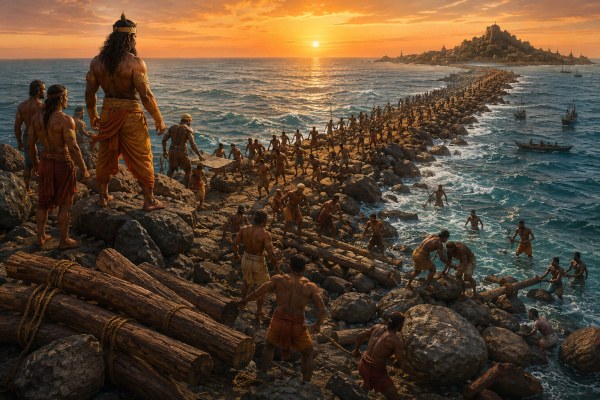
The ocean before Rama was more than water. It was a wall without gates, a fortress without battlements, a moat so vast that even courage seemed to pause before it. On one side stood Rama, Lakshmana, Sugriva, Hanuman, Angada, Jambavan and the vast Vanara host, burning with purpose after the discovery of Sita in Lanka. On the other side stood Ravana’s island citadel, protected by distance, waves, uncertainty and the natural defensive power of the sea. Between them lay the problem that every army in history has faced in some form: how to move force across an obstacle that geography itself has placed in the path of war.
This is where the Ramayana presents one of its greatest lessons in military science. The construction of Rama Setu is not merely a sacred episode of devotion and divine grace. It is also one of the most powerful examples of engineering warfare in ancient imagination. It shows how a commander converts terrain into opportunity, how labour becomes combat power, how measurement becomes strategy, and how a seemingly impossible natural barrier can be turned into an invasion route through organisation, discipline and technical leadership.
In the Yuddha Kanda, the Vanara army reaches the southern shore after Hanuman’s reconnaissance confirms Sita’s location in Lanka. The intelligence problem has been solved. The political alliance has been built. The army has been mobilised. The commander’s objective is clear. Yet the campaign still cannot move forward because intelligence and bravery alone cannot carry an army across the sea. This is one of the most realistic military truths hidden inside the epic. Victory requires access. Access requires engineering. A force that cannot cross rivers, mountains, deserts, marshes or seas remains trapped by terrain, however brave its soldiers may be.
The arrival of Nala at this moment is deeply significant. Nala is not presented merely as a labour organiser. He is the technical mind of the operation, the combat engineer of Rama’s campaign. He understands the problem as a matter of structure, sequence, manpower and materials. The shoreline becomes a giant military worksite. Trees are felled. Rocks are gathered. Measuring poles are used. Labour is organised. The Vanaras, who until then had displayed speed, strength and reconnaissance skill, now become an engineering corps. Their energy is channelled into construction. Their wild physical power is transformed into disciplined military utility.
This is the essence of engineering warfare. It is the art of making an army move where the enemy believes movement is impossible. In modern battlefields, the same principle appears when combat engineers build pontoon bridges across rivers under pressure, clear minefields for armoured columns, repair bombed runways overnight, open mountain tracks for artillery, create landing zones for helicopters, restore damaged ports, construct forward bases, and build roads through terrain that looks hostile to movement. The weapon in such moments is not only the rifle, missile or tank. The weapon is the bridge, the road, the culvert, the causeway, the ferry point, the runway, the logistics corridor.
Rama Setu begins with a commander facing a hard operational question: how does one carry an entire army across the sea? Hanuman had already crossed alone through personal power and divine courage. That was reconnaissance. War demands something bigger. A single hero can leap; an army must move. Soldiers need routes, formation space, supply movement, command continuity and evacuation paths. This difference between heroic movement and military movement is central to the episode. Hanuman’s leap proved that Lanka could be reached. Nala’s bridge made it possible for the whole campaign to reach Lanka.
The construction scene is cinematic in scale. One can imagine the shore roaring with activity: Vanaras dragging massive trees, rolling stones, lifting boulders, tying materials, carrying loads in teams, responding to commands, moving in rhythm with the urgency of war. The ocean wind blows salt into their faces. Waves crash against the forming line of the bridge. The horizon, once empty and intimidating, slowly begins to show a path. What was earlier a blue expanse of separation becomes a physical line of advance. Every stone placed into the water becomes a declaration that geography will serve dharma.
The use of measuring poles in the tradition gives the episode a strikingly practical character. Measurement is the first language of military engineering. Before a bridge is built, the engineer studies distance, depth, alignment, current, foundation and load. Before a modern army crosses a river, engineers examine bank conditions, flow speed, approach roads, enemy observation, artillery threat and the weight of vehicles that must pass. In the Ramayana, the measuring pole becomes a symbol of applied intelligence. The bridge is not chaos; it is planned effort. It is not only enthusiasm; it is organised execution.
Nala’s role also shows the importance of specialised talent inside a war effort. Rama is the supreme commander and moral centre. Lakshmana is the fierce warrior brother. Sugriva provides alliance power. Hanuman provides reconnaissance, courage and deep penetration capability. Jambavan provides wisdom. Nala provides engineering competence. The army succeeds because different forms of strength are brought together. This is how modern military forces also operate. Infantry captures ground, armour breaks through, artillery shapes the battlefield, air power strikes depth targets, intelligence identifies enemy systems, signals units maintain communication, logistics sustains movement, and engineers create the physical possibility of manoeuvre.
A great army is therefore not only a collection of fighters. It is a living system of specialists. The Rama Setu episode captures this beautifully. The Vanara army’s strength becomes meaningful because Nala gives it structure. Raw manpower becomes construction capacity. Enthusiasm becomes timetable. Physical force becomes a line of communication. The transformation is the real military miracle of the episode.
The bridge also represents the conversion of a natural obstacle into a strategic corridor. In defensive warfare, rivers, seas, mountains and deserts protect a kingdom by slowing the attacker. Lanka’s island geography gives Ravana natural depth. The sea creates warning time, separation and psychological advantage. Rama Setu collapses that advantage. Once the bridge rises, Lanka is no longer unreachable. The enemy’s protective moat becomes Rama’s approach road. This is one of the oldest truths of warfare: when engineering defeats terrain, strategy changes instantly.
Ravana’s great strategic comfort was the sea. He believed Lanka’s geography would do the work of defence, that distance, water and isolation would slow any army before it could reach his gates. In modern India’s border history, a similar older caution once shaped thinking on the Himalayan frontier. Former Defence Minister A.K. Antony acknowledged in Parliament in 2013 that for many years independent India had followed the belief that the best defence was to leave border areas undeveloped, because an undeveloped border appeared safer than a developed one; he also admitted that China had moved ahead in border infrastructure during that period. That thinking carried the same danger as Ravana’s faith in the ocean: it allowed the obstacle to become a comfort instead of a theatre to be mastered. Under Prime Minister Narendra Modi’s leadership, India has moved in the opposite direction by treating border roads, bridges and tunnels as instruments of deterrence, mobility and national resolve. Projects such as the Atal Tunnel, Sela Tunnel and the expanding Border Roads Organisation network have turned difficult terrain into military access, giving soldiers faster movement, stronger logistics and all-weather reach toward sensitive frontiers. In the language of Rama Setu, the lesson is clear: the side that builds the road controls the tempo, while the side that trusts the obstacle slowly loses the initiative.
Modern warfare has repeatedly shown the same logic. A river can halt tanks until engineers build a crossing. A mountain valley can block artillery until roads are cut into rock. A damaged airfield can paralyse operations until runway repair teams restore it. A mined approach can freeze an assault until breaching teams open lanes. A coastline can resist invasion until landing craft, floating harbours, beach exits and supply dumps are prepared. The battle is often decided before the first major clash, at the point where engineers decide whether the army can reach the fight in strength.
Rama’s campaign against Lanka therefore moves through a complete military sequence. First comes intelligence: Hanuman enters Lanka, observes the city, identifies Sita’s location and returns with actionable knowledge. Then comes mobilisation: the Vanara forces gather under Sugriva’s leadership. Then comes operational planning: the army reaches the sea and recognises the obstacle. Then comes engineering: Nala organises the bridge. Then comes force projection: the army crosses into the enemy theatre. The epic does not treat war as a single emotional charge. It presents war as a layered campaign requiring reconnaissance, alliance, logistics, engineering, morale and command.
The emotional power of Rama Setu lies in the way it unites devotion with discipline. The Vanaras are not merely building a structure; they are building a path for a righteous mission. Every tree dragged to the shore, every rock carried into the surf, every command shouted over the wind, every line measured across the water becomes part of a larger vow. In modern terms, this is morale converted into infrastructure. Armies often perform extraordinary engineering feats when the troops believe that the task has moral and national meaning. Bridges built under fire, roads opened in high mountains, disaster routes cleared after floods, airstrips restored in conflict zones — these are acts where technical skill and collective will merge.
The bridge also changes time. Before construction, the sea imposes delay. Delay favours Ravana because it gives Lanka time to prepare. By building the bridge, Rama’s side seizes the tempo of the campaign. In modern military language, tempo is the speed at which operations are planned, executed and exploited. A force that moves faster than the enemy expects creates shock. Engineering enables tempo. A repaired bridge can allow armour to arrive earlier than anticipated. A rapidly built forward road can shift artillery into range. A temporary landing strip can bring supplies into a theatre. Rama Setu compresses the distance between intention and action.
There is also a logistical dimension. Crossing an army is different from reaching a destination. An army requires continuous flow. Fighters, commanders, messengers, supplies, weapons, medical assistance and reserves must move in a controlled manner. Rama Setu gives the Vanara army a line of communication between the mainland and Lanka. This line allows the campaign to sustain itself after the initial crossing. In modern warfare, logistics corridors are as important as combat formations. A spearhead that outruns supply becomes vulnerable. A bridge, road or port can decide whether an offensive continues or stalls. Nala’s bridge gives Rama not only access to Lanka, but the ability to project sustained force.
The episode also speaks to the psychology of war. For the Vanara army, the sea is initially an intimidating presence. Once work begins, fear is replaced by labour. The soldiers are no longer staring at the obstacle; they are attacking it with tools, hands and coordination. This shift matters. Engineering turns anxiety into action. In modern armies, obstacle-breaching drills, bridge-laying operations and route-opening missions have the same psychological effect. Troops gain confidence when they see that terrain can be mastered. A constructed path becomes a visible promise that the campaign is moving forward.
For Ravana, the bridge carries the opposite psychological meaning. The sea that guarded Lanka begins to fail as a shield. The impossible becomes visible from the enemy’s side. A line of advance slowly appears across the water. This is strategic signalling through engineering. A bridge is not silent. It tells the enemy that the attacker has organisation, patience, manpower, technical leadership and unwavering intent. It says that the campaign has crossed from desire into execution.
The Rama Setu episode can also be read as an ancient reflection on civil-military mobilisation. The Vanara host acts collectively, with each participant contributing to a massive public work under wartime urgency. Modern states do this through military engineers, construction agencies, railway units, road organisations, port authorities, logistics commands, contractors, scientists and local labour. In war, the boundary between battlefield and infrastructure narrows. Roads, bridges, tunnels, ports, dams, fuel depots and communication towers become part of national defence. A country’s engineering base becomes a strategic reserve.
This is highly relevant to India’s modern defence thinking. India’s geography contains mountains, deserts, rivers, islands, forests, coastlines and high-altitude frontiers. In such a landscape, engineering is inseparable from security. Border roads, tunnels, advanced landing grounds, bridges, forward ammunition points, coastal infrastructure and logistics hubs determine how quickly forces can move and sustain themselves. The lesson of Rama Setu fits naturally into this reality. Geography may be difficult, but organised engineering gives the nation reach, resilience and response speed.
The spiritual essence of the episode remains central. Rama Setu is built for the recovery of Sita and the restoration of dharma. This gives the engineering effort a moral direction. The bridge is not built for conquest in a narrow sense; it is built to correct an act of abduction, arrogance and adharma. That moral clarity energises the entire campaign. In military history, the strongest operations often combine practical planning with a clear moral or national objective. Soldiers endure hardship more willingly when they understand the purpose of the mission. The Vanaras carry stones because they are carrying Rama’s cause.
Nala’s achievement also teaches that leadership sometimes means recognising the right expert at the right time. Rama does not need to personally design the bridge. His greatness lies in enabling the one who can. This is a mature command principle. A supreme commander sets the aim, preserves morale, makes decisions and trusts specialists. Modern commanders do the same when they rely on engineers for crossings, logisticians for supply, intelligence officers for targeting, cyber teams for networks and air planners for operational reach. Command becomes powerful when it integrates knowledge rather than centralising every detail.
The completed bridge is a turning point in the war. Once Rama’s army crosses, the conflict enters its decisive phase. Lanka’s isolation is broken. Ravana must now face the consequences of his actions on his own ground. The sea no longer separates the two moral worlds of the epic. The bridge has joined them, forcing adharma to confront dharma directly. This is why Rama Setu is one of the most memorable images in the Ramayana. It is physical, strategic, emotional and sacred at once.
As a defence lesson, Rama Setu tells us that wars are won not only by warriors in the final clash, but also by those who make the clash possible. The engineer who builds the bridge, the scout who maps the route, the worker who carries material, the planner who measures distance, the commander who preserves purpose, and the soldier who crosses with faith all belong to the same victory. Engineering warfare is the hidden skeleton of military success.
In the Ramayana, the bridge across the sea is the moment when imagination becomes infrastructure. The impossible distance to Lanka is measured, organised, filled and crossed. The ocean remains vast, the waves continue to roar, but the army now has a path. That is the genius of Rama Setu. It shows that when courage is guided by knowledge, when devotion is disciplined by organisation, and when leadership trusts skill, even the sea can become a road to victory.
You may also like
-
India’s Indigenous Firefighting Robot Moves from INS Vikrant to Army and Air Force
-
India and Singapore Begin SIMBEX 2026 Naval Exercise in Bay of Bengal, Focus on Anti-Submarine Warfare
-
IBSAMAR IX 2026 Concludes in South Africa, Strengthening Maritime Cooperation Between India, Brazil and South Africa
-
Ammunic Systems Develops Indigenous Loitering Munition Warheads and Drone-Integrated Weapon Technologies
-
Indian Air Force Signs Contract with Cyronics for Indigenous Wideband HF Modem Developed Under iDEX
