GI Produce of India — 05
Among India’s celebrated mangoes, Rataul occupies an unusual place. It is neither exceptionally large nor dependent on brilliant colour for its appeal. A ripe Rataul is comparatively modest in size and may retain a greenish-yellow skin even when ready to eat. Its real distinction reveals itself after the fruit is opened, when the orange, almost fibreless flesh releases the intense sweetness and pronounced fragrance that have remained the variety’s defining characteristics for generations.
The mango takes its name from Rataul in Baghpat district of western Uttar Pradesh, a historic orchard settlement situated within the fertile agricultural landscape between the Yamuna and Hindon river systems. Here, mango cultivation developed alongside the wider farming economy of western Uttar Pradesh on deep alluvial soils shaped by centuries of river deposition. The official GI documentation directly connects the variety with this landscape and with the horticultural work of Sheikh Mohammad Afaq Faridi, the mango enthusiast and nurseryman who played a decisive role in identifying, propagating and popularising the cultivar during the early decades of the twentieth century.
That relationship between a distinctive fruit, a particular orchard landscape and generations of local cultivation eventually received legal recognition when Rataul Mango was registered as a Geographical Indication on 14 September 2021. The registered proprietor is the Rataul Mango Producers Association, representing the fruit-growing community associated with the historic production area of Baghpat.
A Small Mango With an Extraordinary Aroma
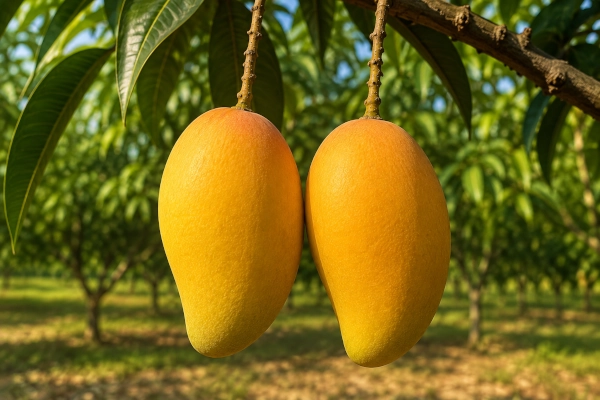
Rataul challenges the assumption that a premium mango must necessarily be large or brightly coloured. According to its official GI specification, the fruit generally weighs around 140 to 220 grams and has an ovate-oblong shape with a rounded base and no strongly pronounced beak. Even when ripe, its skin normally develops a relatively restrained greenish-yellow appearance rather than the brilliant gold associated with some other Indian mango varieties.
The true character of Rataul lies beneath this understated exterior. The pulp develops an attractive medium-orange colour and contains relatively little fibre, giving the fruit a smooth and pleasant eating texture. The official specification records total soluble solids of approximately 18–22° Brix, indicating the high sugar concentration responsible for its pronounced sweetness. This sweetness is accompanied by a particularly strong and pleasant fragrance that has become the cultivar’s most famous identifying feature.
The combination of intense aroma, rich sweetness, soft pulp and limited fibre makes Rataul primarily a table mango. Its comparatively thin skin and tender flesh encourage fresh consumption, although careful handling is required after harvest. Under suitable conditions, the official GI documentation indicates that the fruit can retain acceptable quality for approximately six to eight days at ordinary room temperatures, giving it sufficient keeping quality for movement from orchards to regional markets and potentially to more distant destinations.
Rataul — A Mango Village Near Delhi
The geographical story of the mango begins in Khekra tehsil of Baghpat district, within western Uttar Pradesh and relatively close to the enormous consumer markets of Delhi and the National Capital Region. Despite this proximity to one of India’s largest urban areas, Rataul developed historically as an agricultural settlement whose identity became inseparable from mango orchards.
Baghpat forms part of the fertile Yamuna-Hindon doab, an interfluvial landscape created by the long geological activity of river systems flowing through the western Indo-Gangetic plain. Over thousands of years, these rivers deposited layers of sand, silt and clay, eventually creating deep alluvial soils capable of supporting intensive agriculture. The mango-growing areas around Rataul are characterised particularly by loam and sandy-loam soils, which provide the drainage and root penetration required by mature mango trees.
Climate provides the second major geographical influence. The region experiences cold winters, intensely hot summers and strongly seasonal rainfall, with the overwhelming majority of precipitation arriving during the southwest monsoon between June and September. This seasonal contrast is well suited to mango cultivation because relatively dry winter and early-spring conditions favour flowering, while rising temperatures during spring and early summer support fruit development and sugar accumulation.
The result is a landscape where Rataul cannot be understood simply as a mango cultivar planted in Baghpat. Its reputation emerged through the interaction between the cultivar’s genetics, the soils of the Yamuna-Hindon doab, the region’s pronounced seasonal climate and generations of local orchard management.
The Six-Village Orchard Geography
Although the GI Registry records the geographical area at the broader state level as Uttar Pradesh, the detailed GI specification identifies a much more concentrated traditional production landscape around Rataul. The recognised historic orchard belt includes Rataul, Shekhpuri, Vinaypur, Mubarikpur, Tigri and Lahchoda, all located within Khekra tehsil of Baghpat district.
At the time the GI documentation was prepared, this traditional landscape covered approximately 85 hectares and contained more than 10,000 Rataul mango trees. These figures illustrate the localised nature of the cultivar’s historical identity. Unlike mango varieties whose names became associated with very large production regions, Rataul developed around a comparatively compact cluster of villages whose growers maintained the cultivar through successive generations.
This concentrated geography is central to understanding the GI. The reputation attached to Rataul Mango was not created by statewide production alone. It emerged from a small orchard landscape where particular families, nurseries and growers repeatedly propagated the variety and built recognition for its fragrance and flavour.
The Orchards Before Rataul
The mango history of Rataul predates the cultivar that now bears the village’s name. Historical material incorporated into the GI documentation records that earlier orchards in the region were populated largely by tukhmi, or seedling-grown, mango trees. Because mango seedlings display considerable genetic variation, these older orchards contained trees producing fruit with many different characteristics.
A gradual shift towards grafted mango cultivation began during the nineteenth century. The GI documentation records that around 1874, grafted plants of a variety known as Bambai were brought from Daula village in Baghpat district. A few years later, around 1880, Abdur Razzaq, son of Sheikh Inayat Ali, established approximately 1.5 hectares of mango orchards at Rataul. Other orchardists subsequently introduced additional cultivars, gradually transforming the settlement into a centre where numerous types of mango could be compared, preserved and propagated.
This horticultural diversity created the environment from which the famous Rataul cultivar eventually emerged. The variety was therefore not the product of an isolated event but of a larger orchard culture in which growers were constantly observing trees, exchanging grafting material and evaluating fruit for sweetness, aroma, productivity and appearance.
Sheikh Mohammad Afaq Faridi and the Discovery of Rataul
The official historical account identifies Sheikh Mohammad Afaq Faridi, a grandson of Abdur Razzaq, as the horticulturist most closely associated with the emergence and propagation of Rataul Mango. Faridi developed an extraordinary interest in mango diversity and became known for collecting and maintaining large numbers of cultivars in his nursery.
According to the traditional account preserved in the GI documentation, Faridi once noticed a young mango tree while passing through a farm. He crushed one of its leaves and was struck by its unusual fragrance. His interest in the tree continued until it eventually produced fruit. When he tasted the mature mango, he found its aroma and sweetness sufficiently distinctive to justify preserving the tree through grafting.
The GI record states that four grafted Rataul trees were planted in 1917, followed by another 30 to 40 plants during the following year. Through this deliberate propagation, the desirable characteristics of a single seedling were transformed into a stable cultivar that could be reproduced across orchards.
The story illustrates one of the fundamental processes behind India’s extraordinary mango diversity. Nature produces variation through seedlings, but human observation determines which individuals are considered exceptional. Once an outstanding tree is identified, grafting allows its desirable characteristics to survive beyond the lifespan of the original tree.
The Shohra-e-Afaq Nursery and Hundreds of Mango Varieties
Faridi’s horticultural work expanded considerably when he established the Shohra-e-Afaq Nursery on 7 May 1928. The GI historical record states that the nursery was formally registered in 1935 and eventually maintained a remarkable collection of approximately 461 mango varieties.
Such a collection demonstrates that Rataul emerged from a sophisticated culture of mango observation and selection rather than from commercial monoculture. Growers could compare fruit differing dramatically in aroma, texture, colour, sweetness, bearing behaviour and maturity period. This diversity made it possible to recognise the unusual characteristics of Rataul and preserve them as a distinct cultivar.
The nursery subsequently distributed planting material to other parts of India, helping the variety travel beyond its original village. Nevertheless, Rataul remained the geographical centre of the cultivar’s identity and the source of the reputation that later justified GI protection.
From One Seedling to Thousands of Trees
The continued survival of Rataul’s distinctive characteristics depends upon vegetative propagation, particularly grafting. Planting the seed of an excellent Rataul mango would not reliably produce another genetically identical Rataul tree because mango seedlings contain a new genetic combination and may produce fruit differing considerably from the parent.
Growers therefore reproduce the cultivar by taking suitable scion material from authentic Rataul trees and grafting it onto established rootstocks. The fruit-bearing portion of the resulting plant retains the desirable characteristics of the selected cultivar, allowing the same genetic identity to be maintained across generations.
This biological process gives enormous importance to reliable nurseries and authentic mother plants. A mango orchard represents a long-term investment, and farmers may have to maintain young trees for several years before the fruit can be properly evaluated. If planting material has been incorrectly labelled or comes from inferior sources, the economic consequences may become apparent only after considerable time and expense.
The history of Rataul itself demonstrates why vegetative propagation matters. Without grafting, the extraordinary characteristics identified in one seedling during the early twentieth century could easily have disappeared when that individual tree eventually died.
The Soil Beneath the Rataul Orchards
The official GI documentation connects Rataul cultivation closely with the deep alluvial soils of Baghpat. The region contains mixtures of clay, sand, loam and sandy loam deposited over long periods by the river systems of the western Gangetic plain. Such soils provide a combination of fertility, drainage and depth that can support the extensive root systems of mature mango trees.
Rataul performs particularly well in reasonably well-drained soils. Persistently waterlogged, stony or strongly alkaline conditions can restrict root growth and affect the long-term health of the trees. The official cultivation specification broadly associates suitable soils with a pH range of approximately 5.5 to 7.5, although individual orchard conditions naturally vary.
The significance of the Yamuna-Hindon doab therefore extends far beneath the visible orchard canopy. The geological history of the region created the physical foundation on which generations of mango cultivation became possible, while growers subsequently adapted irrigation and orchard-management practices to local conditions.
A Climate of Cold Winters and Fierce Summers
Rataul experiences some of the strongest seasonal contrasts found in India’s important mango-growing regions. Winters can become cold enough to create frost risks for young trees, while May and June can bring extremely high temperatures accompanied by dry winds.
The GI cultivation record even documents traditional practices used to protect young mango plants from winter cold. Newly planted trees were covered during the coldest periods, and straw could be placed around the lower trunk until the plant became sufficiently established to withstand seasonal temperature fluctuations.
Summer creates the opposite challenge. Hot winds during May can cause developing mangoes to fall prematurely. The official specification notes that Rataul is affected by this phenomenon, although its fruit drop was considered comparatively lower than that observed in some other locally cultivated mango varieties.
At the same time, warm temperatures during fruit development help the mango accumulate sugars and reach its characteristic sweetness when sufficient soil moisture remains available. Successful cultivation therefore depends on maintaining a delicate balance between heat, moisture and tree health.
Flowering and the Approach of the July Harvest
The seasonal timing of Rataul gives it a distinct place within the north Indian mango calendar. According to the GI cultivation record, flowering normally begins during early March, while the fruit generally reaches maturity from early to mid-July.
This places Rataul in the medium-season group rather than among the earliest mangoes harvested in northern India. By the time Rataul begins reaching markets in quantity, consumers have already encountered Dusseheri and several other major varieties.
Rataul therefore competes within a crowded mango season, but its reputation has never depended upon being the earliest fruit available. Its strong fragrance, rich sweetness and distinctive orange flesh provide the characteristics through which consumers recognise it.
For communities around Baghpat, the appearance of mature Rataul mangoes in July becomes one of the recurring agricultural markers of the north Indian summer.
Knowing When a Rataul Mango Is Ready
Harvesting mangoes requires considerably more skill than simply waiting for their skin to become yellow. Fruit intended for transport must normally be collected after achieving physiological maturity but while still sufficiently firm to survive grading, packing and transportation.
The challenge is particularly interesting with Rataul because the skin can remain greenish yellow even as the fruit approaches eating maturity. Colour alone therefore cannot provide a reliable guide to harvesting.
Experienced growers judge the crop through several indicators, including the date of flowering, fruit development, size, shape, firmness and seasonal conditions. Such practical knowledge is accumulated through years of orchard experience and is difficult to replace with a single visual indicator.
Fruit harvested too early may soften without developing the sweetness or aroma expected from the cultivar. Fruit left too long on the tree may become vulnerable to bruising and rapid deterioration. Correct harvest maturity is therefore one of the invisible factors separating an ordinary mango from an exceptional one.
After harvest, the fruit must be sorted and graded. Damaged, diseased, immature or overripe mangoes are separated, while suitable fruit can be packed in ventilated corrugated-fibreboard boxes for transportation.
The Year-Round Work Behind a Mango Orchard
A mature mango tree may survive for many decades, but commercial orchard production requires continuous management. Young Rataul plants need particular attention during their establishment years, when root systems remain relatively limited and the trees are more vulnerable to heat, cold and moisture stress.
Irrigation is adjusted according to tree age, soil type, seasonal weather and the stage of flowering or fruit development. Too little water during critical growth periods can reduce fruit size and increase stress, while excessive irrigation can damage roots and encourage disease. Good drainage is therefore just as important as water availability.
Orchard management also includes nutrition, weed control, pruning, sanitation and the maintenance of healthy tree canopies. These practices demonstrate why geographical indications often involve much more than the natural environment. Soil and climate create the underlying conditions, but generations of human knowledge determine how successfully those conditions are translated into high-quality fruit.
Pests, Diseases and the Risk Behind Every Harvest
Like other mango cultivars, Rataul faces numerous biological threats during the growing season. The official GI specification identifies mango hopper, mealy bug, shoot gall psylla and fruit fly among the important pests capable of damaging the crop.
Weather frequently influences the severity of these problems. High humidity and repeated rainfall can encourage fungal diseases, while changing seasonal conditions can alter insect populations and flowering behaviour. The result is that an orchard’s final yield may remain uncertain for months.
A grower can invest in a crop through flowering and fruit development only to encounter severe losses from hot winds, storms, disease or premature fruit drop. The apparent permanence of a large mango tree therefore hides the considerable risk involved in commercial orchard agriculture.
Traditional experience remains important, but increasingly sophisticated pest surveillance, integrated management and weather-based agricultural advice are becoming necessary for maintaining consistent production.
The Mango Economy of Rataul
For Rataul and its neighbouring villages, mango cultivation represents much more than the sale of fruit. The orchards support an economic network that extends through nurseries, agricultural labour, transportation, packaging, wholesale trade and retail markets.
Nurseries propagate grafted planting material, while orchard workers manage irrigation, pruning, nutrition and plant protection. Labour requirements increase as the season approaches harvest. Mangoes must then be picked carefully, graded according to quality and maturity, packed into suitable containers and transported towards wholesale markets.
Rataul’s location provides a notable advantage because Baghpat lies close to Delhi and the wider National Capital Region. The orchards therefore have access to one of India’s largest and wealthiest fresh-fruit markets without requiring the exceptionally long domestic transport journeys faced by producers in more distant regions.
Yet proximity alone could never have created the mango’s reputation. Consumers returned to Rataul because they recognised the fragrance and flavour associated with the cultivar. The market grew around a sensory reputation built over generations.
The Long Road to Geographical Indication Recognition
The formal journey towards geographical protection began when the Rataul Mango Producers Association filed its GI application on 5 April 2010. The application received GI Application No. 206 under Class 31 for agricultural goods.
The supporting documentation described the cultivar’s history, fruit characteristics, traditional production area, cultivation methods and connection with Rataul and the neighbouring villages of Baghpat district. The application was subsequently advertised through Geographical Indications Journal No. 140, whose published document is dated 31 August 2020.
Formal registration followed when Certificate No. 401 was issued on 14 September 2021, giving legal recognition to an agricultural reputation that the region’s orchardists had been developing for generations.
GI Details at a Glance
- Geographical Indication: Rataul Mango
- State: Uttar Pradesh
- Product: Agricultural
- Class: 31
- Application Number: 206
- Date of Filing: 5 April 2010
- GI Journal: No. 140
- Journal Availability/Publication Date: 31 August 2020 in the published GI Journal document
- Certificate Number: 401
- GI Certificate Date: 14 September 2021
- Registered Proprietor: Rataul Mango Producers Association
- Geographical Area: Uttar Pradesh; the GI specification particularly identifies Rataul, Shekhpuri, Vinaypur, Mubarikpur, Tigri and Lahchoda in Khekra tehsil, Baghpat district
- Registration Valid Until: Not available in APEDA’s current GI listing. The IP India database shows an inconsistent legacy date despite the product remaining listed with Registered status, so a later renewal-validity date should not be stated without Registry confirmation.
What the GI Tag Actually Protects
The geographical indication does not imply that a Rataul mango tree is biologically incapable of growing outside Baghpat. Grafting material can travel, and a cultivar can be planted elsewhere whenever climate and soil permit.
What the GI protects is the geographical reputation attached to Rataul Mango from its recognised producing landscape. This distinction between cultivar identity and geographical identity is central to understanding agricultural GIs.
A cultivar represents inherited biological characteristics. A geographical indication adds the dimension of place, established production tradition and collective reputation. As successful mango cultivars spread beyond their original regions, protecting this distinction becomes increasingly important.
Without effective traceability, fruit cultivated elsewhere can easily be marketed using a famous geographical name. The GI system therefore provides genuine producers with a mechanism for protecting the reputation created by their region while giving consumers a clearer understanding of origin.
From Registration to the Authorised Grower
The effectiveness of a GI depends upon connecting legal registration with the people actually producing the crop. The GI Registry lists authorised users associated with the Rataul production landscape, including growers linked with the protected geographical indication.
This development is important because a certificate by itself cannot improve farmer income. Producers need the ability to use the protected identity commercially, while traders and consumers need reliable mechanisms for identifying genuine fruit.
Traceability, appropriate packaging, authorised-user registration, grading standards and consumer awareness therefore determine whether geographical protection translates into real economic value.
The Rataul Mango Producers Association identified conservation of the variety, expansion of cultivation, improvement of farmer returns and development of quality fruit for domestic and international markets among the objectives associated with its GI effort. The long-term success of the indication will depend on how effectively those goals are translated into the orchard economy.
Rataul Enters India’s International Mango Promotion
Although Rataul remains most strongly associated with northern India’s domestic market, the variety has begun appearing more prominently in India’s overseas mango-promotion programmes.
During the 2025 mango season, APEDA and Indian diplomatic missions showcased Rataul in promotional activities in Saudi Arabia. At a Mango Promotion Festival in Jeddah, the variety appeared alongside Chausa, Langra, Amrapali, Fazli and Mallika. A subsequent business-promotion programme in Riyadh again included Rataul among Indian mangoes presented to retailers, importers and prospective buyers.
Such initiatives are important because India’s international mango identity has historically been dominated by a relatively small number of varieties. Presenting additional regional cultivars allows India to market the extraordinary diversity of its mango heritage rather than competing only through a handful of established names.
For Rataul, fragrance may ultimately become its strongest international selling point. Consumers accustomed to choosing mangoes primarily by size or colour encounter a fruit whose most memorable characteristic becomes apparent only when it ripens and releases its aroma.
The Challenge of Carrying Aroma Across Borders
Exporting a premium mango involves much more than transporting fruit from one country to another. The characteristics that make Rataul valuable—its fragrance, sweetness, tender pulp and low fibre—must survive harvesting, sorting, treatment, packaging, storage and transportation before the fruit reaches the consumer.
Correct harvest maturity is essential. Fruit picked too early may arrive intact but never develop its expected flavour, while fruit harvested too late may suffer bruising or decay before reaching its destination.
Temperature management also becomes critical. Mangoes continue to respire and ripen after harvest, so the supply chain must slow deterioration without damaging the fruit through inappropriate chilling.
For relatively small GI-producing regions, collective infrastructure is particularly important. Individual growers may struggle to establish independent grading centres, pack houses, testing facilities or export-treatment systems. Producer organisations, exporters and APEDA-supported market development can therefore play an important role in transforming Rataul from a locally celebrated mango into a viable premium export product.
Preserving the Mango Diversity Behind Rataul
The history of Rataul also contains a larger lesson about India’s mango heritage. Afaq Faridi’s nursery reportedly maintained hundreds of cultivars, functioning as an extraordinary reservoir of mango diversity long before modern terminology such as germplasm conservation entered mainstream agricultural discussion.
India’s mango diversity was built through generations of observation and exchange. Farmers noticed unusual seedlings, orchardists preserved exceptional trees, collectors exchanged graftwood, and nurseries multiplied cultivars considered valuable.
Some varieties became nationally famous. Others remained restricted to a few villages. Each represents a unique combination of characteristics that may include differences in flowering time, fruit colour, flavour, texture, disease response, shelf life or tolerance to climatic stress.
This diversity has value far beyond cultural nostalgia. Plant breeders may eventually require traits found in relatively obscure cultivars to develop varieties capable of responding to emerging pests, diseases or climatic conditions.
Protecting Rataul should therefore not mean replacing all other local mango trees with Rataul. The deeper agricultural heritage lies in preserving the diversity from which remarkable cultivars such as Rataul originally emerged.
Climate Variability and the Delicate Mango Flower
Climate variability creates a particularly serious challenge for mango cultivation because the eventual harvest depends heavily upon conditions during a relatively short flowering period.
Rataul normally begins flowering around early March. At this stage, unexpected rain, excessive humidity, unusual temperature fluctuations or storms can interfere with pollination and fruit set. Even a large flowering display does not guarantee a strong crop because only a very small proportion of mango flowers ultimately develop into mature fruit.
Later in the season, extreme heat becomes another threat. The traditional Rataul cultivation record already recognises hot winds during May as a cause of fruit drop. Increasingly severe heat events could intensify moisture stress and create additional pressure on orchards unless adequate irrigation and soil-water management are available.
The future of this century-old cultivar may therefore depend increasingly upon combining inherited orchard knowledge with weather forecasting, efficient irrigation, canopy management, integrated pest control and modern post-harvest science.
Protecting the Trees Behind the Certificate
The GI certificate legally protects the name Rataul Mango, but the true geographical indication survives in living orchards. It exists in the grafted trees carrying the cultivar’s genetic identity, in the alluvial soil supporting their roots and in the growers who know how to manage flowering, irrigation and harvest maturity.
If these systems disappear, legal registration alone cannot recreate them.
Mother plants must therefore be conserved, authentic scion material maintained and nurseries encouraged to supply reliable grafted plants. Existing orchards need to remain economically viable, while younger growers need sufficient incentive to continue investing in a crop whose trees may remain productive for decades.
A successful GI should ultimately make conservation economically worthwhile. When farmers receive recognition and better opportunities because they maintain authentic regional produce, geographical protection begins performing the role for which it was designed.
The Fragrant Mango of the Yamuna-Hindon Doab
Rataul Mango tells a story very different from that of India’s largest commercial fruit varieties. Its reputation began in a comparatively small orchard landscape of western Uttar Pradesh, where generations of growers had already been cultivating and collecting mangoes before the famous variety emerged.
A chance seedling produced something unusual. A knowledgeable horticulturist recognised its fragrance and flavour. Grafting transformed that individual tree into a reproducible cultivar, and nurseries gradually carried its descendants into new orchards.
More than a century later, the name of the village itself became legally attached to the fruit through geographical indication protection.
The result is a mango that does not require enormous size or brilliant saffron skin to announce itself. A properly ripened Rataul reveals its identity through aroma, while its understated greenish-yellow exterior conceals orange, sweet and almost fibreless flesh shaped by the hot summers, cold winters and deep alluvial soils of the Yamuna-Hindon doab.
The 14 September 2021 GI registration formally recognised this relationship, but the history behind the certificate stretches through nineteenth-century orchards, Afaq Faridi’s extraordinary mango collection and generations of growers who kept the variety alive around Rataul.
Rataul is therefore not simply a mango variety that borrowed the name of a village. It is an orchard tradition whose geography, horticultural history and fragrance became inseparable from the village that created its reputation.
You may also like
-
India’s Economic Warfare Challenge: Strategic Autonomy, Energy Security and the Rise of a Global Power
-
India-US Trade Deal Stalemate: Why Washington’s Tariff Pressure Has Failed to Secure an Agreement
-
US Double Standards in Foreign Policy: 16 Recent Cases Involving India, Russia, China and Global Trade
-
India’s Arctic Energy Ambitions: Russian Oil, LNG and a New Sea Route to Indian Ports
-
India and Russia Explore Joint Icebreaker Construction as Maritime Industrial Cooperation Expands
