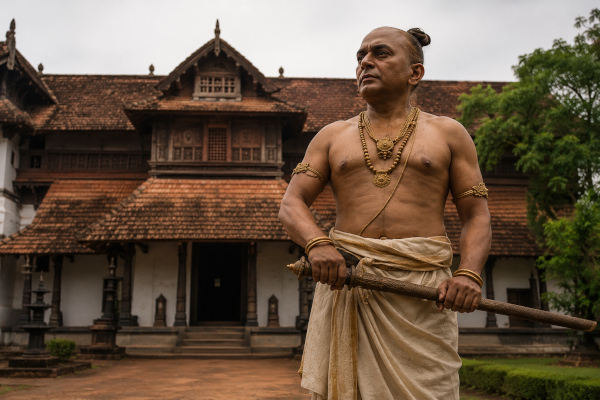
Rama Varma Sakthan Thampuran stands among the most powerful and remembered rulers of the Kingdom of Kochi. His name itself carries the force of his personality. “Sakthan” means strong, and the title suited a king who ruled with firmness, discipline and administrative clarity. He came to power at a time when the Kochi kingdom needed central authority, political order and a ruler capable of controlling rival power centres. His reign from 1790 to 1805 became one of the most decisive periods in the history of Kochi and Thrissur.
Sakthan Thampuran belonged to the Cochin royal family, also known as the Perumpadappu Swaroopam. Before he formally ascended the throne, he had already become an important figure in administration. By the time he became ruler, he had developed a deep understanding of power, revenue, temple administration, local elites and regional politics. This experience shaped his style of kingship. He believed that a kingdom could survive only when authority flowed from the throne with confidence and discipline.
His greatest political achievement was the strengthening of royal power. In the older structure of Kerala society, many local chieftains, temple authorities and influential families held strong control over land, revenue and public affairs. Sakthan Thampuran reduced the influence of feudal power centres and brought administration directly under the authority of the state. His rule marked the movement of Kochi from a medieval pattern of scattered authority toward a more centralised political order.
This centralisation gave Kochi a stronger administrative backbone. Sakthan Thampuran treated disorder as a threat to the kingdom. He expected obedience from officials, discipline from local chiefs and accountability from those who handled public responsibilities. His methods were remembered as strict, and this strictness became part of his legend. In the political world of his time, firmness was a tool of survival. Kochi stood between powerful neighbours, European trading interests and internal factions. A weak court could have lost control. Sakthan Thampuran gave the throne a commanding presence.
His connection with Thrissur is the most enduring part of his legacy. Thrissur owes much of its modern identity to his vision. He saw the town as a place of religious importance, cultural energy and administrative potential. Around the great Vadakkumnathan Temple lay a dense area that he transformed into a planned civic and ceremonial centre. The clearing and organisation of the space around the temple created the foundation for Thekkinkadu Maidan, the great open ground that still forms the heart of Thrissur.
This was urban planning with cultural intelligence. Sakthan Thampuran understood that a city requires a centre, and Thrissur found its centre around Vadakkumnathan Temple and Thekkinkadu Maidan. The circular arrangement around this sacred and civic space later grew into the famous Swaraj Round. Even today, the movement, memory and rhythm of Thrissur revolve around this central zone. Markets, festivals, processions, public gatherings and cultural life all carry the imprint of his planning.
The Shakthan Thampuran Palace in Thrissur remains a physical reminder of his age. Reconstructed in 1795, the palace reflects a blend of Kerala and Dutch architectural styles. Its thick walls, high doors, spacious rooms, tiled roofs and traditional inner courtyard show the meeting point of royal Kerala architecture and colonial-era influence. The palace later became a heritage museum, preserving the memory of Kochi’s royal past and the ruler who gave Thrissur its defining shape.
Sakthan Thampuran’s most beloved contribution to Kerala’s cultural history is Thrissur Pooram. Before Thrissur Pooram became the grand festival known across the world, temple festivals in central Kerala followed older local patterns. Sakthan Thampuran brought several temples together into a structured, spectacular and disciplined festival centred around Vadakkumnathan Temple. He organised participating temples into groups and gave the event a ceremonial order that continues to guide its spirit.
Thrissur Pooram became more than a religious festival. It became a statement of civic unity. It brought temples, musicians, elephant processions, percussion traditions, artisans, devotees and spectators into one great public celebration. The festival displayed Kerala’s ritual discipline, visual splendour and musical power in a single space. Sakthan Thampuran’s genius lay in turning temple rivalry and local devotion into a larger shared spectacle. He created a cultural institution that outlived kings, dynasties and political changes.
The Pooram also shows his understanding of public emotion. A ruler who controls only armies and taxes leaves behind fear. A ruler who shapes festivals, cities and cultural memory leaves behind belonging. Sakthan Thampuran used authority to create order, and he used cultural imagination to create identity. That is why Thrissur remembers him through both palace and festival, through both administration and celebration.
His reign must also be understood in the wider political climate of Kerala. The 18th century had brought the pressure of Mysorean invasions, European trading powers, local conflicts and shifting alliances. Kochi needed practical diplomacy and internal strength. Sakthan Thampuran balanced the requirements of statecraft with the realities of his time. He dealt with power directly and understood the need to protect the kingdom’s autonomy within a changing world.
His rule brought a transition in Kochi’s political character. The older age of feudal fragmentation gradually gave way to a stronger state structure. His reforms, decisions and disciplinary actions created a more organised kingdom. This is why later memory often describes his period as a turning point. He was a ruler who pushed Kochi toward a more modern administrative phase while remaining rooted in the traditional structure of monarchy.
Sakthan Thampuran’s legacy lives most powerfully in Thrissur. The city’s identity as Kerala’s cultural capital carries his signature. The open ground around Vadakkumnathan Temple, the flow of Swaraj Round, the grandeur of Thrissur Pooram, the memory of the palace and the city’s deep cultural confidence all point back to his age. Few rulers are so closely tied to the making of a city. Thrissur remembers him not merely as a king who ruled from a palace, but as a builder who gave the city its heart.
Rama Varma Sakthan Thampuran was a ruler of strength, order and vision. He strengthened Kochi’s royal authority, reshaped Thrissur’s civic space and created one of Kerala’s greatest cultural festivals. His memory stands at the meeting point of power and culture. In him, Kerala saw a king who could command a kingdom, discipline its institutions and still leave behind a festival of colour, rhythm and collective pride. That is why Sakthan Thampuran remains one of the most famous kings of Kochi and one of the true makers of Thrissur.
References:
- District Thrissur, Government of Kerala — History of Thrissur and Sakthan Thampuran
https://thrissur.nic.in/en/history/ - Kerala Tourism — Shakthan Thampuran Palace, Thrissur
https://www.keralatourism.org/kerala-article/2023/shakthan-thampuran-palace-architecture-thrissur/1298 - Kerala Tourism — Thrissur Pooram
https://www.keralatourism.org/event/thirssur-pooram/7/ - Kerala Tourism — Thrissur District, Cultural Capital of Kerala
https://www.keralatourism.org/districts/thrissur/
You may also like
-
Tamralipta — The Maritime Gateway of the Lower Ganga
-
Suhma — The River-and-Forest Country of Southwestern Bengal
-
Gauda — The Western Bengal Country of the Bhagirathi and the Rise of Karnasuvarna
-
Pundra — The Northern Bengal Kingdom of the Karatoya and the Ancient City of Pundranagara
-
Vanga — The River Kingdom of the Bengal Delta and the Eastern Sea
