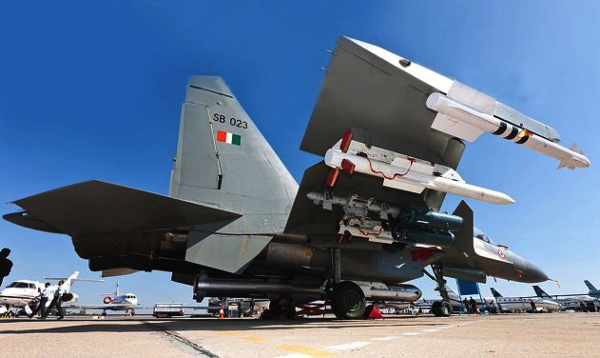
The Indian Air Force has finalised a raft of purchases worth Rs 7,500 crore including missiles, precision-guided bombs and latest avionics in the last two months, official sources said. The purchases included procurement of a batch of air-to-air missiles from Russia at a cost of around Rs 1,000 crore to make the Sukhoi fighter fleet of the IAF more lethal, they said. Last month, the government signed a Rs 300 crore deal with an Israeli defence firm to procure a batch of SPICE 2000 guided bombs. The IAF had used SPICE bombs in its strikes on a terrorist training camp in Pakistan’s Balakot on February 26.
The purchases are being made based on a plan finalised by the IAF to address its short-term requirements. After the Balakot strikes and subsequent Pakistani retaliation, the government is undertaking several measures to strengthen the IAF’s combat prowess. The government has recently decided to fast-track integration of Brahmos supersonic cruise missiles into over 40 Sukhoi fighter jets under a closely-guarded project. Official sources said modernisation of the IAF is a key priority area for the government and a raft of purchases worth around Rs 7,500 crore were sanctioned since the Modi government came to power for the second time on May 30.
Sources said the government had carried out a review of the IAF’s February 26 airstrikes deep inside Pakistan’s Balakot and the consensus was that the adversary would not have dared to retaliate the next day if India possessed superior air defence system as well as strike capability. In this context, the government decided to take a series of steps to bolster the IAF’s overall combat capability, they said.
Source: N18
Image Courtesy: DW
You may also like
-
Indian Navy Targets Historic Induction of 18 Warships in 2026
-
CSIR-CGCRI and DRDO Advance Lightweight Bullet-Resistant Glass-Ceramic Armour for Military Platforms
-
BonV Aero Supplies 45 Indigenous Logistics Drones to Indian Army Eastern Command
-
Paras Defence Wins ₹26.59 Crore DRDO Order for Hyperspectral Mission Optics
-
Bharat Forge and Kadet Defence Showcase New Long-Range UAV at IAF Dronothon 2026
