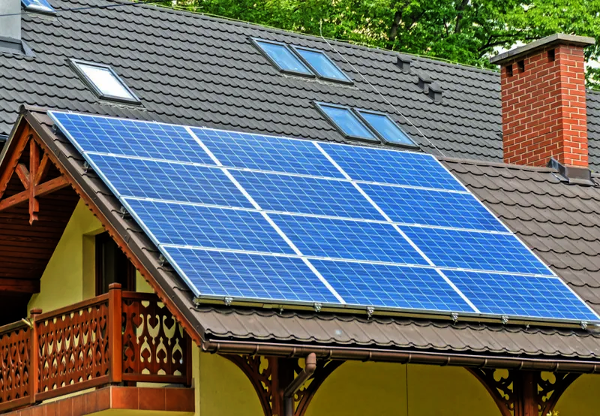
India’s rooftop solar mission has entered a faster growth phase, with the Union Government setting its sights on 75 lakh households under the PM Surya Ghar: Muft Bijli Yojana by December 2026. Union New and Renewable Energy Minister Shri Pralhad Joshi said the scheme has already crossed 40 lakh beneficiary households within two years, showing strong public participation and rapid adoption across the country.
The announcement came during the event “Two years of PM Suryaghar Muft Bijli Yojana: Scaling the solar home to 1 crore rooftops,” where the Ministry of New and Renewable Energy reviewed the progress of one of India’s most ambitious residential clean-energy programmes. The scheme was launched on 13 February 2024 with an outlay of ₹75,021 crore and has now become the world’s largest domestic rooftop solar programme.
One of the most important new steps is the Utility-Linked Aggregation model. This model is designed to speed up rooftop solar adoption, especially among underserved households. Under this approach, around 30 lakh rooftop solar installations have already been planned across States, with power utilities expected to play a central role in execution. The model is particularly aimed at families consuming between 1 kW and 3 kW of electricity, helping them access affordable clean power more easily.
The public response to the scheme has been strong. More than 65 lakh applications are already in the pipeline, while over 1 crore households have registered on the National Portal. As of May 2026, more than 33 lakh rooftop systems had been installed, adding over 12 GW of capacity. Rooftop solar now accounts for nearly 45 percent of residential solar capacity, with deployment growth rising to 85 percent during 2024–2026.
India’s solar expansion is also accelerating at the national level. The country’s first 50 GW of solar capacity took 96 months, the next 50 GW took 36 months, and the jump from 100 GW to 150 GW took only 14 months. Total solar capacity crossed 150 GW as of March 2026, strengthening India’s path towards the target of 500 GW non-fossil fuel capacity by 2030.
May 2026 became the strongest month since the launch of the PM Surya Ghar scheme, with a record 3.16 lakh rooftop solar installations in a single month. The programme also added 15,000 households in just one day. The pace of adding one lakh households has improved sharply from 118 days earlier to less than eight days now, showing how quickly rooftop solar is becoming a mainstream household energy option.
The scheme is also creating direct financial benefits for families. More than ₹22,750 crore in subsidies has been disbursed so far, including ₹2,743 crore in May 2026 alone. Over 17 lakh households have already achieved zero electricity bills, turning rooftop solar into a visible household saving tool rather than only a climate or energy policy programme.
The larger strategic value of the scheme is equally important. At a time when global energy markets face uncertainty, rooftop solar gives India a decentralised source of power generation. Every solar home reduces pressure on the grid, lowers dependence on conventional energy sources and strengthens energy security at the household level. It also helps reduce subsidy pressure on electricity distribution companies while encouraging citizens to become active participants in the clean-energy transition.
The government is also preparing for the next phase of rooftop solar growth. Battery Energy Storage Systems are expected to be integrated as storage costs decline, while the Model Solar Village initiative will expand solar adoption at the community level. During the event, the PM Surya Ghar logo and WhatsApp bot were also launched to improve public outreach and access to scheme-related information.
The PM Surya Ghar mission now stands at the centre of India’s household energy transformation. It combines clean power, lower electricity bills, domestic energy security, employment opportunities and citizen participation. From 40 lakh solar-powered homes today to the target of 75 lakh households by December 2026, the programme is turning rooftops into power assets and making solar energy a people-driven movement.
You may also like
-
India’s Economic Warfare Challenge: Strategic Autonomy, Energy Security and the Rise of a Global Power
-
India-US Trade Deal Stalemate: Why Washington’s Tariff Pressure Has Failed to Secure an Agreement
-
US Double Standards in Foreign Policy: 16 Recent Cases Involving India, Russia, China and Global Trade
-
India’s Arctic Energy Ambitions: Russian Oil, LNG and a New Sea Route to Indian Ports
-
India and Russia Explore Joint Icebreaker Construction as Maritime Industrial Cooperation Expands
