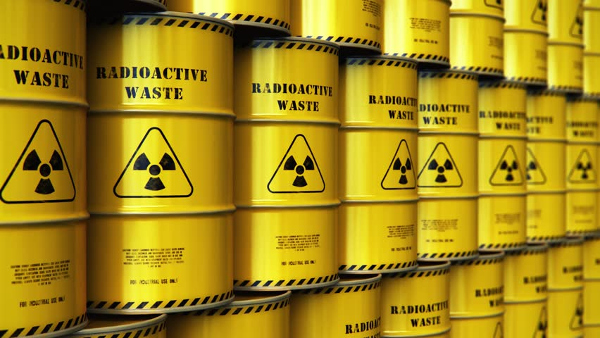
New Delhi: India has adopted “closed fuel cycle”, where spent nuclear fuel is regarded as a material of resource. Closed fuel cycle aims at reprocessing of spent fuel for recovery of Uranium and Plutonium and recycling them back to reactor as fuel. This finally leads to a very small percentage of residual material present in spent nuclear fuel requiring their management as radioactive waste.
Safe management of radioactive waste has been accorded high priority right from the inception of our nuclear energy programme. High level radioactive waste also contains many useful isotopes like Caesium-137, Strontium-90, Ruthenium-106 etc. With the advent of new technologies based on partitioning of waste, emphasis is accorded to separation and recovery of these useful radio-isotopes so as to make use of the waste for various societal applications.
Initiatives/advancements w.r.t. partitioning of the waste have been implemented safely and successfully enabling recovery of useful radio- isotopes like Caesium-137, Strontium-90, Ruthenium-106 etc. and their deployment for societal applications. Utmost emphasis is given to waste volume minimization, effective containment and isolation of radio-activity followed by near zero discharge of radioactivity to the environment.
As a waste management philosophy, no waste in any physical form is released / disposed to the environment unless the same is cleared, exempted or excluded from regulations. A comprehensive radioactive waste management is established taking into account the operational capability for the management of radioactive waste and an independent regulatory capability for its overview. The nuclear waste management practices are at par with international practices following the guidelines of International Atomic Energy Agency.
Source: Press Information Bureau
Image Courtesy: Shutterstock
You may also like
-
Puralink Builds Autonomous Ferret Robot for Underground Pipe Inspection and Mapping
-
India’s National Highway Network Expands 61% to More Than 1.46 Lakh Kilometres
-
ULOOK Develops Space-Based RF Intelligence Platform as It Joins Peak XV Surge 12
-
TDB Backs Multi Nano Sense With ₹37.51 Crore to Build Indigenous Multi-Gas Sensor Platform
-
Textiles Ministry Plans 5,000–10,000 New Exporters as India Expands District-Led Textile Export Push
