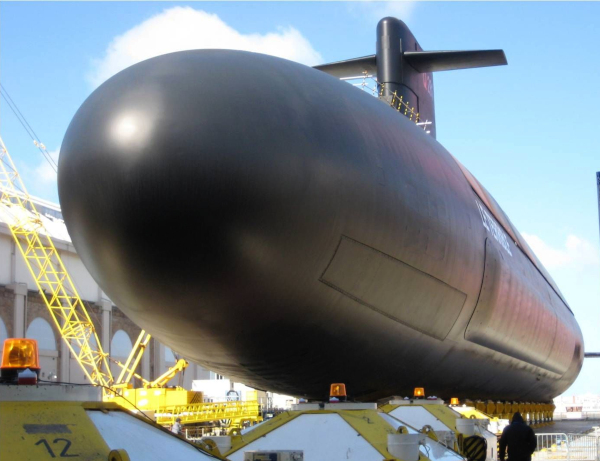
After more than two decades of planning, restructuring and repeated delays, India’s Project 75I submarine programme has reached its most advanced stage yet. The Indian Navy plans to acquire six next-generation conventional submarines equipped with Air Independent Propulsion, advanced weapons and modern sensors.
Germany’s ThyssenKrupp Marine Systems (TKMS) and India’s Mazagon Dock Shipbuilders Limited (MDL) have emerged at the centre of the programme. The submarines are planned for construction in India, with extensive transfer of technology and progressively higher indigenous content.
The programme was originally estimated at more than ₹40,000 crore when the formal tender process began. Current estimates place its value much higher, commonly between ₹70,000 crore and ₹90,000 crore, depending on the final configuration, technology package and associated equipment.
Project 75I is not simply another submarine purchase. India wants the programme to create domestic capability to manufacture, maintain and eventually design advanced conventional submarines.
That ambition also helps explain why negotiations have taken so long.
Project 75I Has Its Roots in India’s 30-Year Submarine Plan
The roots of the programme go back to July 12, 1999, when the Cabinet Committee on Security approved a 30-year plan for the serial construction of submarines for the Indian Navy.
The government envisaged submarine construction in two phases, with the second phase moving towards greater indigenous capability.
The first major result was Project 75, under which MDL constructed six Kalvari-class submarines based on the French Scorpene design.
That programme is now complete. The sixth submarine, INS Vaghsheer, was commissioned on January 15, 2025. The Ministry of Defence confirmed that all six Project 75 submarines had then been delivered and commissioned.
Project 75I represents the next technological step.
It should not be confused with Project 75. The new submarines are expected to offer greater underwater endurance, modern combat systems and an operational fuel-cell AIP system from the outset.
Formal Approval Came in 2019
A major breakthrough came on January 31, 2019, when the Defence Acquisition Council approved indigenous construction of six Project 75I submarines.
The project was then valued at more than ₹40,000 crore.
The government chose to pursue it through the Strategic Partnership model. Under this system, an Indian shipbuilder would work with a foreign original equipment manufacturer to manufacture the submarines in India.
The stated objective went beyond assembling six vessels. India wanted transfer of submarine design and equipment technologies, development of specialised skills and creation of a domestic submarine manufacturing ecosystem.
The 2021 Tender Set Demanding Requirements
On July 20, 2021, the Ministry of Defence issued the formal Request for Proposal for six Project 75I submarines.
The tender went to Mazagon Dock Shipbuilders Limited and Larsen & Toubro as the shortlisted Indian strategic partners.
Five foreign submarine manufacturers had been shortlisted at that stage:
- TKMS of Germany
- Naval Group of France
- JSC Rosoboronexport of Russia
- Daewoo Shipbuilding and Marine Engineering of South Korea
- Navantia of Spain
The Navy demanded considerably more than a standard diesel-electric submarine.
The vessels were required to incorporate a fuel-cell-based Air Independent Propulsion system, advanced torpedoes, modern missiles, sophisticated sensors and modern countermeasure systems.
Technology transfer was also central to the programme.
The foreign partner was expected to help establish manufacturing infrastructure in India and transfer technologies covering submarine design, manufacturing and maintenance.
These requirements made Project 75I one of India’s most complex defence acquisition programmes.
Why Air Independent Propulsion Matters
Conventional submarines normally rely on batteries while submerged.
Those batteries must eventually be recharged by diesel engines. This requires the submarine to surface or raise a snorkel mast, increasing its vulnerability to detection by aircraft, ships, satellites and other surveillance systems.
An Air Independent Propulsion system allows a conventional submarine to generate power underwater without relying continuously on atmospheric oxygen.
This extends submerged endurance and reduces the frequency with which a submarine must expose itself.
For the Indian Navy, which operates across the Arabian Sea, Bay of Bengal and wider Indian Ocean, greater underwater endurance has obvious operational value.
It also became one of the toughest conditions in the Project 75I competition.
The Navy wanted an AIP technology with demonstrated operational maturity rather than an experimental system.
TKMS and MDL Move to the Front
Over time, the competition narrowed considerably.
The MDL-TKMS combination ultimately became the leading team, with the German company offering its established submarine technology and fuel-cell AIP expertise.
TKMS officially confirmed on September 11, 2025 that it and MDL had begun formal contract negotiations with the Indian procurement authorities for six German-developed submarines.
The company also confirmed that MDL and TKMS had completed work under their Concept Design Agreement by August 31, 2025.
TKMS subsequently submitted binding offers covering engineering services, submarine components, AIP systems and combat-system solutions.
That represented a significant change in Project 75I’s status.
The programme had moved beyond evaluations and competitive trials into detailed contract negotiations.
Six Submarines to Be Built in India
Under the emerging arrangement, all six submarines are expected to be manufactured at MDL’s Mumbai facilities.
TKMS would provide the submarine design, engineering support, critical technologies and AIP-related systems.
India’s objective is to progressively increase domestic participation.
Current reports indicate that indigenous content could begin at around 45 per cent in the first submarine and rise towards 60 per cent in later vessels.
This progression matters almost as much as the submarines themselves.
Building a submarine requires specialised capability in pressure-hull fabrication, metallurgy, propulsion, acoustic management, combat-system integration, underwater sensors, weapons and complex electrical systems.
A deep technology-transfer arrangement could therefore influence India’s future indigenous submarine programmes.
What Kind of Submarine Will India Get?
The precise final design configuration has not yet been publicly released by the Ministry of Defence.
Reports have broadly linked the proposal with a next-generation development of TKMS’s Type 214 family.
What has been officially established is the basic requirement.
The Navy wants six modern conventional submarines featuring fuel-cell AIP, advanced torpedoes, missiles, sensors and state-of-the-art countermeasures.
TKMS has separately confirmed that its offer includes advanced submarine components and AIP technology.
Until the contract is signed and detailed specifications are formally released, claims about displacement, exact missile types, sonar configurations and maximum submerged endurance should therefore be treated cautiously.
Why Has Project 75I Taken So Long?
Project 75I’s lengthy journey reflects several overlapping problems.
The first is technology.
India did not simply want six imported submarines. It sought a proven AIP system, substantial domestic manufacturing, technology transfer and access to expertise that could help build an indigenous submarine-design capability.
The second issue was commercial responsibility.
Submarine programmes involve enormous technological and financial risks. Questions involving warranties, intellectual property, liability, design responsibility and technology transfer required extensive negotiation between Indian yards, foreign manufacturers and the government.
The third challenge involved the tender itself.
Several manufacturers that were initially considered did not remain viable throughout the process. The demanding requirement for proven AIP technology significantly narrowed the field.
Finally, the programme had to balance immediate naval requirements against India’s longer-term objective of becoming technologically independent.
That combination turned what could have been a straightforward foreign procurement into a strategic industrial programme.
Project 75I Has Become More Urgent
Time has also increased the programme’s importance.
The Indian Navy still operates ageing conventional submarines that will eventually need replacement.
Meanwhile, China has continued expanding its submarine force and maintaining a growing naval presence across the Indian Ocean.
Pakistan is also modernising its underwater fleet.
For India, submarine strength is therefore about much more than maintaining numbers.
Modern submarines provide surveillance, intelligence gathering, sea denial, anti-ship warfare, anti-submarine warfare and covert special-forces capabilities.
Their greatest strategic advantage comes from uncertainty. An adversary that does not know where a submarine is must devote significant resources to finding it.
The longer a submarine can remain underwater without exposing itself, the more difficult that problem becomes.
India-Germany Defence Cooperation Gives Project New Momentum
Project 75I has also developed into one of the most important potential defence-industrial collaborations between India and Germany.
Germany’s Defence Minister Boris Pistorius said in April 2026 that he was highly confident the agreement would be signed soon. At that stage, he expected a conclusion within roughly three months. Reuters valued the proposed cooperation at around $8 billion.
The negotiations have taken longer than that forecast, but they have continued to advance.
The programme is now far closer to contract signature than at any previous stage.
Finance Ministry Clearance Moves Deal Towards CCS
Another major development came in May 2026.
Reports said the Union Finance Ministry had cleared the Project 75I proposal, then valued at around ₹70,000 crore, clearing the way for consideration by the Cabinet Committee on Security.
The first submarine is expected to be delivered approximately seven years after the contract is signed, with subsequent submarines following at roughly one-year intervals, according to the same reporting.
The financial figure has continued to vary as negotiations progressed.
By June and August 2026, several reports placed the programme closer to €8 billion or approximately ₹90,000 crore.
The difference illustrates why the final contract value should not yet be treated as fixed.
Technology Transfer Became the Final Major Question
By June 30, 2026, negotiations had entered their final phase.
Defence sources said a detailed review of the technology-transfer package offered by TKMS remained a major step before the proposal could go to the CCS.
The review was intended to determine whether India would receive enough technological depth to justify the enormous investment.
This is particularly significant because India does not want to remain dependent on foreign designers indefinitely.
The knowledge gained through Project 75I could feed directly into future Indian submarine programmes and strengthen domestic maintenance and upgrade capabilities.
German Ambassador Says Agreement Is Close
The sense that Project 75I was finally approaching conclusion strengthened in late July.
On July 30, 2026, German Ambassador to India Philipp Ackermann said he was confident the submarine agreement would be signed “very soon”, indicating that it could happen within the following month.
At that stage, reports continued to indicate that the programme was awaiting final CCS clearance.
The statement was significant because Germany has strong commercial and strategic interests in bringing the project to completion.
For TKMS, India would become one of its most important submarine production partnerships outside Germany.
For India, the relationship could provide access to decades of German experience with fuel-cell AIP and conventional submarine design.
A Potential ₹90,000-Crore Boost for Mazagon Dock
Project 75I would also dramatically transform MDL’s future workload.
Recent Financial Express analysis, citing Antique Stock Broking, estimates the programme at around ₹90,000 crore. It says P75I, together with other potential naval programmes, could contribute to an MDL order pipeline exceeding ₹2.9 lakh crore.
That projection should not be confused with confirmed orders.
Much of the ₹2.9-lakh-crore figure represents a prospective order funnel dependent on future government approvals.
However, Project 75I alone would represent one of the largest contracts ever awarded to the shipyard.
It would also sustain specialist submarine construction skills in India well into the next decade.
Project 75 and Project 75I Serve Different Purposes
The similarity in their names sometimes creates confusion.
Project 75 involved six French-designed Scorpene submarines built by MDL. That programme concluded with the commissioning of INS Vaghsheer in January 2025.
Project 75I, meanwhile, involves another six submarines built under a different programme and with a much stronger emphasis on operational AIP, technology transfer and future indigenous design capability.
The two programmes should therefore be viewed as successive stages in India’s long-term submarine-building strategy rather than as extensions of the same contract.
Project 75I Could Shape India’s Future Submarines
The long-term importance of P75I may ultimately exceed the six submarines themselves.
India wants the programme to create engineering knowledge that can be retained inside the country.
That includes submarine design, production, system integration, maintenance and lifecycle support.
The Ministry of Defence explicitly stated when issuing the RFP that one of the programme’s goals was to establish India as a global hub for submarine design and production through technology transfer and domestic manufacturing.
Achieving that objective would make Project 75I an industrial capability-building programme rather than a simple purchase.
Updated Status — August 17, 2026
Project 75I has not yet crossed the final contractual finish line.
The latest available information indicates that MDL and TKMS remain the leading combination for construction of the six submarines in India. Formal contract negotiations began in September 2025, as officially confirmed by TKMS.
The Finance Ministry has reportedly cleared the proposal, while subsequent reports have placed the programme at the final approval stage before the Cabinet Committee on Security.
Recent defence-sector analysis also indicates that contractual negotiations for major programmes, including P75I, have been largely completed, leaving final approvals as the principal trigger before order placement.
However, as of August 17, 2026, I could find no official Ministry of Defence, PIB, MDL or TKMS announcement confirming that the CCS has given final approval or that the ₹70,000–90,000 crore Project 75I contract has actually been signed.
That distinction is important.
The programme appears to be in its final clearance phase, not yet in the contract-execution phase.
If CCS approval arrives and the contract is signed, India will finally move from nearly three decades of planning towards construction of a second generation of advanced conventional submarines.
More importantly, Project 75I could give India something strategically more valuable than six additional boats: a deeper domestic capability to design, build and sustain the submarines that follow them.
Official and Primary Sources
Ministry of Defence / PIB — December 12, 2014: Confirms that the CCS approved India’s 30-year submarine construction plan on July 12, 1999.
Ministry of Defence / PIB — January 31, 2019: Confirms DAC approval for indigenous construction of six Project 75I submarines under the Strategic Partnership model.
Ministry of Defence / PIB — July 20, 2021: Official Project 75I RFP detailing six AIP-equipped submarines, weapons, sensors, technology transfer and domestic construction requirements.
TKMS — September 11, 2025: Official confirmation that TKMS and MDL entered contract negotiations with India’s procurement authority and completed their Concept Design Agreement work.
Ministry of Defence Year-End Review 2025: Confirms completion of Project 75 with all six Kalvari-class submarines commissioned.
Latest-status references: Reuters, India Today and Financial Express reporting on negotiations, approvals and the estimated programme value.
You may also like
-
Astra Microwave Expands Counter-Drone Capabilities with Layered Detection and Neutralisation Systems
-
MDL Begins Development of Indigenous Lithium-Ion Battery System for Project-75(I) Submarines
-
Tarang Shakti Delegates from 28 Countries Visit HAL and BEL to Explore India’s Defence Manufacturing Ecosystem
-
India’s 114 Rafale Fighter Jet Programme Moves Towards Final Decision with Focus on Indigenous Integration
-
Embraer and Mahindra Identify Nagpur as Potential C-390 Millennium Assembly Hub in India
