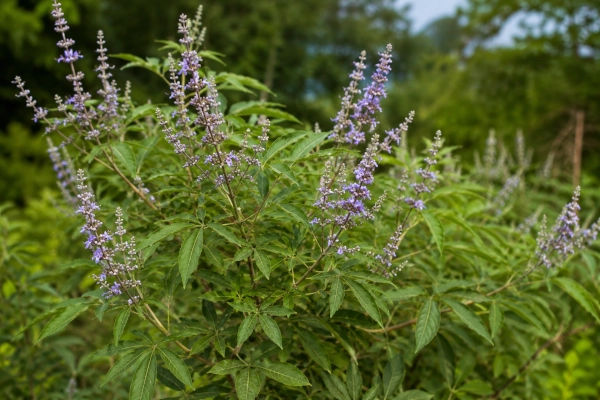
Sanskrit name: Nirguṇḍī / Nirgundi
Botanical name: Vitex negundo L.
Family: Lamiaceae
Older botanical classification: Verbenaceae
English name: Five-leaved chaste tree / Chinese chaste tree
Common Indian names: Nirgundi, Sindhuvara, Sambhalu
Tamil: Nochi
Malayalam: Karinochi
Kannada: Bile-Nekki / Lakki
Nirgundi is one of the better-known aromatic medicinal shrubs of Ayurveda, particularly associated with the management of Vata disorders, painful joints, swelling, muscular stiffness and inflammatory conditions. Its strongly aromatic leaves have traditionally been used both internally in Ayurvedic preparations and externally as pastes, oils, fomentations and medicated washes.
The accepted botanical species is Vitex negundo L., presently placed in the family Lamiaceae. Kew describes it as a shrub or small tree native across a vast region extending from eastern Africa and Iran through the Indian subcontinent to East and Southeast Asia. India forms an important part of its natural distribution.
The National Medicinal Plants Board of the Ministry of AYUSH recognises Nirgundi as Vitex negundo and includes it among India’s medicinal plants considered important for cultivation.
Botanical Description
Nirgundi commonly grows as a large shrub or small tree and may reach several metres in height. Its leaves are characteristically divided into several leaflets, commonly three to five, and release a distinct aromatic smell when crushed. The lower surface of the leaf is generally paler and hairy, while the margins may be entire or slightly toothed. Kew records Vitex negundo as an aromatic shrub or tree that can grow to around four metres in height.
The flowers are usually small and bluish-purple to violet and occur in branching clusters. The fruits are small, rounded and darken as they mature. The aromatic nature of the foliage is one of the plant’s easiest field-identification characteristics.
Nirgundi grows readily along village boundaries, roadsides, riverbanks, wastelands, forest margins and open countryside. Its ability to withstand seasonal dryness has contributed to its widespread occurrence across the Indian landscape.
Nirgundi in Ayurveda
Nirgundi is not merely a plant adopted by later folk medicine. References associated with the drug occur within the classical Ayurvedic tradition.
The Charaka tradition records Nirgundi or related synonyms such as Sindhuvarika, Shephali, Samhalu and Harenu in several therapeutic contexts. It appears in discussions concerning Krimighna, or substances used against worms and undesirable organisms, as well as in external applications, fumigation-related preparations and formulations associated with Vata disorders. The Charaka database also records Nirgundi Taila in the context of Vata-related treatment.
Traditional Ayurvedic pharmacology particularly values Nirgundi as a Vata-Kapha Shamaka dravya, meaning a substance capable of pacifying aggravated Vata and Kapha when appropriately administered.
Its reputation as an herb for painful and swollen joints arises naturally from this Ayurvedic understanding.
Ayurvedic Properties — Rasa Panchaka
Rasa — Taste
Katu — pungent
Tikta — bitter
Some traditional descriptions additionally mention a degree of Kashaya, or astringency, although Katu and Tikta are the most consistently cited tastes.
Guna — Qualities
Laghu — light
Ruksha — dry
These qualities help explain its traditional application where Kapha, heaviness, congestion and excessive unctuousness are considered prominent.
Virya — Potency
Ushna — heating
The heating nature of Nirgundi is particularly important in its traditional use for conditions characterised by coldness, stiffness and aggravated Vata-Kapha.
Vipaka — Post-Digestive Effect
Katu — pungent
Effect on Doshas
Vatahara — pacifies aggravated Vata
Kaphahara — pacifies aggravated Kapha
Because of its Ushna Virya, Nirgundi is particularly valued when Vata manifests together with stiffness, coldness or obstruction by Kapha.
Pitta-dominant conditions require more careful consideration because the plant is heating and drying.
Principal Ayurvedic Actions
Vedanasthapana — Relieving Pain
One of the most celebrated traditional actions of Nirgundi is Vedanasthapana, referring to its use in conditions dominated by pain.
Ayurvedic practitioners have consequently employed Nirgundi preparations in painful joints, muscular discomfort, backache, neuralgic pain and Vata-related stiffness.
Its association with pain management is sufficiently prominent that Ayurvedic pharmacological literature groups Nirgundi among important Vedanasthapana herbs.
Shothahara — Reducing Swelling
Nirgundi is traditionally considered Shothahara, meaning useful in managing swelling.
This action forms the foundation of many traditional external applications of Nirgundi leaves. Warm leaves, leaf paste or Nirgundi-based oils have traditionally been applied to swollen joints and painful tissues.
The combination of Tikta and Katu Rasa, Ushna Virya and Vata-Kapha pacifying activity makes Nirgundi particularly characteristic of Ayurvedic treatment approaches to swelling associated with stiffness and impaired movement.
Nirgundi for Sandhi and Musculoskeletal Disorders
Nirgundi has acquired perhaps its greatest popular reputation as a plant for the joints, muscles and nerves.
Ayurveda associates pain, stiffness, restricted mobility and degeneration largely with disturbances of Vata. When Kapha or Ama contributes heaviness, swelling and obstruction, treatment generally requires herbs possessing heating, penetrating and Kapha-reducing properties.
Nirgundi fits this profile remarkably well.
It has therefore traditionally been incorporated into therapies for conditions corresponding broadly with:
- Sandhishula — joint pain
- Sandhishotha — joint swelling
- Katishula — lower-back pain
- Gridhrasi — disorders resembling sciatica
- Amavata — inflammatory joint disease associated with Ama
- muscular stiffness
- painful sprains
- Vata-related limb discomfort
These are Ayurvedic therapeutic categories rather than direct equivalents of modern biomedical diagnoses.
Nirgundi and Amavata
Amavata represents an important Ayurvedic condition in which Ama combines with disturbed Vata and becomes lodged particularly within the joints.
The resulting picture may involve pain, swelling, stiffness, heaviness and restriction of movement.
Nirgundi’s Katu and Tikta Rasa, Ushna Virya and Vata-Kaphahara properties make it traditionally relevant to this type of presentation. Ayurvedic literature discussing Amavata consequently recognises Nirgundi particularly for its Vedanasthapana, Vatashamaka and Ama-related actions.
It should nevertheless not be interpreted as a substitute for medical assessment in rheumatoid arthritis or another inflammatory joint disease.
External Application of Nirgundi
External use is one of the most distinctive features of Nirgundi in traditional Indian medicine.
The fresh leaves may traditionally be warmed before being used as part of a local application to painful or stiff areas. Leaf paste is also described in classical and regional practice.
Nirgundi is additionally processed into medicated oils used during massage and local Ayurvedic therapies.
Heating the leaves also releases their strongly aromatic volatile constituents, which explains their traditional use in forms of herbal fomentation.
The aim of these practices is generally to combine the qualities of Snehana, Swedana and the Vata-pacifying action of Nirgundi to reduce stiffness and improve comfortable movement.
Nirgundi Taila
Nirgundi Taila is among the best-known preparations associated with the plant.
References connected with Nirgundi Taila occur within the classical Ayurvedic tradition, including material linked with the treatment of Vata disorders.
Different Ayurvedic manufacturers and classical formulations may prepare the oil differently, but Nirgundi leaves or extracts form the central therapeutic component.
Such oils are commonly employed externally as part of Ayurvedic management of joint, muscle and Vata-related discomfort.
Nirgundi for Wounds and Skin
Nirgundi is traditionally described as possessing Vranaropana, or wound-supporting, properties and is also mentioned among herbs traditionally applied in certain skin disorders. Ayurvedic pharmacodynamic reviews identify Nirgundi among plants described in the classical tradition for wound-related applications.
Its use historically included leaf preparations and cleansing applications.
Open wounds, infections, persistent ulcers and severe skin disorders, however, require proper medical evaluation rather than unsupervised application of herbal material.
Krimighna — Traditional Action Against Krimi
Nirgundi is included in the Krimighna Mahakashaya tradition associated with Charaka, referring to substances employed against Krimi.
The Ayurvedic concept of Krimi is broader than the modern term “intestinal worms” and historically encompasses several types of organisms and pathological processes.
Nirgundi’s aromatic, bitter and pungent nature helps explain why it acquired an important place in this group.
Respiratory Uses
Because Nirgundi reduces Kapha and possesses Ushna Virya, it has also been traditionally employed in respiratory conditions involving Kapha accumulation, congestion and obstruction.
Traditional Ayurvedic teaching sources mention uses associated with Kasa, or cough, and Shwasa, or difficult breathing, among other Kapha-Vata conditions.
These applications belong to traditional Ayurvedic practice and should not be interpreted as treatment for pneumonia, asthma attacks or other serious respiratory illness without medical supervision.
Useful Parts of Nirgundi
Several parts of the plant have medicinal applications.
Leaves — Patra
The leaves are the most familiar medicinal portion and are widely employed in external treatments, medicated oils, decoctions and other preparations.
Root — Mula
The root and root bark occur in traditional formulations, particularly within Vata-related applications.
Seeds or Fruits — Bija/Phala
The fruits and seeds also possess a history of medicinal use and contain several biologically active constituents.
Bark and Whole Plant
Certain formulations and regional traditions also use the bark or broader portions of the plant.
Ayurvedic teaching sources commonly identify the leaf, root and seed among the useful medicinal parts.
Important Phytochemicals
Modern phytochemical investigation has identified numerous compounds within Vitex negundo.
The plant contains several classes of constituents including:
Flavonoids
Iridoid glycosides
Terpenoids
Lignans
Phenolic compounds
Volatile oils
Compounds reported from the plant include substances such as casticin, luteolin derivatives, aucubin, agnuside and various terpenoid components.
These compounds are being studied to understand the pharmacological basis behind some of Nirgundi’s traditional applications.
Modern Research — Anti-inflammatory Activity
Among the traditional properties of Nirgundi, its possible anti-inflammatory action has attracted particularly strong research interest.
A study published in the Journal of Ethnopharmacology investigated an aqueous extract of mature fresh Vitex negundo leaves in animal models. The researchers observed significant anti-inflammatory and pain-suppressing activity and proposed mechanisms involving inhibition of prostaglandin synthesis, antioxidant effects, membrane stabilisation and antihistamine activity.
More recent experimental research has also reported anti-inflammatory effects from constituents isolated from Vitex negundo.
These findings provide an interesting pharmacological parallel to the Ayurvedic concepts of Shothahara and Vedanasthapana, although laboratory or animal results cannot by themselves establish clinical effectiveness in humans.
Modern Research — Pain Relief
Experimental studies have repeatedly examined the analgesic or antinociceptive potential of Nirgundi.
Studies involving both the leaves and compounds isolated from the plant have demonstrated pain-reducing activity in animal models. Research on compounds isolated from the seeds has likewise reported analgesic effects apparently associated partly with anti-inflammatory mechanisms.
This scientific interest is particularly noteworthy because pain relief is already one of Nirgundi’s most prominent traditional Ayurvedic uses.
What About Human Clinical Evidence?
Human clinical evidence remains much more limited than the plant’s long history of traditional use.
One randomised, double-blind, placebo-controlled study involving 72 adults investigated a proprietary formulation combining Vitex negundo leaves with ginger for non-specific lower-back pain. Because it was a combination product, its results cannot establish the independent effect of Nirgundi itself.
Consequently, modern evidence should currently be regarded as supportive but not definitive, particularly for specific diseases.
Why Nirgundi Is Especially Associated With Vata
The reputation of Nirgundi as a Vata herb becomes easier to understand through Ayurvedic pharmacology.
Vata disorders frequently manifest as pain, irregular movement, spasms, stiffness and neurological discomfort. Nirgundi possesses Ushna Virya, which counteracts the cold quality associated with aggravated Vata.
At the same time, its Tikta and Katu character and relatively drying qualities help reduce excessive Kapha.
This makes Nirgundi particularly appropriate in the traditional Ayurvedic framework when Vata and Kapha combine to produce painful stiffness and swelling.
Its therapeutic personality is therefore very different from nourishing Vata herbs such as Ashwagandha or Bala. Nirgundi is comparatively more penetrating, heating and clearing.
Traditional Forms of Administration
Ayurvedic medicine employs Nirgundi in several forms, including:
Nirgundi Patra Swarasa — fresh leaf juice
Nirgundi Kwatha — decoction
Nirgundi Churna — powdered material
Nirgundi Taila — medicated oil
Patra Lepa — leaf paste
Patra Sweda — therapeutic fomentation involving leaves
The preparation chosen depends upon the condition, the dominant dosha, the patient’s constitution and whether treatment is internal or external.
For internal medicinal use, the dose should be determined by a qualified Ayurvedic physician rather than extrapolated from general herbal information.
Cultivation and Importance in India
Nirgundi has the advantage of being a hardy medicinal shrub that can grow under relatively demanding climatic conditions.
The National Medicinal Plants Board includes Vitex negundo among medicinal plants prioritised under its cultivation-related framework, illustrating its continuing importance to India’s medicinal-plant sector.
Because the plant can be maintained as a hedge or boundary shrub, Nirgundi also has considerable potential for medicinal gardens and household Ayurvedic gardens where climatic conditions are suitable.
Precautions
Nirgundi is a medicinal plant and should not be treated simply as an ordinary culinary herb.
Its Ushna, Ruksha and Katu characteristics mean that indiscriminate or excessive internal use may not be suitable for every constitution or disease state.
Concentrated extracts, oils and internal formulations should preferably be used under professional guidance. Human safety data are substantially less extensive than the traditional history of use, and experimental evidence cannot be used to assume that every preparation or dosage is safe.
Pregnant women, breastfeeding mothers, children, people taking regular medicines and those with chronic medical conditions should obtain qualified medical or Ayurvedic advice before using concentrated Nirgundi preparations internally.
Externally, any preparation that produces significant burning, irritation or allergic reaction should be discontinued.
Nirgundi — The Ayurvedic Herb of Movement
Among the hundreds of medicinal plants described by Ayurveda, Nirgundi possesses a particularly recognisable therapeutic identity. It is an aromatic, heating, bitter-pungent plant directed especially toward Vata and Kapha, and its traditional reputation revolves around restoring comfortable movement where pain, swelling and stiffness have become dominant.
Its importance in joint and muscular disorders illustrates the sophistication of Ayurvedic Dravyaguna. Rather than considering pain as a single isolated symptom, Ayurveda examines whether it arises from cold Vata, obstructive Kapha, accumulated Ama, inflammation, tissue degeneration or combinations of these factors. Nirgundi is selected when its particular qualities correspond to that pathological pattern.
Modern experimental investigations into the anti-inflammatory and analgesic properties of Vitex negundo provide an intriguing scientific parallel to this traditional understanding.
For generations, the unmistakable fragrance of warmed Nirgundi leaves has therefore accompanied traditional treatment of aching joints and stiff limbs across India. From the classical Ayurvedic pharmacopoeia to contemporary medicinal-plant research, Nirgundi remains one of Bharat’s important Vata-Kapha medicinal plants and one of Ayurveda’s characteristic herbs for pain, swelling and mobility.
References
- National Medicinal Plants Board, Ministry of AYUSH, Government of India — Nirgundi (Vitex negundo) and prioritised medicinal plants.
- Pharmacopoeia Commission for Indian Medicine & Homoeopathy — Ayurvedic Pharmacopoeia of India, Nirgundi extracts.
- Charaka Samhita Online — Nirgundi: classical references and Ayurvedic pharmacological properties.
- Royal Botanic Gardens, Kew — Plants of the World Online: Vitex negundo L.
- Dharmasiri MG et al. Anti-inflammatory and analgesic activities of mature fresh leaves of Vitex negundo. Journal of Ethnopharmacology, 2003.
- Sivapalan S et al. Evaluation of anti-inflammatory and antioxidant properties of Vitex negundo. Journal of Ethnopharmacology, 2024.
- Bioactive chromone constituents from Vitex negundo alleviate pain and inflammation. Journal of Pain Research.
- Critical Review of Nirgundi (Vitex negundo) in Classical Texts, International Journal of Ayurveda and Pharma Research.
Health Disclaimer:
The information provided in this article is for educational and informational purposes only and is based on traditional Ayurvedic knowledge, published references and available scientific research. It is not intended to diagnose, treat, cure or prevent any disease, nor should it be considered a substitute for professional medical advice, diagnosis or treatment. Individual responses to herbs and traditional remedies may vary. Pregnant or breastfeeding women, children, elderly individuals, people with chronic illnesses, and those taking prescription medicines should consult a qualified healthcare professional or registered Ayurvedic practitioner before using any herb, supplement or therapeutic preparation. Never discontinue or alter prescribed medication without medical supervision.
You may also like
-
Jihva Nirlekhana in Ayurveda: How Tongue Hygiene Connects Oral Health with Heart and Lung Health
-
Ayurveda on Fresh Food Versus Reheated Food: Why Freshly Prepared Meals Are Preferred for Healthy Digestion
-
Ayurveda on Cold Foods and Iced Drinks: Why Food Temperature Matters for Digestion
-
Serum Institute of India-Manufactured Ebola Vaccine Enters Clinical Trial in Uganda
-
Ayurveda and Hydration: How Much Water Should We Really Drink?
