
Researchers at the Institute of Nano Science and Technology (INST), Mohali, have developed a novel electrolyte additive that could significantly improve the performance, safety and lifespan of aqueous zinc-ion batteries (AZIBs), a promising alternative to conventional lithium-ion batteries.
AZIBs are gaining attention as low-cost, environmentally friendly and safer energy storage solutions. However, their large-scale adoption has been limited by challenges such as zinc dendrite formation, corrosion, hydrogen evolution reactions and poor long-term cycling stability. These issues reduce battery efficiency, shorten lifespan and increase maintenance requirements.
To address these challenges, scientists led by Dr. Ramendra Sundar Dey, Scientist E at INST, developed a new electrolyte additive known as 1,3-bis (1,3-dicarboxypropyl)-1H-imidazole-3-ium chloride (BDIM). Rather than redesigning battery materials, the research focuses on engineering the battery’s electrochemical interface, offering a practical and scalable solution for improving performance while keeping costs low.
The BDIM additive selectively adsorbs onto the zinc metal surface and regulates the Inner Helmholtz Plane (IHP), the region where key electrochemical reactions take place. By occupying this critical interface, the additive displaces water molecules that typically trigger unwanted side reactions.

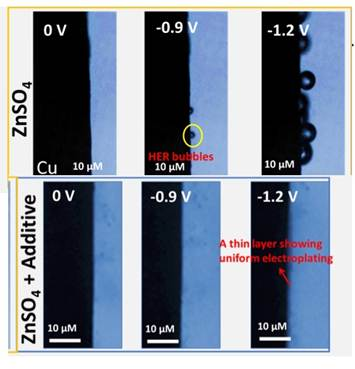
Fig: (Left) Cover image of the work accepted in ACS Electrochemistry showing how electrolyte additive controls the Zn surface. (Right) Comparison of the effect of the BDIM additive on the zinc anode surface in suppressing HER
As a result, BDIM effectively suppresses hydrogen evolution, corrosion and zinc dendrite growth—three major factors responsible for battery degradation. This leads to enhanced stability, improved cycling performance and longer battery life.
To better understand the zinc deposition process, the researchers combined a specially fabricated ultramicroelectrode (UME) with fast-scan cyclic voltammetry (FSCV). The advanced analytical approach enabled direct observation of charge-transfer and mass-transfer processes at the battery interface, providing valuable insights into the mechanisms governing zinc deposition and battery performance.
The findings demonstrate that controlling the electrochemical interface through targeted electrolyte additives can substantially improve zinc battery durability without increasing manufacturing complexity or cost.
Published in the Journal of ACS Electrochemistry, the research has significant implications for renewable energy storage, backup power systems and grid-scale energy infrastructure. Improved zinc-ion batteries could offer a safer and more economical solution for storing energy generated from solar and wind sources while reducing maintenance costs and extending operational lifetimes.
The development represents an important step toward creating sustainable, affordable and high-performance energy storage technologies capable of supporting the growing demand for clean energy worldwide.
Publication link – https://doi.org/10.1021/acselectrochem.5c00322
You may also like
-
Self-assembly of Organic Molecules Opens a New Path to Green Hydrogen Production
-
Bi-layered Single-piece Dental Implant Reduces the Need for Surgical Unterventions
-
NASA Invites ISRO Into Moon Base Programme as US Opens Door Wider to Indian Space Startups
-
ISRO Successfully Completes Final EOS-05 Orbit-Raising Manoeuvre
-
Scientists Uncover A Way to Outsmart Quantum Entanglement Loss with A Single Move
