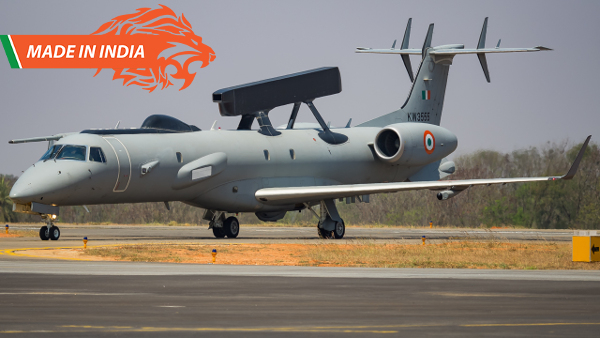
India’s indigenous Netra Airborne Early Warning and Control system has received Final Operational Clearance, marking a major step in the country’s journey towards self-reliance in advanced airborne surveillance and battle management systems. The clearance confirms the system’s readiness for deeper operational use by the Indian Air Force and strengthens India’s ability to detect, track and respond to aerial threats in real time.
The Netra AEW&C system has been developed by the Defence Research and Development Organisation through its Centre for Airborne Systems in Bengaluru. It is based on the Embraer EMB-145 aircraft platform and carries a suite of mission systems that turn the aircraft into a flying command, control and surveillance centre. DRDO describes the system as an airborne platform equipped with sensors for locating and providing early warning of airborne targets, sea-surface targets and hostile emissions, while also giving information to onboard controllers and ground stations.
The declaration of Final Operational Clearance was made at CABS, Bengaluru, by Air Marshal Awadhesh Kumar Bharti, Deputy Chief of the Air Staff. The milestone represents the completion of a demanding development, testing and validation cycle involving DRDO scientists, the Indian Air Force and several associated technology partners. For a complex “system of systems” like Netra, FOC is especially significant because it reflects the maturity of multiple integrated elements working together: radar, electronic support measures, communications, data links, mission computers, operator consoles and aircraft integration.
Netra is often called India’s “eye in the sky” because it gives the Air Force a wide-area airborne view of the battlespace. Flying at altitude, the system can look far beyond the limits of many ground-based sensors. It can detect and track hostile aircraft, unmanned aerial vehicles, missiles and other aerial activity at long ranges. It also helps commanders build a clearer picture of the air situation and pass timely information to fighter aircraft, air defence units and ground control stations.
The system is vital for network-centric warfare. Modern air combat depends on speed, information and coordination. A fighter pilot may have only a few seconds to respond to a threat. A ground commander may need a real-time picture before assigning interceptors or activating air defence systems. Netra supports this decision cycle by gathering sensor data from the air, processing it onboard and sharing actionable information across the operational network.
Its value goes beyond surveillance. Netra functions as an airborne battle management platform. It can guide friendly fighters, assist in interception, support air defence coordination, monitor hostile movement and improve situational awareness during high-tempo operations. This makes it a force multiplier for the Indian Air Force, especially in contested airspace and along sensitive borders where reaction time is critical.
The system’s indigenous character adds strategic importance to the clearance. Airborne early warning platforms are among the most complex military technologies in the world. They require mastery over sensors, signal processing, secure communications, electronic warfare support, aircraft modification and mission software. By developing Netra, India has built a strong domestic foundation in a technology area that only a limited number of countries have achieved.
The clearance also validates the partnership between the Indian Air Force and India’s scientific ecosystem. The Air Force provided operational feedback through the development and evaluation process, while DRDO and CABS refined the system for mission requirements. This user-driven model is important for future programmes such as larger AWACS platforms and next-generation airborne surveillance systems.
Netra’s operational relevance has already been highlighted in national security discussions. Reports have noted its role in supporting Indian air operations such as Balakot, and recent coverage has also referred to its contribution during Operation Sindoor. Such platforms are valuable during crises because they provide commanders with continuous surveillance, early warning and command support while remaining mobile and flexible.
The regional air threat environment is becoming more complex with advanced fighters, drones, cruise missiles, stand-off weapons and electronic warfare assets. A strong airborne early warning fleet gives the country better coverage, quicker response and improved coordination between offensive and defensive air operations.
The system also supports India’s larger defence modernisation goals. A modern air force requires not only fighter aircraft and missiles, but also airborne sensors, secure networks and command platforms that connect the entire battlespace. Netra strengthens this architecture by acting as a flying node in India’s air defence and surveillance grid.
The Final Operational Clearance is a statement of India’s growing technological confidence in high-end defence systems. It strengthens the Indian Air Force, deepens Atmanirbhar Bharat in aerospace defence and provides a foundation for future indigenous airborne command-and-control platforms.
As India moves towards next-generation surveillance aircraft and expanded air defence networks, Netra will remain a landmark achievement. It proves that Indian science, industry and the armed forces can jointly build advanced systems that serve national security with precision, reliability and strategic value.
You may also like
-
PRAHAAR: India’s First National Counter-Terrorism Policy and Strategy
-
Takshak Heavyweight Torpedo: How India’s Indigenous Submarine Weapon Compares With the World’s Leading Torpedoes
-
Embraer Builds Dual Aerospace Strategy in India Through C-390 Military and E175 Regional Aircraft Programmes
-
NextLeap Tests Indigenous Jet Engine for Long-Range Stryker Kamikaze UAV
-
Côte d’Ivoire Military Delegation Visits HAL, Shows Interest in India’s Indigenous Aerospace Platforms
