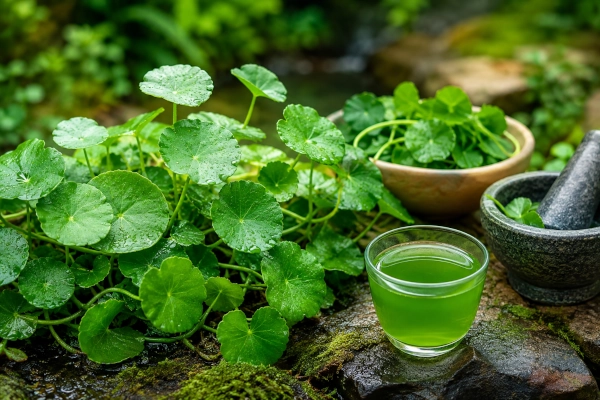
Botanical name: Centella asiatica (L.) Urban
Family: Apiaceae
Sanskrit name: मण्डूकपर्णी — Mandukaparni
English names: Indian Pennywort, Asiatic Pennywort, Gotu Kola
Tamil: Vallarai
Malayalam: Kudangal / Kutangal
Part used: Whole plant, particularly the leaves and aerial portions
Among the small herbs that quietly grow in moist corners of the Indian landscape, few possess the classical reputation enjoyed by Mandukaparni, or Centella asiatica. Its rounded leaves and creeping stems may make it appear like an ordinary ground-covering plant, but Ayurveda places Mandukaparni among its important Medhya Rasayana herbs—plants associated with the nourishment of Medha, a concept encompassing intellect, comprehension, retention and memory.
The importance accorded to Mandukaparni is not merely a modern interpretation of Ayurveda. Charaka specifically mentions the fresh juice of Mandukaparni among the Medhya Rasayanas, together with Yashtimadhu, Guduchi and Shankhapushpi. The Ayurvedic Pharmacopoeia of India officially identifies Mandukaparni as Centella asiatica, while the Ministry of AYUSH’s e-Charak medicinal-plant database identifies the whole plant as the medicinal raw material.
The Plant and Its Identity
Mandukaparni is a small creeping herb that favours moist, shaded and damp environments. Slender runners spread horizontally across the ground and develop roots at the nodes. From these runners emerge the characteristic rounded or kidney-shaped leaves carried on comparatively long petioles.
The plant can form a dense green carpet where moisture remains available. It occurs naturally in various parts of India and is also cultivated as a medicinal herb. Its preference for wet and shady conditions makes it suitable for moist portions of a household garden, although excessively stagnant or contaminated water should be avoided when the plant is intended for food or medicine.
The name Mandukaparni is traditionally understood in relation to the shape and appearance of its leaves. Manduka means frog, while parni refers to a leaf, giving the sense of a plant whose leaves resemble the form associated with a frog.
Mandukaparni and Brahmi Are Not Necessarily the Same Plant
One important botanical distinction must be made before discussing the herb further.
Mandukaparni is Centella asiatica.
The plant most widely identified botanically as Brahmi is Bacopa monnieri.
The two plants have sometimes shared vernacular names, particularly because both have longstanding reputations as Medhya herbs. Some later traditions and regional practices consequently use the name Brahmi for Centella asiatica. Even the National Medicinal Plants Board records “Brahmibooti” among names associated with Centella asiatica. Nevertheless, classical discussions and modern pharmacopoeial identification make it useful to distinguish Mandukaparni (Centella asiatica) from Brahmi (Bacopa monnieri) when discussing medicinal plants scientifically.
This distinction becomes especially important when buying plants from nurseries or purchasing dried herbal material.
Mandukaparni in Ayurveda
Mandukaparni occupies an unusually prestigious position in Ayurvedic Rasayana therapy because of its association with the mind, memory and healthy ageing.
Ayurvedic Pharmacological Profile
Rasa — Taste: Tikta (bitter), Kashaya (astringent), with Madhura also described in some later classifications
Guna — Qualities: Laghu (light), Sara (mobile or flowing)
Virya — Potency: Sheeta (cooling)
Vipaka — Post-digestive effect: Madhura (sweet), according to commonly followed contemporary Ayurvedic descriptions
Dosha action: Particularly associated with pacification of aggravated Pitta and Kapha, although descriptions vary somewhat between Ayurvedic authorities.
Principal Karma: Medhya, Rasayana, Balya and traditionally associated with healthy ageing and mental function.
Ayurvedic descriptions are not completely uniform across every Nighantu and later Dravyaguna tradition, particularly regarding the expanded Rasa and Vipaka classification. The consistent themes, however, are its cooling nature, lightness, bitter character and Medhya action.
Mandukaparni as a Medhya Rasayana
The most important classical reference comes from the Charaka Samhita, Chikitsa Sthana, Rasayana chapter.
Charaka begins the Medhya Rasayana formulation with:
मण्डूकपर्ण्याः स्वरसः प्रयोज्यः
Maṇḍūkaparṇyāḥ svarasaḥ prayojyaḥ — the fresh juice of Mandukaparni is to be used.
Charaka then groups Mandukaparni with Yashtimadhu, Guduchi and Shankhapushpi and describes these as Rasayanas beneficial to Medha. The succeeding verse associates the group with longevity, health, strength, digestive capacity, complexion and voice in addition to its Medhya character.
This passage is particularly significant because Charaka specifically prescribes Mandukaparni as Swarasa—the fresh expressed juice of the plant—rather than merely mentioning it as one ingredient among dozens.
The herb therefore belongs to the small and important group popularly described as the Medhya Rasayana Chatushtaya, comprising:
Mandukaparni — Centella asiatica
Yashtimadhu — Glycyrrhiza glabra
Guduchi — Tinospora cordifolia
Shankhapushpi — traditionally identified with Convolvulus pluricaulis and related regional sources
Medhya — More Than Simply “Improving Memory”
It would be overly simplistic to translate Medhya merely as a “memory booster.”
The Ayurvedic concept of Medha encompasses the faculties involved in understanding, retaining, processing and recalling knowledge. Consequently, a Medhya Rasayana is traditionally understood as supporting the broader intellectual and nervous functions rather than acting as a modern pharmaceutical stimulant.
Mandukaparni’s cooling character is particularly interesting within this framework. Ayurveda does not portray enhancement of intellectual capacity simply as increasing stimulation. Mental clarity also depends upon balanced functioning, nourishment and the absence of disturbances that interfere with concentration and recollection.
Mandukaparni therefore became associated with mental clarity, memory, retention and steadiness rather than short-lived stimulation.
A Rasayana Associated With Healthy Ageing
Mandukaparni’s classical significance extends beyond Medhya Rasayana.
Charaka also includes it in contexts connected with Rasayana and Vayasthapana, concepts concerned with maintaining healthy physiological function as age advances. The Charaka herb database records Mandukaparni under the Vayasthapana Mahakashaya, the classical group associated with preservation of youthful physiological qualities.
This provides an important insight into how Ayurveda viewed the plant. Mandukaparni was not regarded only as something to be used when memory became weak. Its place within Rasayana suggests a broader concept of maintaining the quality of mind and body over time.
Traditional Ayurvedic Uses of Mandukaparni
Supporting Memory and Intellect
The best-known application of Mandukaparni is its use as a Medhya Rasayana. Classical and later Ayurvedic practice consequently associates it with maintaining memory, comprehension and intellectual faculties.
It has traditionally been incorporated into preparations intended for students, scholars and individuals undergoing prolonged intellectual work, although therapeutic administration and dosage should be determined according to individual constitution and condition.
Supporting a Calm and Clear Mind
Because Mandukaparni combines Medhya action with Sheeta Virya, later Ayurvedic practice has frequently employed it where mental exhaustion, excessive agitation or difficulty maintaining concentration accompanies intellectual work.
This does not mean that Mandukaparni should be regarded as a treatment for psychiatric or neurological disorders without medical evaluation. Its traditional role is better understood as supporting normal mental function within the Ayurvedic framework.
Skin and Tissue Support
Mandukaparni also developed a strong traditional reputation in preparations applied to the skin.
Interestingly, this traditional use has attracted considerable modern research. Contemporary studies of Centella asiatica have concentrated particularly on its triterpenoids and their relationship with collagen formation, inflammation and tissue repair.
A systematic review examining clinical studies found promising evidence for wound-healing effects, including effects on granulation, re-epithelialisation and collagen-related pathways, while also stressing that the number of high-quality clinical trials remains limited.
Traditional use should therefore not be interpreted as justification for placing unsterile homemade herbal preparations on serious, infected, surgical or chronic wounds.
Mandukaparni as Food
One of the most fascinating aspects of Mandukaparni is that the boundary between medicine and food is unusually thin.
Charaka refers to Mandukaparni in the Shaka Varga—the category of leafy vegetables—in addition to discussing it medicinally.
This is entirely consistent with living culinary traditions elsewhere in South Asia. Centella asiatica continues to be consumed as a green leafy vegetable, salad ingredient, juice and food preparation in several regions. A scientific review of the plant’s nutritional use notes its established consumption as a leafy vegetable and its content of carotenoids, minerals, polyphenols and other plant constituents.
In Tamil culinary tradition, Vallarai is particularly well known as an edible green.
This culinary history is important because it demonstrates that Mandukaparni was not viewed exclusively as an exotic medicinal substance. In appropriate quantities and traditions, it also occupied the familiar Indian space where Ahara and Aushadha—food and medicine—overlap.
Common Traditional Forms of Use
Ayurvedic practice has employed Mandukaparni in several forms.
Swarasa is the freshly expressed juice and is particularly important because this is the form explicitly mentioned by Charaka in the Medhya Rasayana passage.
Kalka is the fresh plant ground into a paste and belongs to the traditional Ayurvedic methods of processing herbs.
Churna is the dried plant reduced to powder.
Mandukaparni may also form part of compound Rasayana and other Ayurvedic preparations.
The Ministry of AYUSH’s pharmacopoeial resources recognise both Mandukaparni whole plant and preparations derived from it, including powder and hydro-alcoholic extract monographs.
Therapeutic doses should not be extrapolated from ordinary culinary consumption. Concentrated powders, extracts and prolonged Rasayana regimens should preferably be used under the guidance of a qualified practitioner.
Modern Science and Mandukaparni
Modern pharmacological interest in Centella asiatica has concentrated heavily on a group of pentacyclic triterpenoids.
Among the best studied compounds are:
Asiaticoside
Madecassoside
Asiatic acid
Madecassic acid
These compounds are being investigated for effects involving antioxidant pathways, inflammation, collagen metabolism, neuronal function and tissue repair.
Research on Memory and the Nervous System
Experimental studies have produced considerable evidence for neuroprotective and cognition-related activity of Centella asiatica. Proposed mechanisms include changes in antioxidant status, mitochondrial function and inflammatory pathways.
Human evidence, however, remains considerably more limited than the laboratory literature. A major review concluded that animal research and a relatively small body of human research support its traditional reputation as a cognitive herb, but stronger clinical studies are still needed.
This distinction is important. Ayurveda’s traditional description of Mandukaparni as Medhya is historically well established, but modern scientific research has not yet established the herb as a proven treatment for dementia, Alzheimer’s disease or other neurological diseases.
Research on Wound Healing
The evidence surrounding skin and wound healing is somewhat more developed.
Centella compounds appear capable of influencing collagen synthesis, fibroblast activity, angiogenesis and inflammatory signalling. Clinical research has examined preparations containing Centella in burns, ulcers and other forms of damaged skin.
Systematic reviews describe the results as encouraging but still call for larger and better-controlled studies.
Growing Mandukaparni Around the Home
Mandukaparni is an excellent candidate for a small household medicinal garden because it does not require the space of a large shrub or tree.
The plant naturally favours moist soil and partial shade. Once established, its creeping runners can spread over the surface and root at their nodes, gradually producing a mat of rounded leaves.
A shallow container with moisture-retentive soil can therefore suit the plant well. Unlike many Mediterranean medicinal herbs that require dry conditions and strong sunlight, Mandukaparni should not be allowed to remain chronically dry.
For culinary use, plants should be grown in clean soil with clean irrigation water, particularly because the species naturally thrives in damp environments where contamination from wastewater or polluted standing water can otherwise become an issue.
Precautions
The fact that Mandukaparni has both traditional medicinal use and culinary use should not lead to the assumption that unlimited quantities of concentrated extracts are automatically safe.
Small clinical studies using standardised Centella extracts have generally reported good tolerability. However, rare cases of clinically significant liver injury associated with Centella-containing products have been reported. The US National Institutes of Health’s LiverTox database therefore describes Centella as generally regarded as safe while recognising it as a probable rare cause of clinically apparent liver injury.
People with existing liver disease, those taking multiple medicines, pregnant or breastfeeding women, and anyone contemplating prolonged therapeutic use or concentrated extracts should obtain appropriate professional advice.
Ordinary culinary use of a correctly identified plant should also be distinguished from medicinal doses of powders, capsules and standardised extracts.
Mandukaparni — The Little Leaf With a Large Ayurvedic Reputation
Mandukaparni illustrates one of the most interesting characteristics of India’s traditional relationship with plants. A herb creeping almost unnoticed through damp ground could simultaneously be regarded as a vegetable, household plant, Rasayana and support for the intellect.
Charaka’s decision to specifically identify Mandukaparni Swarasa among the Medhya Rasayanas gave the plant a distinguished position in the Ayurvedic materia medica. Modern research into Centella asiatica has subsequently uncovered triterpenoids such as asiaticoside and madecassoside and has produced promising findings concerning neuronal protection and tissue repair, although substantial clinical questions remain unanswered.
For the modern household medicinal garden, Mandukaparni is therefore particularly appropriate. It is small enough to grow in a pot, familiar enough to have surviving culinary traditions, and ancient enough to appear in one of Ayurveda’s most important discussions of Medhya Rasayana.
Rather than being merely the fashionable international herb now marketed as “Gotu Kola”, Centella asiatica belongs to a much older Indian tradition as Mandukaparni—the frog-leaved herb associated with Medha, Rasayana and the preservation of a clear and capable mind.
References
- Charaka Samhita, Chikitsa Sthana 1/3/30–31 — Medhya Rasayana section describing Mandukaparni Swarasa with Yashtimadhu, Guduchi and Shankhapushpi.
- Pharmacopoeia Commission for Indian Medicine & Homoeopathy, Ministry of AYUSH — Ayurvedic Pharmacopoeia of India, Mandukaparni (Centella asiatica) monographs.
- National Medicinal Plants Board, Ministry of AYUSH — Mandukparni (Centella asiatica) medicinal-plant records.
- e-Charak, Ministry of AYUSH — Centella asiatica, Mandukparni; whole plant as medicinal raw material.
- Orhan IE. Centella asiatica — Phytochemistry and mechanisms of neuroprotection and cognitive enhancement.
- Arribas-López E. et al. A Systematic Review of the Effect of Centella asiatica on Wound Healing.
- Sun B. et al. Review of the therapeutic properties of asiaticoside and madecassoside.
- NIH LiverTox — Centella asiatica, safety and reported rare liver injury.
Health Disclaimer:
The information provided in this article is for educational and informational purposes only and is based on traditional Ayurvedic knowledge, published references and available scientific research. It is not intended to diagnose, treat, cure or prevent any disease, nor should it be considered a substitute for professional medical advice, diagnosis or treatment. Individual responses to herbs and traditional remedies may vary. Pregnant or breastfeeding women, children, elderly individuals, people with chronic illnesses, and those taking prescription medicines should consult a qualified healthcare professional or registered Ayurvedic practitioner before using any herb, supplement or therapeutic preparation. Never discontinue or alter prescribed medication without medical supervision.
You may also like
-
Why Ayurveda Warns Against Suppressing Hunger, Thirst and Sleep
-
India Strengthens Quality Standards for Ayurveda, Yoga and Sowa-Rigpa Through Nationwide BIS Initiative
-
Sanofi Receives Indian Approval for Qfitlia, a New RNA-Based Treatment for Haemophilia A and B
-
Dr. Reddy’s Receives Indian Approval for Zytorvi Immunotherapy to Treat Advanced Oesophageal Cancer
-
The Ayurvedic Importance of Natural Urges: Why Suppressing the Body’s Signals Can Affect Health
