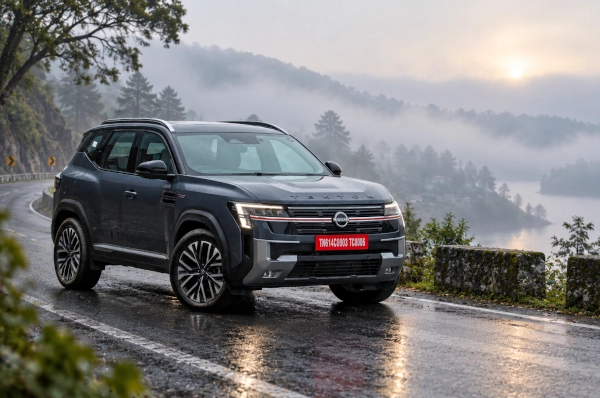
India’s role in Nissan’s global manufacturing network has expanded with the Japanese automaker beginning overseas shipments of the Made-in-India Nissan Tekton, starting with South Africa, Bhutan and Nepal.
Nissan Motor India announced the beginning of Tekton exports on September 1, 2026, dispatching a first combined batch of more than 1,300 SUVs to the three markets. The company describes these shipments as the opening phase of a broader international rollout that will progressively take the India-built SUV to additional overseas markets.
The programme is important because the Tekton was conceived from the outset as both an Indian-market vehicle and a global export product.
Nissan manufactures the SUV at its Chennai production facility under what it calls its “One Car. One World” strategy. The approach is intended to produce vehicles in India to a common global standard, allowing the same basic product to serve domestic customers while also being exported to international markets.
South Africa is particularly significant among the first destinations because it gives the Chennai-built Tekton an immediate foothold in a major overseas automotive market.
Bhutan and Nepal extend the SUV’s reach into neighbouring South Asian markets, while Nissan says more countries will follow as production and exports scale up.
The move reflects a broader change in the role of India within international automotive supply chains. Indian factories were once used by many global manufacturers primarily to produce affordable vehicles for the domestic market. Increasingly, however, India is becoming a manufacturing base for vehicles engineered from the beginning for sale in several countries.
Nissan is explicitly placing the Tekton within that model.
When the SUV made its world premiere in India in July 2026, the company said the vehicle was developed under the “One Car. One World” philosophy and would be manufactured in Chennai for both Indian customers and international markets. Nissan described the model as an important part of its renewed India strategy and its wider global manufacturing plans.
The first export batch therefore represents the transition of that strategy from announcement to actual overseas shipments.
The Tekton also arrives at a time when Nissan’s domestic Indian business is showing stronger momentum. During August 2026, Nissan Motor India recorded total wholesale volumes of 9,350 vehicles, including 3,426 units in the domestic market and 5,924 units exported internationally. Domestic wholesales were up 147% year-on-year, supported by demand for the company’s SUV portfolio and the introduction of the Tekton.
The first 1,300-plus Tekton units form only part of Nissan’s overall exports for the month, but they establish a new export line for the Chennai facility.
For the Indian manufacturing sector, this distinction matters. Exporting a locally produced model to multiple international markets requires the manufacturing plant and its supplier ecosystem to meet consistent requirements covering quality control, safety, durability, component traceability and market-specific homologation.
As export volumes grow, the programme can also provide additional scale to Indian component manufacturers supplying systems ranging from sheet-metal parts and seats to electronics, tyres, glass, wiring harnesses and powertrain components.
The Tekton is positioned in the highly competitive midsize SUV category, one of the fastest-growing segments of the Indian passenger-vehicle market. Nissan offers it in India with turbocharged petrol powertrains and both manual and automatic transmission options.
Its export strategy, however, is potentially as important as its domestic sales.
By combining Indian demand with orders from markets such as South Africa, Nissan can spread development and manufacturing volumes across a wider customer base. That can improve utilisation of local production capacity and strengthen the commercial case for additional localisation.
Nissan Motor India Managing Director Saurabh Vatsa said the company’s export operations demonstrate the international competitiveness of vehicles manufactured in India and underline the growing strategic importance of the company’s Indian operations within Nissan’s worldwide network.
The Tekton programme consequently fits into India’s larger emergence as an automotive export base.
Indian factories already ship passenger vehicles, commercial vehicles, two-wheelers and automotive components to markets across Africa, Latin America, the Middle East, Europe and Asia. Global automakers increasingly use Indian facilities not simply because of manufacturing costs, but because the country combines a large domestic market with an extensive supplier base and increasingly sophisticated vehicle-engineering capabilities.
South Africa is a particularly attractive destination within that strategy. Indian-manufactured vehicles have built an established presence there, while similarities in demand for compact and midsize vehicles create opportunities for models engineered around Indian market requirements.
For Nissan, the first Tekton exports are therefore about more than 1,300 vehicles.
They represent the beginning of an attempt to make the Chennai-built SUV a global product manufactured from India, with domestic and international volumes supporting the same production ecosystem.
Tekton story is another example of India’s automotive industry gradually moving from being primarily a large domestic manufacturing base to becoming an increasingly important global production and export hub.
You may also like
-
Mankind Pharma to Acquire 70% Stake in Belgian CAR-T Cancer Therapy Developer for €48 Million
-
Solar Industries to Acquire Sivasakthi Industrial Explosives for ₹115 Crore, Expands Manufacturing Business
-
India Ranks Third Globally in Contracted Clean Hydrogen Volumes, Secures 3 Lakh Tonnes Annually
-
Government Finalises Airfare Pricing Rules to Protect Passengers from Excessive Ticket Charges
-
India’s Inland Waterway Cargo Movement Reaches 218 Million Tonnes, Surpasses 2030 Target Four Years Early
