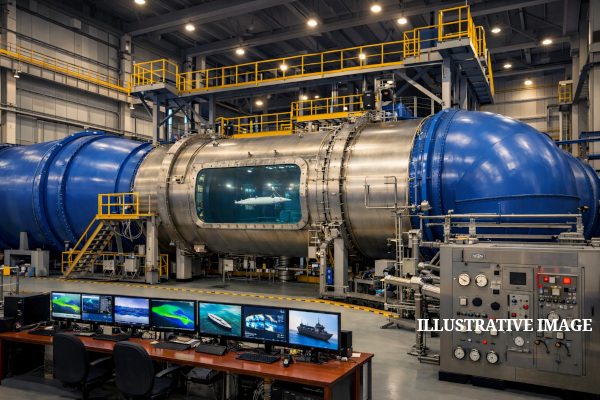
India’s decision to build a Large Cavitation Tunnel at the Naval Science and Technological Laboratory in Visakhapatnam is far more than a laboratory expansion. It is a strategic defence investment in the invisible physics that decide whether a warship runs quieter, a submarine remains harder to detect, a propeller performs efficiently under stress, and an underwater weapon behaves predictably in combat conditions. The Ministry of Defence said on 3 April 2026 that the new facility is intended to strengthen indigenous naval research and testing, support next-generation ships, submarines and underwater platforms, and reduce dependence on overseas testing infrastructure. It also described the project as a strategic national asset and said the facility will combine closed-loop simulations for submarine studies with free-surface simulations for surface-ship research in one integrated setup.
To understand why this matters, one must start with cavitation itself. Cavitation happens when local pressure in a flowing liquid falls low enough for vapor bubbles to form and then collapse violently. In naval engineering, this is not a minor technical nuisance. Cavitation around propeller blades, control surfaces, pump-jets, torpedo bodies or appendages can reduce propulsive efficiency, damage surfaces through erosion, generate vibration, and, most importantly for military platforms, create underwater noise. Cavitation tunnels exist to reproduce and study those flow conditions in a controlled environment before the real platform ever goes to sea. Research and industrial tunnel operators use them to investigate hydrodynamic performance, cavitation behavior, pressure fluctuations, erosion, and radiated noise from propulsors and underwater bodies.
That last point is where the defence significance becomes especially sharp. A navy can tolerate many things; being acoustically loud in contested waters is not one of them. Modern anti-submarine warfare depends heavily on detecting signatures in the water column. If a submarine, unmanned underwater vehicle, or even a surface combatant’s propulsion train produces excessive cavitation noise, it becomes easier to classify, track and target. The PIB release explicitly says the Large Cavitation Tunnel will strengthen propulsion development, noise-reduction work and stealth capabilities. That is a direct signal that the facility is not merely about academic hydrodynamics; it is about survivability, concealment and combat credibility in the undersea battlespace.
For India, the timing is important. NSTL is DRDO’s principal laboratory for underwater weapons and naval hydrodynamics, and the same defence-ministry event highlighted its work in torpedoes, underwater mines, decoys, autonomous underwater vehicles and swarming systems. A modern cavitation tunnel gives those programmes a much stronger test and validation backbone. Torpedoes, for instance, must move through water at high speed with predictable flow behavior and manageable acoustic output. Decoys and underwater drones also need hydrodynamic refinement if they are to remain stable, efficient and tactically useful. A facility that can accurately model cavitation and wake effects therefore supports not just shipbuilding, but the entire underwater combat ecosystem around the fleet.
There is also a deeper ship-design reason. A large warship is not designed only by drawing its hull and installing engines. Designers must validate how the hull, appendages, propulsors and wake field interact in realistic operating conditions. Cavitation tunnels are used internationally to test propellers in open-water and behind-hull conditions, study cavitation patterns, measure induced pressure pulses, assess underwater noise, and examine forces and moments acting on submerged bodies. SINTEF’s cavitation tunnel, for example, is used for cavitation testing, flow measurements, force measurements, pressure fluctuation work and propeller-noise studies for vessels and underwater vehicles. The NSTL facility documentation listed through ITTC shows similar applications: cavitation studies on hulls and propellers, acoustic studies in cavitating and non-cavitating conditions, wake measurement, propeller performance measurement, and force-and-moment testing on submerged and surface bodies.
India already had a cavitation tunnel at NSTL, and that fact helps explain why the new project is a leap rather than a beginning. The ITTC facility sheet for NSTL’s existing cavitation tunnel says the current facility is a closed-circuit, variable-speed, variable-pressure tunnel with a 6-metre test section, 1 m x 1 m cross-section, and flow speed up to 15 m/s. It also lists acoustic sensors, an acoustic trough, wake rake systems, videography, dynamometers and pressure-control arrangements for propulsor and body testing. In other words, NSTL has long possessed foundational hydrodynamic test infrastructure. The significance of the new Large Cavitation Tunnel lies in scale, sophistication, integration and the ability to support larger, more complex and more future-oriented naval programmes.
The phrase “large” matters because scale matters in hydrodynamics. Bigger and more advanced tunnels can accommodate larger models, more realistic wake simulation, better instrumentation layouts, richer optical access, and more precise study of interactions that become difficult to capture in smaller rigs. This is especially relevant for destroyers, aircraft carriers, advanced submarines and emerging unmanned platforms. The PIB release explicitly says the new Indian facility will support hydrodynamic validation of major naval platforms including destroyers and aircraft carriers. That suggests the tunnel is intended to strengthen the full design cycle: from model testing and propulsion optimization to signature reduction and risk retirement before expensive sea trials.
Another major feature is the facility’s ability to handle both submarine-oriented and surface-ship-oriented research in one integrated infrastructure. According to the PIB release, the new LCT will be globally distinctive because it can perform both closed-loop simulations essential for submarine studies and free-surface simulations critical for surface ships. This matters because the physics of a deeply submerged body and a vessel operating near the free surface are not identical. Surface effects can alter flow, pressure distribution, wake characteristics and hydrodynamic loads, while submarine studies often demand tightly controlled recirculating conditions for detailed investigation of underwater bodies and propulsors. A combined facility should improve design continuity across India’s naval portfolio instead of forcing separated test chains.
From a defence-industrial standpoint, the new tunnel also fits neatly into the logic of Aatmanirbhar Bharat. Rajnath Singh said that India has often had to go abroad for critical testing even after developing systems domestically, and that this situation will now change. That may be the single most important strategic line in the entire announcement. Sovereign naval design capability is incomplete if the most sensitive validation stages depend on foreign facilities, foreign schedules, foreign confidentiality regimes or foreign export-control pressures. Indigenous test infrastructure closes that loop. It lets a country design, test, fail, redesign and optimize on its own terms. For military technology, that independence is often as valuable as the hardware itself.
There is a quieter but equally important benefit: better testing reduces downstream cost and risk. Ship and submarine programmes are brutally expensive, and defects that appear late in development or after commissioning can become cripplingly costly. A robust cavitation tunnel allows designers to identify noisy propeller regimes, adverse wake interactions, pressure pulsation problems, force anomalies or erosion risks much earlier. International cavitation-tunnel literature likewise emphasizes use cases such as cavitation observation, cavitation erosion assessment, induced-noise measurement, pressure-fluctuation measurement and validation of propulsor behavior in realistic wake conditions. In practical defence terms, that means fewer unpleasant surprises after steel is cut or after a platform reaches sea trials.
The tunnel’s relevance extends beyond classic hull-and-propeller work. Future naval warfare is increasingly shaped by autonomous systems, distributed sensors, swarming underwater craft and stealthier undersea effectors. The same NSTL visit that showcased the LCT project also featured demonstrations of autonomous underwater vehicles and a swarm of man-portable AUVs. Hydrodynamic and acoustic optimization for such systems will become even more important as navies push for lower signatures, longer endurance and more reliable autonomous behavior underwater. The tunnel therefore sits at the intersection of traditional shipbuilding and future naval robotics.
Seen in that light, the Large Cavitation Tunnel is exactly the sort of infrastructure that serious naval powers build when they want lasting technological depth. Missiles, torpedoes and submarines attract attention, but the laboratories that make them quieter, cleaner and more dependable are what separate a buyer of platforms from a builder of maritime power. By creating a domestic facility for advanced hydrodynamic validation, acoustic refinement and propulsion-system testing, India is investing in the hidden engineering base that underwrites naval combat effectiveness. That is why the Large Cavitation Tunnel deserves to be read not as a civil works story, but as a defence story about stealth, self-reliance and the long mechanics of sea power.
You may also like
-
Exercise Tarang Shakti 2026 Concludes in Jodhpur, Showcasing India’s Air Power, Indigenous Defence Technology
-
Indian Navy Vice Chief Inspects Japan’s Mogami-Class Stealth Frigate as India-Japan Shipbuilding Cooperation Expands
-
Philippine Marine Wargames Reportedly Show BrahMos Can Penetrate Chinese Destroyer Air Defences
-
Safran Signs 18 Agreements with Indian Aerospace Suppliers, Expanding Make in India Manufacturing Partnerships
-
Indian Army’s Vajra Corps Certifies First Batch of Drone Operators, Strengthens Battlefield Surveillance
