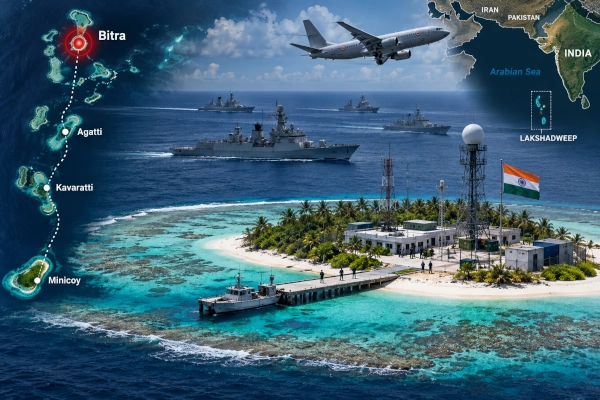
The Union Territory Administration of Lakshadweep has formally moved ahead with the acquisition of the entire land area of Bitra Island, placing India’s smallest inhabited island at the centre of a wider expansion of strategic and security infrastructure across the Lakshadweep archipelago.
An official Lakshadweep Gazette notification published in April 2026 records the acquisition of the entire land area of Bitra Island. The move follows earlier land-acquisition proceedings and comes as the Government of India steadily strengthens naval, air and dual-use infrastructure across Lakshadweep.
The decision is significant because Bitra occupies the northern part of the island chain, while India has already established naval and air-force infrastructure at Kavaratti, Minicoy and Agatti. Taken together, these official developments point to a broader effort to improve surveillance, operational reach, logistics and connectivity across India’s western island territories.
Bitra Is Lakshadweep’s Smallest Inhabited Island
Bitra is the smallest inhabited island in Lakshadweep. According to the Lakshadweep Administration, it has a land area of about 0.105 sq km, a maximum length of around 0.57 km and a width of approximately 0.28 km. It lies about 483 km from Kochi.
Despite its small land area, Bitra is surrounded by a lagoon covering about 45.61 sq km. The island recorded a population of 271 people in the 2011 Census, making it the least populated inhabited island in the Union Territory.
Lakshadweep as a whole comprises 12 atolls, three reefs and five submerged banks spread across the Arabian Sea. The Union Territory Administration notes that the archipelago has around 20,000 sq km of territorial waters and an economic zone of roughly four lakh sq km, giving the islands a maritime significance far greater than their small land area might suggest.
Gazette Confirms Acquisition of Entire Bitra Land Area
The Lakshadweep Gazette, Volume LXII No. 1, records a notification concerning the acquisition of the entire land area of Bitra Island.
The Gazette represents the clearest official confirmation that the Administration has moved beyond preliminary discussion and into a formal acquisition process. The published notification forms part of the statutory framework governing land acquisition in the Union Territory.
The official documents available publicly do not, however, announce a commissioned naval establishment named INS Bitra. Nor has the Ministry of Defence or Indian Navy publicly identified the precise infrastructure that will eventually be created on the island.
The confirmed development is therefore the acquisition of Bitra’s entire land area, while the exact defence installations, unit structure and commissioning timeline remain to be officially announced.
Bitra Fits Into a Larger Lakshadweep Security Build-Up
The Bitra acquisition becomes more significant when viewed alongside other officially announced defence projects across Lakshadweep.
The Indian Navy already operates INS Dweeprakshak at Kavaratti and INS Jatayu at Minicoy. When INS Jatayu was commissioned in March 2024, the Ministry of Defence described it as the Navy’s second base in Lakshadweep after INS Dweeprakshak.
The Ministry said the expansion of naval infrastructure in Lakshadweep was intended to strengthen operational reach, surveillance and sustenance while supporting anti-piracy and anti-narcotics operations in the western Arabian Sea.
The commissioning of INS Jatayu also included the opening of a Maritime Operations Centre at Minicoy, strengthening the Navy’s ability to monitor and coordinate operations in the surrounding waters.
Minicoy Anchors India’s Southern Lakshadweep Presence
Minicoy occupies the southern end of Lakshadweep and has long been regarded by the Government as strategically important.
The Ministry of Defence has stated that Minicoy lies astride vital sea lines of communication and that an independent naval unit there would strengthen the Navy’s operational capability in the islands. INS Jatayu was specifically intended to extend surveillance, improve logistical support and increase the Navy’s ability to respond rapidly in the region.
The Government has also linked the development of Minicoy with improved connectivity and wider island development rather than treating military infrastructure as an isolated project.
This dual-purpose approach has become a recurring feature of Lakshadweep infrastructure planning.
Agatti and Minicoy Airfields Add an Air-Power Dimension
India’s security expansion in Lakshadweep is not limited to naval infrastructure.
The Government has approved the creation of a joint-user greenfield airfield and Indian Air Force Forward Base Support Unit at Minicoy, along with the expansion of the Agatti airfield and establishment of another Forward Base Support Unit there.
Official government documents place the cost of the Minicoy project at ₹4,452.50 crore and the Agatti expansion at ₹7,354.34 crore.
The Government has stated that both airfields will support military operations as well as civil aircraft. Their strategic location is intended to improve the Armed Forces’ logistical support and operational flexibility while also improving mainland connectivity and supporting tourism and the local economy.
Together with Kavaratti and Minicoy’s naval facilities, these projects create a more distributed security architecture across the island chain.
Lakshadweep Is Central to India’s Western Maritime Reach
Lakshadweep’s importance stems from geography.
The islands sit deep in the Arabian Sea, west of mainland India, close to important shipping routes connecting the Indian Ocean with the Persian Gulf, Red Sea and western Indian Ocean.
The Government has repeatedly described the islands as strategically placed and has linked new infrastructure there to operational flexibility, maritime surveillance, anti-piracy activity, narcotics interdiction and rapid response.
India’s official policy is therefore not limited to maintaining isolated military posts. The emerging pattern combines naval bases, airfields, communications infrastructure and civilian connectivity across several islands.
Bitra adds a new northern dimension to that framework.
Why Bitra’s Northern Location Matters
Bitra is located at approximately 11°36′ N latitude and 72°11′ E longitude, placing it among the northern inhabited islands of Lakshadweep.
Its location distinguishes it from Minicoy, which anchors the southern end of the archipelago, and from Kavaratti and Agatti in the central part of the island chain.
Acquiring the entire island therefore gives the Government the ability to plan infrastructure at a location geographically separated from the existing principal naval bases.
The precise military role of Bitra has not yet been publicly defined. However, the Government’s established policy elsewhere in Lakshadweep shows a clear emphasis on distributed surveillance, operational reach, logistics and connectivity.
Dual-Use Infrastructure Is Becoming the Lakshadweep Model
The expansion of defence infrastructure across Lakshadweep has repeatedly been paired with civilian development.
When the Government approved the Agatti and Minicoy airfield projects, it explicitly stated that they would accommodate both military and civilian aircraft. The same projects were also linked with better connectivity, increased tourism opportunities and benefits for the local economy.
The Government has followed a similar approach in other sectors. In January 2024, Prime Minister Narendra Modi inaugurated or launched development projects worth more than ₹1,150 crore across Lakshadweep, including the Kochi-Lakshadweep submarine optical fibre connection, drinking-water infrastructure, solar power facilities, health projects and public amenities.
The submarine optical fibre connection increased available bandwidth dramatically and gave the islands high-speed connectivity supporting government services, healthcare, education, banking and digital services.
This combination of strategic infrastructure and civilian development suggests that new defence investments are being integrated into a broader effort to improve the resilience and connectivity of the island territory.
Bitra’s Population Makes Acquisition a Sensitive Process
Bitra is not an uninhabited outpost.
Its 2011 population of 271 people lived on a landmass of barely one-tenth of a square kilometre. The island’s small size means that acquisition of the entire land area has direct implications for existing residents, homes and community life.
That is why statutory land-acquisition procedures, including social-impact assessment and rehabilitation considerations, are central to the process.
The acquisition therefore differs fundamentally from establishing a defence facility on an uninhabited island. Strategic requirements will have to be implemented within the legal framework governing compensation, rehabilitation and resettlement.
The Government’s formal notification process provides the legal route for addressing those issues before development proceeds.
No Official Confirmation Yet of ‘INS Bitra’
Recent reports have referred to the possibility of a future naval base being called INS Bitra.
That name has not yet appeared in an official Indian Navy, Ministry of Defence or PIB announcement.
The distinction is important. The Government has officially confirmed the acquisition of Bitra’s entire land area, but the final institutional form of the defence presence has not yet been announced.
Until such an announcement is issued, it is more accurate to describe Bitra as part of an expanding strategic infrastructure programme rather than as an already approved or commissioned naval base.
Lakshadweep’s Security Grid Is Becoming More Distributed
The official developments across the archipelago show a clear geographic spread.
Kavaratti hosts INS Dweeprakshak. Minicoy hosts INS Jatayu and is being developed with a new joint-use airfield and IAF Forward Base Support Unit. Agatti is being expanded for joint civil-military aviation use and will also host an IAF support unit. Bitra is now subject to acquisition of its entire land area.
This distributes security infrastructure across the central, southern and northern parts of Lakshadweep instead of concentrating it at a single location.
For an island territory spread across a large maritime area, distributed facilities can improve endurance, shorten response times and support surveillance over wider sectors.
Those benefits are consistent with the objectives already stated by the Ministry of Defence for Lakshadweep: greater operational surveillance, reach, sustenance and first-response capability.
A Broader Indian Ocean Strategy Is Taking Shape
The acquisition of Bitra should also be seen within India’s broader approach to maritime security.
The Indian Navy has increasingly emphasised persistent surveillance, protection of sea lanes, anti-piracy operations, counter-narcotics missions and rapid humanitarian response across the Indian Ocean.
Lakshadweep gives India strategically positioned territory in the Arabian Sea from which naval and air assets can operate closer to important maritime approaches.
The strengthening of Minicoy, Agatti, Kavaratti and now Bitra therefore improves India’s ability to support operations from multiple points across the archipelago rather than relying exclusively on mainland bases.
Bitra Marks the Next Stage of Lakshadweep’s Strategic Transformation
The formal acquisition of the entire land area of Bitra represents another step in the transformation of Lakshadweep from a lightly developed island chain into a more connected and strategically capable maritime territory.
Official documents do not yet reveal what specific military installations will be built on Bitra, and there is no government confirmation of a naval base named INS Bitra. What is clear is that the acquisition is taking place alongside major investments in naval basing, military aviation, communications and dual-use infrastructure elsewhere in Lakshadweep.
The emerging architecture gives India stronger northern, central and southern points across the archipelago. Combined with continued civilian development and improved connectivity, this expansion is strengthening Lakshadweep’s role in India’s maritime security framework and giving the country greater depth across the western Indian Ocean.
References
Lakshadweep Administration — Lakshadweep Gazette, Vol. LXII No. 01: Notification regarding acquisition of the entire land area of Bitra Island, April 2026.
https://lakshadweep.gov.in/document-category/gazatte-notifications/page/6/
Lakshadweep Administration — Bitra Island: Official Island Profile.
https://lakshadweep.gov.in/islands/bitra/
Lakshadweep Administration — Islands of Lakshadweep: Official Profile.
https://lakshadweep.gov.in/islands/
Office of the Registrar General & Census Commissioner, India — District Census Handbook, Lakshadweep, Census 2011.
https://censusindia.gov.in/
Press Information Bureau, Ministry of Defence — Indian Navy to Enhance its Operational Capability with Commissioning of INS Jatayu at Minicoy Island, March 2, 2024.
https://www.pib.gov.in/PressReleasePage.aspx?PRID=2010884
Press Information Bureau, Ministry of Defence — Indian Navy Commissions INS Jatayu at Minicoy, Strengthening Foothold in Lakshadweep Island, March 6, 2024.
https://www.pib.gov.in/PressReleasePage.aspx?PRID=2012143
Press Information Bureau — Official information on expansion of Agatti airfield and development of a new airfield at Minicoy.
https://www.pib.gov.in/
Press Information Bureau — Official information on IAF Forward Base Support Units at Minicoy and Agatti.
https://www.pib.gov.in/PressReleasePage.aspx?PRID=2088180
Prime Minister’s Office / Press Information Bureau — PM inaugurates and lays foundation stone for development projects worth more than ₹1,150 crore in Kavaratti, Lakshadweep, January 2024.
https://www.pib.gov.in/PressReleasePage.aspx?PRID=1992653
You may also like
-
Indian Army Special Forces Depart for Indonesia for Exercise Garuda Shakti 2026
-
India to Train 600 Nigerian Army Soldiers in Specialised Jungle and Mountain Warfare
-
India Moves Towards Five-Year Assured Orders for Defence Startups Under New Procurement Reforms
-
Zen Technologies Introduces Indigenous Hyper-Strike Falcon AI-Guided Counter-Drone Interceptor
-
L&T and Germany’s SCHOTTEL Expand Partnership for Controllable Pitch Propeller Systems in Indian Shipbuilding
