Warcraft Strategies from the Purāṇas | Śrīmad Bhāgavata Purāṇa, Skandha 10, Chapter 59
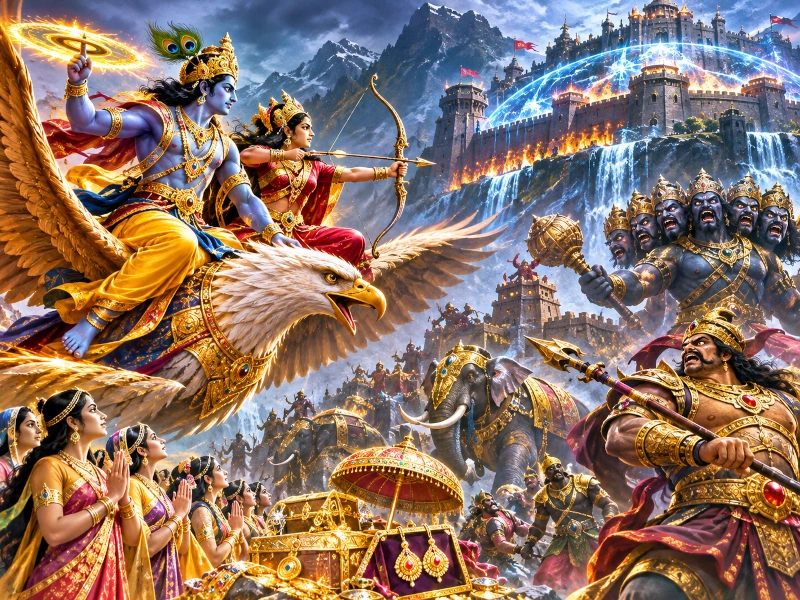
The destruction of Narakāsura’s fortress at Prāgjyotiṣa is one of the most elaborate accounts of an assault against a heavily fortified capital in the Purāṇic tradition. Protected by mountains, formidable weapons, barriers of fire, water and wind, and supernatural defensive obstructions, the city was designed to withstand an assault through several successive layers of resistance. Yet Śrī Krishna, accompanied by Satyabhāmā and mounted upon Garuḍa, penetrated these defences, defeated the fortress’s principal commanders and ultimately destroyed Narakāsura himself.
The episode, narrated in the fifty-ninth chapter of the Tenth Skandha of the Śrīmad Bhāgavata Purāṇa, presents a remarkable progression from the destruction of defensive infrastructure to the defeat of organised military resistance. Krishna employed different weapons against different obstacles, overcame successive counterattacks and isolated Narakāsura after eliminating the forces protecting him. Viewed through a military-strategic perspective, the narrative illustrates the importance of understanding defensive systems, selecting appropriate means of attack, neutralising enemy commanders and maintaining the initiative throughout an offensive.
The campaign also carries a larger moral purpose. Narakāsura had seized sacred possessions, challenged the celestial order and imprisoned thousands of royal women. Krishna’s victory therefore did not conclude with the destruction of an enemy ruler but extended to the restoration of stolen possessions, protection of the surviving royal lineage and liberation of those held captive. The narrative connects the exercise of military power with the responsibility to restore dharma after the defeat of oppressive authority.
Narakāsura’s Power and the Strategic Importance of Prāgjyotiṣa
Narakāsura, also known as Bhaumāsura because of his association with Bhūmi, the Earth goddess, ruled from Prāgjyotiṣa, a capital distinguished by its extraordinary defensive arrangements. His power extended beyond his own kingdom, and the Bhāgavata Purāṇa describes his seizure of possessions belonging to the celestial powers. These included the earrings of Aditi, the mother of the gods, Varuṇa’s ceremonial umbrella and a sacred location associated with Mount Mandara. Such actions represented more than the acquisition of valuable objects, for they symbolised a challenge to the established celestial order and the authority of those entrusted with maintaining it.
Indra approached Krishna and informed Him of Narakāsura’s transgressions, seeking intervention against the powerful ruler. Krishna responded by undertaking an expedition to Prāgjyotiṣa with Satyabhāmā, travelling upon Garuḍa towards the enemy capital. The scripture does not describe a prolonged mobilisation involving large armies, supply columns or an extended siege. Instead, it presents a concentrated offensive in which Krishna personally confronted and overcame the protective systems surrounding Narakāsura’s centre of power.
Prāgjyotiṣa was the foundation of Narakāsura’s military security because its defences were intended to prevent an attacker from approaching the ruler directly. The city combined natural barriers, constructed fortifications, defensive weapons and supernatural obstructions into a formidable protective arrangement. Its strategic importance lay not merely in the strength of individual barriers but in their combination, which required an attacker to overcome several different challenges before reaching the defenders stationed within. Narakāsura’s confidence rested upon the assumption that these protections would prevent any adversary from penetrating the capital and threatening his rule.
Prāgjyotiṣa’s Layered Defence System
The Bhāgavata Purāṇa describes Prāgjyotiṣa as a fortress surrounded by formidable defensive barriers. Mountains obstructed the approaches to the city, while additional protections consisted of weapons positioned to resist attackers. These were reinforced by barriers associated with water, fire and wind, creating an extraordinary combination of physical and supernatural obstacles. Around the city were also placed the dreaded Mura-pāśa, powerful cords or nooses associated with the demon Mura, whose purpose was to prevent an approaching enemy from advancing through the defensive perimeter.
The arrangement illustrates the principle of defence in depth, in which security depends upon successive obstacles rather than a single defensive position. A force overcoming one barrier would encounter another, potentially requiring different equipment, methods and tactical decisions. The mountains represented natural obstacles, the weapons provided active resistance, and the elemental barriers introduced additional difficulties that could not necessarily be overcome through ordinary physical force. The Mura-pāśa added another protective layer, ensuring that even an attacker who penetrated the outer barriers would encounter further resistance.
From a military perspective, the effectiveness of such a system depends upon the ability of its different components to reinforce one another. Fortifications can delay an enemy, defensive weapons can inflict casualties during an approach, and obstacles can channel an attacking force towards positions favourable to the defenders. However, the same arrangement also creates vulnerabilities when an adversary possesses the means to overcome each obstacle without surrendering the initiative. Prāgjyotiṣa’s extraordinary defences were formidable, but their strength ultimately depended upon preventing the attacker from progressing through the successive layers.
Krishna’s Assault Begins: Matching Weapons to Defensive Obstacles
Krishna’s attack upon Prāgjyotiṣa is described with particular precision in the fourth verse of Chapter 59. Rather than employing one weapon indiscriminately against every obstacle, He selected different weapons according to the nature of the defensive arrangements. He shattered the mountain fortifications with His mace, destroyed the weapon-based protections with arrows and overcame the barriers of fire, water and wind with His Sudarśana Chakra. He then used His sword to sever the formidable Mura-pāśa that obstructed the approach to the city.
The sequence is significant because it presents the destruction of a complex defensive system through the application of different forms of force. Krishna’s mace was directed against solid obstacles, while His arrows neutralised the weapons intended to resist His advance. The Sudarśana Chakra overcame the elemental barriers, and the sword destroyed the binding obstructions associated with Mura. Each action removed a specific component of the fortress’s protection, allowing the assault to continue without becoming immobilised before any single defensive layer.
The strategic interpretation of this passage lies in the importance of matching capabilities to operational requirements. An attacking force must first understand the characteristics of an obstacle before selecting the means most suited to overcoming it. Concentrating effort against a barrier without considering its nature can consume time and resources while allowing defenders to strengthen their resistance. Krishna’s actions demonstrate a contrasting approach in which the method of attack changes according to the defensive challenge, enabling the offensive to maintain its momentum as one obstacle after another is destroyed.
The destruction of the outer barriers also deprived Narakāsura’s defenders of the advantages for which their defensive arrangements had been constructed. Once the mountains, weapon protections and supernatural obstructions were overcome, the fortress could no longer prevent Krishna from reaching its principal military positions. The outer system had been designed to protect the defenders from direct engagement, but its collapse exposed them to the very confrontation they had sought to avoid.
Pāñcajanya and the Psychological Collapse of the Fortress
After breaking through the principal defensive barriers, Krishna sounded His conch, Pāñcajanya, producing a tremendous sound that reverberated across Prāgjyotiṣa. The Bhāgavata Purāṇa describes the sound as destroying the magical protections associated with the city and terrifying its defenders. Krishna then struck the surrounding earthen ramparts with His heavy mace, further demolishing the structures that protected the inner approaches. The combination of these actions marked a transition from overcoming the outer obstacles to directly threatening the fortress’s remaining defensive positions.
The sounding of Pāñcajanya introduces an important psychological element into the narrative. A fortress depends not only upon walls, barriers and weapons but also upon the confidence of those responsible for defending it. Soldiers who believe that their positions are secure may resist with determination, while the sudden destruction of supposedly impregnable protections can undermine their willingness to continue fighting. The scripture depicts the sound of Krishna’s conch as both a manifestation of divine power and an event that strikes fear into those guarding the city.
In military terms, the account illustrates how the perception of security can collapse when successive defensive assumptions are disproved. Narakāsura’s forces had relied upon the strength of their protective barriers, yet Krishna had penetrated them with apparent ease. The destruction of the outer defences, followed by the terrifying sound of Pāñcajanya and the demolition of the ramparts, demonstrated that the capital could no longer provide the protection its defenders expected. Nevertheless, the collapse of these barriers did not immediately end the battle, for the most powerful guardian of Prāgjyotiṣa was still prepared to resist the advancing Krishna.
Mura Emerges from the Moat to Defend the Capital
The sound of Pāñcajanya awakened Mura, a terrifying five-headed demon who had been sleeping beneath the waters of the fortress’s moat. The Bhāgavata Purāṇa describes his emergence as a fearsome spectacle, with his five heads radiating an extraordinary brilliance and his appearance suggesting overwhelming destructive power. Awakened by the assault upon Prāgjyotiṣa, Mura rose from the water and immediately confronted Krishna and Garuḍa. His emergence demonstrated that Narakāsura’s defensive arrangements included powerful guardians capable of engaging an attacker after the surrounding barriers had been penetrated.
Mura launched his attack by hurling a formidable trident towards Garuḍa, seeking to strike Krishna’s mount and disrupt the offensive. Krishna intercepted the weapon before it reached its target, breaking it into three pieces with two arrows. He then struck Mura’s faces with additional arrows, provoking the demon to continue the confrontation with his mace. When Mura hurled the weapon, Krishna countered with His own mace and shattered it into thousands of fragments, depriving the guardian of another means of attack.
The confrontation illustrates a successive neutralisation of the defender’s offensive capabilities. Mura first attempted to attack Garuḍa with a powerful projectile weapon, but Krishna destroyed it before impact. He then sought to continue the engagement with his mace, only to lose that weapon as well. Deprived of his principal means of attack, Mura rushed directly towards Krishna, attempting to overcome Him through a final assault. Krishna ended the confrontation by severing the demon’s five heads with the Sudarśana Chakra, causing Mura to fall into the waters from which he had emerged.
The destruction of Mura was an important turning point because the fortress lost one of its most formidable guardians. His position within the moat had allowed him to remain protected until an attacker approached the inner defences, but Krishna’s rapid defeat of the guardian removed that advantage. The episode also reveals the limitations of relying upon a powerful individual defender without sufficient supporting measures capable of preserving the defensive position after his defeat. With Mura destroyed, the remaining forces of Prāgjyotiṣa were compelled to organise another attempt to prevent Krishna from reaching Narakāsura.
Mura’s Seven Sons Attempt to Regain the Initiative
The death of Mura provoked a counterattack by his seven sons, Tāmra, Antarikṣa, Śravaṇa, Vibhāvasu, Vasu, Nabhasvān and Aruṇa. Acting under Narakāsura’s orders, they entered the battlefield under the command of the general Pīṭha, determined to avenge their father’s destruction and halt Krishna’s advance. Their forces attacked with a variety of weapons, including arrows, swords, clubs, spears, lances and tridents. The account describes a concentrated assault intended to overwhelm Krishna through the simultaneous employment of numerous weapons.
Krishna responded by destroying the weapons directed against Him before they could achieve their purpose. His arrows neutralised the incoming attacks, and He subsequently defeated Pīṭha and the warriors under his command. The destruction of this counterattacking force eliminated another important component of Narakāsura’s military establishment and deprived the ruler of commanders who might otherwise have reorganised the defence of the capital.
The strategic significance of this episode lies in the failure of the defenders to recover their initiative after the destruction of the outer fortress. A counterattack can be employed to interrupt an advancing force, regain lost ground or create the conditions necessary for a defensive reorganisation. However, such an operation requires coordination, effective leadership and sufficient combat power to challenge the attacker. Mura’s sons attempted to restore the defensive position through aggressive action, but their defeat demonstrated that Narakāsura’s forces could no longer prevent Krishna from advancing towards the centre of power.
The successive loss of Mura, his sons and the general Pīṭha also weakened the command structure available to Narakāsura. The ruler had constructed a defensive system supported by powerful warriors, yet each of these elements was being eliminated before he personally entered the battle. The destruction of successive commanders meant that the remaining defenders had fewer opportunities to reorganise their forces or establish another coherent defensive position. Narakāsura was increasingly compelled to rely upon his own military strength and the forces immediately available to him.
Narakāsura Deploys His Elephant Forces
With the principal defenders of Prāgjyotiṣa defeated, Narakāsura emerged from the capital accompanied by a powerful military force that included formidable elephants. The Bhāgavata Purāṇa describes these animals as possessing extraordinary strength and associates them with the Milk Ocean, emphasising the exceptional resources available to the ruler. Narakāsura’s decision to enter the battlefield personally marked a decisive escalation, for the struggle had moved from the destruction of fortifications and subordinate commanders to a direct confrontation with the sovereign himself.
Narakāsura launched a powerful weapon known as the Śataghnī against Krishna, while his soldiers attacked simultaneously with their own weapons. The intention was to concentrate the remaining fighting strength of the defenders against the advancing adversary. Krishna answered with a devastating barrage of arrows, destroying the weapons directed against Him and striking the opposing military formations. His attack rapidly weakened Narakāsura’s troops and reduced their ability to sustain an organised resistance.
Garuḍa played an important role in this phase of the confrontation by attacking the elephant force with his wings, beak and talons. The animals, unable to withstand the assault, retreated towards the protection of the city. Their withdrawal deprived Narakāsura of an important element of his supporting military strength and further exposed him to Krishna’s advance. The scripture thus presents the defeat of the elephant force as another stage in the progressive isolation of the ruler.
The episode illustrates the importance of preserving supporting formations during a major engagement. A powerful commander may possess considerable personal ability, but his position becomes increasingly vulnerable when the forces responsible for protecting and supporting him are destroyed. Narakāsura’s defensive system had already lost its outer barriers, principal guardians and counterattacking commanders. The defeat of his army and elephants removed much of the remaining protection upon which he could depend, leaving the ruler to confront Krishna under increasingly unfavourable conditions.
The Final Confrontation and the Death of Narakāsura
After witnessing the destruction of his forces, Narakāsura attempted to strike Garuḍa with a powerful spear. The Bhāgavata Purāṇa describes the weapon as possessing extraordinary destructive capability, yet Garuḍa remained unaffected by its impact. Narakāsura then prepared to attack Krishna with his trident, seeking a decisive blow after the failure of his earlier efforts. Before the weapon could be released, Krishna employed the Sudarśana Chakra and severed Narakāsura’s head while the ruler remained mounted upon his elephant.
The death of Narakāsura brought the military confrontation to its conclusion. The scripture describes the celestial beings honouring Krishna with showers of flowers, celebrating the destruction of the ruler who had challenged their authority and seized their possessions. The fortress that had appeared impossible to penetrate had been overcome, its principal defenders destroyed and its military forces defeated. Narakāsura’s extraordinary preparations had failed to prevent Krishna from reaching the centre of his power and ending his rule.
The progression of the campaign is particularly important for understanding the narrative’s military structure. Krishna did not begin by confronting Narakāsura directly, for the ruler was protected by multiple defensive systems and powerful military formations. Instead, the account describes the removal of successive obstacles until the final confrontation became unavoidable. The destruction of the outer barriers exposed Mura, the defeat of Mura brought forward his sons and their commander, and the destruction of those forces compelled Narakāsura to enter the battle with his army and elephants.
This sequence presents the defeat of a fortified power through the systematic elimination of the elements that sustain its security. Narakāsura’s personal strength could not compensate for the collapse of his defensive infrastructure and supporting forces. By the time he confronted Krishna directly, the military system upon which his authority rested had already been dismantled. The final strike therefore completed a process that had begun with the destruction of the fortress’s outermost protections.
Bhūmi’s Appeal and the Protection of Narakāsura’s Son
Following Narakāsura’s death, Bhūmi, the Earth goddess, approached Krishna and returned the sacred possessions that had been seized by the defeated ruler. These included Aditi’s earrings and Varuṇa’s umbrella, together with other valuable objects associated with the celestial powers. Bhūmi offered prayers to Krishna and acknowledged His divine authority before presenting Narakāsura’s surviving son, who had approached in fear. She requested that the young prince be granted protection, demonstrating concern for the future of the royal lineage after the destruction of its ruler.
Krishna granted the prince fearlessness, ensuring that Narakāsura’s defeat would not automatically result in the destruction of his surviving family. This action marks an important transition in the narrative from warfare to the restoration of order. The ruler responsible for the transgressions had been defeated, but the conclusion of the campaign did not require indiscriminate punishment of those who remained. Instead, Krishna distinguished between the oppressive authority that had to be removed and the individuals who could be protected after its destruction.
The episode presents an important principle concerning conduct after victory. Military success creates an opportunity to determine how the defeated population and surviving institutions will be treated, and the choices made during this stage can shape the stability that follows. Krishna’s response to Bhūmi’s appeal demonstrates that the restoration of dharma involves restraint as well as strength. The destruction of Narakāsura removed an oppressive ruler, while the protection of his son prevented the conflict from continuing as an act of vengeance against the remaining lineage.
This distinction gives the campaign a moral significance beyond the immediate destruction of hostile forces. The objective was not the indefinite continuation of violence but the termination of the conditions that had made intervention necessary. Once Narakāsura had been defeated, Krishna’s actions turned towards restitution and protection, reinforcing the Purāṇic understanding that righteous authority must be exercised with discrimination and responsibility.
Liberation of the Captive Princesses
After defeating Narakāsura, Krishna entered the royal palace and discovered 16,000 princesses who had been abducted and imprisoned by the ruler. Their captivity revealed the extent to which Narakāsura had employed his power to deprive others of their freedom. His fortress had not merely protected his military establishment and accumulated possessions but had also concealed the suffering of those held against their will. The liberation of the princesses therefore formed an essential part of the campaign’s larger purpose.
The Bhāgavata Purāṇa records that the princesses, upon seeing Krishna, desired to accept Him as their husband. Krishna arranged for them to be provided with suitable clothing and transported to Dvārakā, along with treasures and other possessions recovered from Narakāsura’s palace. The narrative subsequently describes Krishna’s marriage to the liberated princesses, placing their release within the larger account of His divine household and the restoration of their dignity.
The military significance of this episode is inseparable from its moral dimension. The destruction of Narakāsura’s defences made it possible to enter the capital, defeat the ruler and release those whom he had imprisoned. A campaign that ended only with the enemy’s death would have left its larger consequences incomplete, for the suffering caused by the defeated ruler required direct attention. Krishna’s actions extended beyond eliminating the source of oppression to providing protection and a future for those who had endured it.
The account consequently connects military victory with responsibility towards the victims of hostile power. The liberation of the princesses demonstrates that the restoration of order cannot be measured solely by the defeat of an opposing army or ruler. It must also be understood through the protection of those who have suffered under that authority and the removal of the conditions that sustained their captivity.
Military Significance: The Destruction of a Layered Defensive System
The most distinctive military feature of the Prāgjyotiṣa campaign is the systematic destruction of a fortress protected by several different forms of resistance. Narakāsura’s capital depended upon mountains, defensive weapons, elemental barriers and the Mura-pāśa to prevent an enemy from reaching its interior. These protections were reinforced by powerful commanders and military formations capable of engaging an attacker who succeeded in penetrating the outer perimeter. The narrative therefore presents the fortress as an integrated defensive establishment rather than an isolated wall or stronghold.
Krishna’s response demonstrates the importance of selecting the appropriate means of overcoming each defensive challenge. He did not employ the same weapon against every obstruction but used the mace, arrows, Sudarśana Chakra and sword according to the nature of the barrier. This distinction illustrates an enduring principle of military planning: successful operations depend upon understanding the characteristics of opposing defences and applying capabilities suited to the task. The Bhāgavata Purāṇa expresses this principle through divine weapons and supernatural obstacles, but the strategic relationship between challenge and response remains intelligible within a broader discussion of warfare.
The campaign also illustrates the importance of maintaining operational momentum. After destroying the outer fortifications, Krishna immediately confronted Mura, then defeated the guardian’s sons and their commander before engaging Narakāsura’s main forces. The defenders were unable to restore the advantages they had lost, and each unsuccessful counterattack further weakened their ability to resist. The continuity of Krishna’s offensive prevented the surviving defenders from establishing a stable position from which they could recover control of the battle.
Another significant lesson concerns the relationship between commanders and the military systems that support them. Mura’s defeat deprived the fortress of a powerful guardian, while the destruction of his sons and Pīṭha weakened the remaining command structure. The collapse of Narakāsura’s elephant force subsequently removed an important element of his battlefield strength. These successive defeats demonstrate that the effectiveness of a ruler’s military power depends upon the continued functioning of defensive infrastructure, subordinate commanders and supporting formations.
Finally, the narrative gives considerable importance to psychological factors and the consequences of victory. The sounding of Pāñcajanya terrified the defenders and accompanied the destruction of the fortress’s magical protections, while Krishna’s treatment of Narakāsura’s son and the captive princesses demonstrated restraint and responsibility after the battle. The account thereby presents warfare as an activity in which physical strength, tactical judgement, leadership, morale and moral purpose are closely connected.
Conclusion: The Fall of Prāgjyotiṣa and the Restoration of Dharma
Krishna’s assault on Prāgjyotiṣa stands as a powerful Purāṇic account of the destruction of a heavily fortified centre of hostile power. Narakāsura had surrounded his capital with extraordinary defensive arrangements intended to prevent any adversary from approaching him. Mountains, weapons, elemental barriers and supernatural obstructions protected the city, while Mura, his seven sons and powerful military formations stood ready to resist an attack. Yet these arrangements could not withstand Krishna’s systematic offensive, which destroyed the outer defences, defeated the principal commanders and ultimately brought Narakāsura into direct confrontation.
The episode’s strategic significance lies in the disciplined progression of the assault. Krishna overcame each defensive obstacle through an appropriate weapon, maintained the initiative against successive counterattacks and progressively deprived Narakāsura of the military resources necessary to sustain resistance. The narrative demonstrates that even a seemingly impregnable fortress becomes vulnerable when its defensive systems are understood, its principal protectors are neutralised and its supporting forces are prevented from restoring the initiative. The destruction of Narakāsura was therefore the culminating event in a campaign that had already dismantled the foundations of his military security.
Yet the Bhāgavata Purāṇa does not present the destruction of the fortress as an end in itself. Krishna restored the possessions seized from the celestial powers, granted protection to Narakāsura’s surviving son and liberated the thousands of royal women imprisoned within the capital. These actions transformed military victory into the restoration of justice and the protection of those who had suffered under oppressive authority. The narrative establishes that the rightful use of power must be measured not only by the ability to defeat an adversary but also by the order that follows the conflict.
The enduring lesson of Prāgjyotiṣa is that defensive strength cannot compensate for the misuse of power, and military superiority acquires lasting significance only when guided by righteous purpose. Krishna’s campaign united decisive action with restraint after victory, demonstrating that the destruction of oppression and the restoration of dharma are inseparable responsibilities. In the Warcraft Strategies of the Purāṇas, the fall of Narakāsura’s fortress remains an illustration of how superior judgement, the appropriate application of force and moral clarity can overcome even the most formidable concentration of hostile power.
References
Primary Scripture: Śrīmad Bhāgavata Mahāpurāṇa, Daśama Skandha, Chapter 59 — Narakāsura Vadha.
The principal account of Krishna’s expedition to Prāgjyotiṣa appears in Śrīmad Bhāgavata Purāṇa 10.59.1–5. These verses describe Indra’s appeal concerning Narakāsura’s seizure of celestial possessions, Krishna’s journey with Satyabhāmā aboard Garuḍa and the destruction of the fortress’s layered defensive arrangements. Verse 10.59.4 is particularly important for the military analysis because it identifies the different weapons Krishna employed against the mountains, defensive weapons, elemental barriers and Mura-pāśa. Verse 10.59.5 describes the sounding of Pāñcajanya and the demolition of the remaining protections.
The confrontation with Mura is narrated in Śrīmad Bhāgavata Purāṇa 10.59.6–11. These verses describe the five-headed guardian emerging from the waters, attacking Krishna and Garuḍa, and losing his weapons before being killed by the Sudarśana Chakra. The subsequent battle involving Mura’s seven sons and the general Pīṭha appears in verses 10.59.12–14, which recount their counterattack and defeat.
Narakāsura’s entry into the battlefield, the engagement involving his elephant forces and the final confrontation are described in Śrīmad Bhāgavata Purāṇa 10.59.15–22. These passages provide the scriptural foundation for examining the progressive destruction of Narakāsura’s remaining military strength and his death at Krishna’s hands.
The aftermath of the battle is narrated in Śrīmad Bhāgavata Purāṇa 10.59.23–37. These verses describe Bhūmi’s prayers, the restitution of the stolen celestial possessions, the protection granted to Narakāsura’s son and Krishna’s discovery and liberation of the 16,000 captive princesses. The concluding verses of the chapter continue the narrative with the restoration of Aditi’s earrings, the Pārijāta episode and Krishna’s marriages to the liberated princesses.
Principal Textual Editions: Śrīmad Bhāgavatam, Tenth Canto, Chapter 59, The Killing of the Demon Naraka, Bhaktivedanta Book Trust edition; and Śrīmad Bhāgavatam, Tenth Canto, Chapter 59, Mura and Bhauma Killed and the Prayers of Bhūmi, available through SrimadBhagavatam.org.
Reference for textual verification: https://vedabase.io/en/library/sb/10/59/
Interpretive Note: The description of Prāgjyotiṣa’s fortifications, supernatural barriers, divine weapons, Mura’s five heads and the destruction of Narakāsura follows the sacred narrative of the Bhāgavata Purāṇa. The discussion of defence in depth, operational momentum, command structures, morale and post-conflict responsibilities constitutes a military-strategic interpretation of the scripture rather than an assertion of independently documented historical warfare. The chapter identifies Satyabhāmā as accompanying Krishna throughout the expedition, while the principal combat actions are attributed to Krishna.
You may also like
-
Rāma’s Counsel to Bharata: Governance, Intelligence and the Responsibilities of Kingship
-
The Economics of Warfare: Treasury, Revenue and Military Sustainability in Kauṭilya’s Statecraft
-
Indian Ocean Navigation Before European Colonial Expansion: Monsoon Winds and Maritime Trade
-
Bharata at Citrakūṭa: A Constitutional Crisis Resolved Through Dialogue and Dharma
-
Vāmana Overturns Bali’s Conquest: Strategic Diplomacy, Ritual Obligation and Victory Without Conventional Warfare
