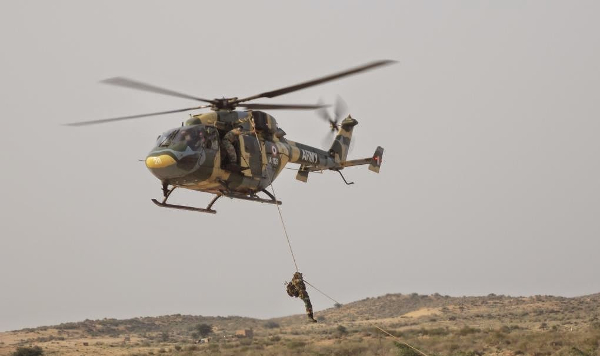
The Ambala-based Indian Army’s prestigious Kharga Corps is embarking on a largescale training exercise with troops in the backdrop of informationised domain and sub-conventional realities with focus on future security threats.
The exercise is scheduled to be held somewhere in May-June in the hinterland of Punjab and Haryana. During the exercise, efficiency of recent new additions in military equipment and weapons will be put to test.
The exercise will be conducted in the obstacle-ridden terrain. Latest military concepts designed to deliver a swift punitive blow to the adversary will also be validated. The exercise entails the jointmanship between arms and services and honing of inter-Army and inter-services good practices
Confirming the development, An Indian Army spokesperson said the components of Indian Air Force (IAF) will also participate to validate joint maneuvers and derive inputs for further consolidation of existing war fighting concepts and evolution of joint operational doctrine for the future.
Various units and formations are in the advanced stages of practice and preparations necessary for the said exercise, which is one of the biggest military exercises of recent times, said the spokesperson.
Ambala based 2-Corpa, popularly called as Kharga Corps, possesses 50% of the Indian Army’s offensive capabilities and has the mandate to launch offensive attack, in case any conflict or war breaks out with neighbouring Pakistan.
Integrated with multiple military formations, Kharga has proved an effective weapon in various wars. The Kharga Corps has been stationed at Ambala since 1985.
Source: TNN
Image Courtesy: Thar Savers
You may also like
-
Indian Army Tests Highway Operations With Rudra, Dhruv and Chetak Helicopters
-
Indian Coast Guard Seizes 526 Kg of Heroin and Methamphetamine in ₹3,000 Crore Arabian Sea Operation
-
INS Sahyadri and Kulish Join ASEAN Navies for AIME 2026 in Philippines
-
From Kaveri Dry Engine to IAF Fighter Powerplant: What India Must Achieve Next
-
Tejas Mk1A Nears IAF Combat Induction as Final Radar and Missile Integration Tests Approach Completion
