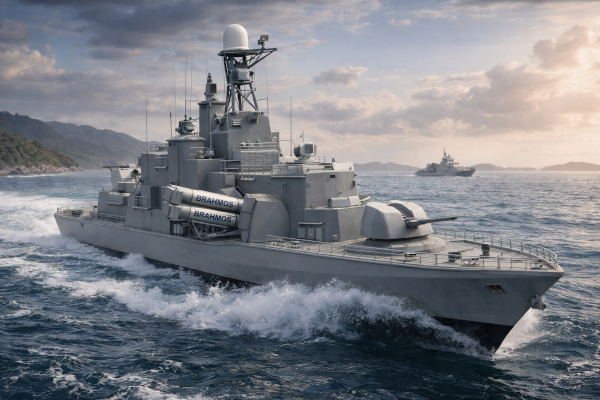
The Indian Navy’s Next Generation Missile Vessel programme is shaping up as one of the clearest examples of how India now wants to fight in contested littorals: with a compact but heavily armed warship that can move fast, strike hard and survive in crowded coastal battlespace. The Ministry of Defence signed the contract with Cochin Shipyard in March 2023 for six NGMVs at about ₹9,805 crore, with deliveries scheduled from March 2027. Officially, the vessels are meant to combine stealth, high speed and offensive capability, with primary roles against enemy warships, merchant shipping and land targets. The steel-cutting ceremony for the first ship was held in December 2024, and the Indian Navy has described the class as part of a future-ready, combat-ready force for the Indian Ocean Region.
What makes the class especially interesting is its propulsion logic. A major propulsion milestone came on 8 April 2026, when the Norwegian Technolgy Enterprise Kongsberg Maritime announced that it had signed a contract to supply 18 large Kamewa waterjets for the Indian Navy’s NGMV programme which will use three waterjets.
Norwegian Kongsberg Maritime’s has set its growing industrial footprint in Kochi. In 2024, the company opened a new facility there and stated that its future plans included local assembly and overhaul of Kamewa waterjet systems in India. That matters because it shifts the relationship beyond a simple buyer-seller model and toward lifecycle support, sustainment, and eventual in-country servicing capability for high-performance naval propulsion systems. In the context of the Indian Navy’s NGMV programme, this Kochi footprint strengthens the long-term support architecture behind the Kamewa waterjet deal and aligns with India’s preference for deeper local maintenance and industrial participation in strategic maritime projects.
GE Aerospace has said the class will use the LM2500 marine gas turbine as the core of its propulsion system and is designed to reach 35 knots. GE also said the LM2500 kits will be assembled and tested in India by HAL It means the NGMV is not being designed as a routine patrol craft with a conventional shaftline-first philosophy. It is being engineered around a high-power, high-response propulsion architecture in which speed and manoeuvre are not secondary traits but part of the weapon system itself. The exact internal machinery arrangement has not been published in full by official sources, so details of the final intake and transmission layout remain an inference, but the three-waterjet count alone points to a stern optimized for concentrated thrust and aggressive handling.
Official waterjet manufacturers say waterjets become especially attractive once ship speeds move above roughly 25 to 30 knots, where they can offer better propulsion efficiency than conventional propellers, along with faster steering response, lower draught, and improved manoeuvrability. Kongsberg says its waterjets can reduce noise and vibration by more than 50 percent above 20 knots and can be tailored for naval requirements involving signature and shock, while Wärtsilä says waterjets are particularly suited to shallow-water operations and high-speed vessels. In Indian conditions, that matters far more than it would for a navy focused only on open-ocean escort work. India has to think about choke-point control, island approaches, coastal clutter, shallow-water manoeuvre and fast reactions in the Arabian Sea, Bay of Bengal and the wider Indian Ocean Region. So for the NGMV, waterjets are not a fashionable propulsion choice. They fit the mission profile of a ship expected to dash into firing position, manoeuvre violently after launch and operate where draught, agility and speed retention can decide survival. That India-specific operational reading is an inference from the official NGMV role and the published characteristics of waterjet systems.
The combat layout also reinforces that reading. Official sources do not yet publish a full deck plan, but the disclosed fit shows a very dense strike architecture. BEL received a ₹2,118.57 crore order from Cochin Shipyard for sensors, weapon equipment, fire-control systems and communication equipment for all six vessels, and the Defence Acquisition Council earlier approved procurement of BrahMos launchers and fire-control systems for the NGMVs. The Navy has also said the class will carry state-of-the-art weapons and sensors. Taken together, that suggests the NGMV is being built as a tightly packed anti-surface warfare platform where propulsion, sensors and missile armament are all optimized around a short, violent kill chain. In other words, this is not a general-purpose small warship trying to do everything. It is an Indian strike vessel built to impose local sea denial quickly and decisively.
That is why the NGMV deserves to be read as an Indian answer to a very specific naval problem. China’s expanding presence in the Indian Ocean, the vulnerability of sea lanes, the importance of island territories, and the need to control narrow maritime approaches all reward fast, survivable, missile-heavy combatants. A propeller-driven craft could still have offered good all-round efficiency, but India has chosen a different emphasis here: a 35-knot-class, waterjet-driven missile vessel whose design priorities appear to be sprint performance, shallow-water freedom, reduced acoustic and vibration signature at speed, and dense offensive punch. With Indian construction at Cochin Shipyard, HAL participation in engine assembly and testing, BEL involvement in combat systems, and major offensive capability built around indigenous naval procurement decisions, the NGMV is emerging as a distinctly Indian synthesis of imported propulsion technology and domestic warship integration. Publicly available information still leaves some configuration details undisclosed, but the broader design philosophy is already visible: this ship is being built to fight the way India expects a modern missile vessel to fight in its own waters.
You may also like
-
Exercise Tarang Shakti 2026 Concludes in Jodhpur, Showcasing India’s Air Power, Indigenous Defence Technology
-
Indian Navy Vice Chief Inspects Japan’s Mogami-Class Stealth Frigate as India-Japan Shipbuilding Cooperation Expands
-
Philippine Marine Wargames Reportedly Show BrahMos Can Penetrate Chinese Destroyer Air Defences
-
Safran Signs 18 Agreements with Indian Aerospace Suppliers, Expanding Make in India Manufacturing Partnerships
-
Indian Army’s Vajra Corps Certifies First Batch of Drone Operators, Strengthens Battlefield Surveillance
