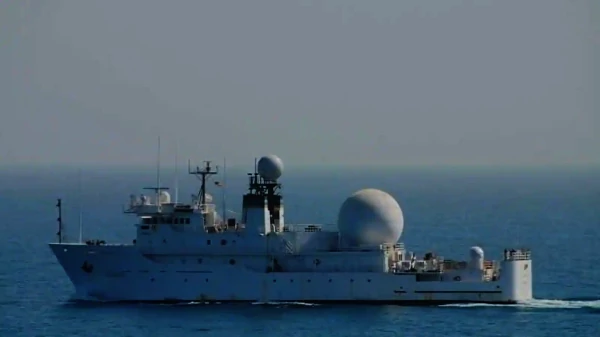
INS Dhruv is one of the most unusual ships in Indian service because it is neither a frontline destroyer nor a routine auxiliary. It is a purpose-built missile range instrumentation and ocean-surveillance vessel designed to do something India could previously do only in a more limited, land-linked way: track strategic missiles deep over the sea, collect telemetry from long-range tests, watch low-earth-orbit satellites, and feed that picture into the wider strategic warning network. Built by Hindustan Shipyard Limited and commissioned in September 2021, Dhruv is India’s first dedicated ship of this kind and places the country in a small group of navies that operate specialized sea-based missile tracking platforms.
Technically, what makes Dhruv valuable is its sensor architecture. Open reporting describes the ship as carrying advanced DRDO-linked AESA radar systems, including X-band and S-band arrangements, plus large tracking antennae and electronics suites meant to follow high-speed missile flights and gather telemetry over long oceanic arcs. That matters because a ballistic missile test does not remain over land for long; once it arcs over the Bay of Bengal or wider Indian Ocean, a sea-based platform becomes essential if you want fine-grained tracking data rather than a simple launch-and-impact narrative. In that sense, Dhruv is less a warship in the traditional firing sense and more a floating instrumentation complex with naval survivability and mobility.
Its design reflects that mission. Reporting on the ship’s induction describes a vessel roughly 175 metres long, over 10,000 tonnes in displacement, capable of about 21 knots, powered by twin diesel machinery and auxiliary generators, and fitted with a helicopter deck. Those figures by themselves do not make Dhruv exceptional; what does is how that volume is used. A ship this size can host large topside sensors, wide-aperture antennae, electronic intelligence equipment, and the onboard computing and analysis teams needed to process tracking data in real time. That is why Dhruv should be seen as a strategic sensor node at sea rather than just another support hull.
Indian reporting has consistently described Dhruv as an early-warning and tracking asset that works in conjunction with geostationary satellites, land-based radars, and ballistic missile defence networks. In practical terms, that means the vessel can detect and track hostile missile trajectories far out at sea, then help hand over the track to shore-based systems for further engagement logic. That is a very different role from ordinary naval surveillance. A frigate watches the maritime battlespace. Dhruv watches the strategic aerospace battlespace from the sea. That difference is what separates it from most auxiliary ships and even from many range-instrumentation vessels abroad, which are often optimized more narrowly for test support than for integration into a broader warning grid.
Another feature that makes Dhruv stand apart is its multi-domain utility. It is reported to monitor low-earth-orbit satellites, understand adversary missile performance, map parts of the ocean bed, and contribute to anti-submarine and broader maritime-domain awareness. That mix is unusually important for India because the country’s strategic competition is not confined to one axis. A ship that can observe missile tests, collect electronic intelligence, improve underwater battlespace knowledge, and watch reconnaissance satellites gives decision-makers a fused picture that is far more useful than single-role telemetry alone. Many countries operate specialized tracking ships; fewer field one that sits so visibly at the overlap of missile defence, ocean surveillance, space awareness, and intelligence collection.
Its command-and-crew model is also unusual. Dhruv is widely reported to be jointly manned or jointly operated by the Indian Navy, DRDO, and the National Technical Research Organisation. That tri-agency structure is a clue to the ship’s actual purpose. Dhruv sits much closer to the seam between operational fleet activity, strategic weapons development, and national technical intelligence. That gives it a character more comparable to a sovereign intelligence and test-support platform than to a conventional commissioned ship. In effect, India did not just build a ship; it built a mobile strategic sensor institution.
The best public demonstration of its relevance came after commissioning. During Mission Divyastra in March 2024, when DRDO conducted the first successful Agni-5 MIRV test, official statements said various telemetry and radar stations tracked the multiple re-entry vehicles, and subsequent reporting identified INS Dhruv as the ship that tracked the missile’s trajectory. That is the kind of mission for which Dhruv exists. MIRV testing is not merely about whether a missile flies; it is about whether the vehicle bus, release sequence, trajectory shaping, and re-entry packages behave exactly as planned. A sea-based tracker positioned downrange is critical for validating that performance with precision.
INS Dhruv is India’s first indigenous dedicated strategic tracking ship; it is part of a tri-agency intelligence-and-defence ecosystem; it contributes simultaneously to missile telemetry, ballistic-missile warning, satellite monitoring, and undersea battlespace understanding; and it has already been tied publicly to one of India’s most important strategic missile events, the Agni-5 MIRV test. In a navy, the loudest ships usually get the most attention. Dhruv is the opposite kind of asset: quiet in profile, enormous in consequence. It projects power by making India’s strategic forces more measurable, more aware, and therefore more credible.
Reference:
https://www.pib.gov.in/PressReleasePage.aspx?PRID=2013549
https://www.hslvizag.in/WriteReadData/userfiles/file/AnnualReports/69AR_2020-21_E.pdf
You may also like
-
India, Brazil and South Africa Strengthen Maritime Security Cooperation Through IBSAMAR IX Naval Exercise
-
India Establishes First High-Altitude Health Research Centre in Himachal Pradesh
-
Bengaluru Startup Astrome Wins Indian Army iDEX Challenge to Develop Indigenous Portable Electronic Intelligence System
-
DRDO’s Shakti Electronic Warfare System: India’s Indigenous Shield Against Radar and Missile Threats at Sea
-
DRDO Develops Generative AI Framework to Improve Military Object Recognition with Limited Training Data
