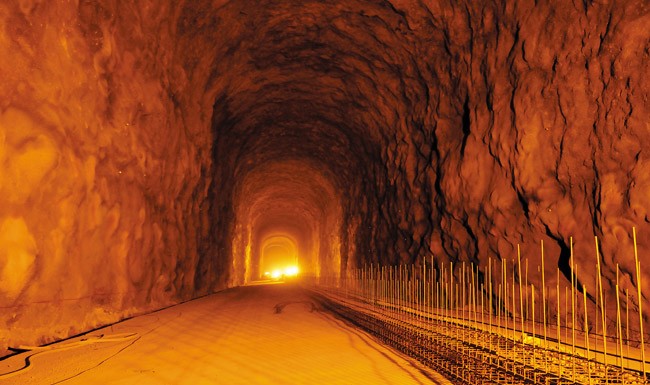
India’s current national capacity for storage of crude oil and petroleum products has reached 74 days after the addition of three new locations at Vishakhapatnam, Mangaluru and Padur.
Indian Strategic Petroleum Reserve Limited (ISPRL), a government-owned special purpose vehicle, has established Strategic Petroleum Reserves (SPR) facilities with the total capacity of 5.33 Million Metric Tonnes (MMT) at these three locations, according to the Ministry of Petroleum & Natural Gas.
As per the consumption pattern of 2019-20, the total capacity is estimated to provide for about 9.5 days of crude oil requirement.
In addition, Oil Marketing Companies (OMCs) in the country have storage facilities for crude oil and petroleum products for 64.5 days, thus the current total national capacity for storage of crude oil and petroleum products currently is 74 days.
Taking advantage of low crude oil prices in April-May 2020, the Strategic Petroleum Reserves have been filled to full capacity, leading to notional savings of approximately Rs 5000 crore, the ministry added.
Under Phase II of the SPR Programme, the government has given ‘in principle’ approval in June 2018 for establishing two additional SPR facilities with a total storage capacity of 6.5 MMT at two locations namely Chandikhol in Odisha (4 MMT) and Padur in Karnataka (2.5 MMT).
As per the consumption pattern of 2019-20, 6.5 MMT SPR capacity is estimated to provide for about additional 12 days of India’s crude oil requirement. This information was given by the Union Minister for Petroleum and Natural Gas Shri Dharmendra Pradhan in a written reply in the Rajya Sabha today.
Source: Timesnow
You may also like
-
SCI and India’s Push for a Larger Indigenous Maritime Fleet
-
Jawahar Dweep Becomes India’s First Plastic-Free Oil Terminal at Mumbai Port
-
Tata Projects and MDS Aero Partner to Build Advanced Aero-Engine Test Infrastructure in India
-
Centre Approves ₹1,176 Crore Six-Lane Bridge Across Teesta River on NH-10 at Sevoke
-
Essar-Backed Mesabi Metallics Announces $18 Billion US Steel Investment Linking Minnesota Mine With Iowa Plant
