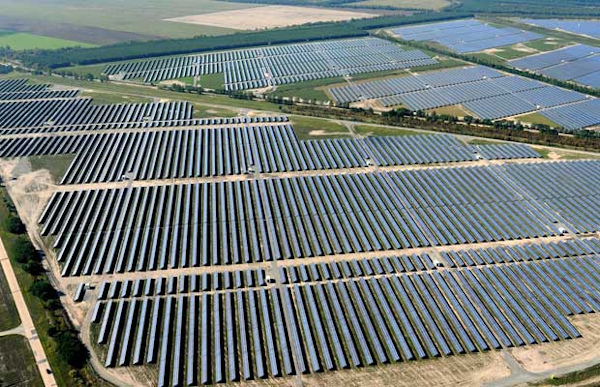
Bengaluru: In a boost to India’s renewables sector, it is expected to get investments to the tune of around USD 500 billion, in order to achieve the target of 450 gigawatts (GW) of capacity by 2030, as per a report on MoneyControl.
This, as per a report by the Institute for Energy Economics and Financial Analysis (IEEFA).
The report stated that pull factors for investments into the country include solar power tariffs hitting record lows, plunging solar module costs, record low-interest rates, and the security of government-backed 25-year power purchase agreements (PPAs).
“We estimate that striving for 450 gigawatts of renewable energy by 2030 would require deploying $500 billion of investment over the coming decade – $300 billion for wind and solar infrastructure, $50 billion on grid firming investments such as gas-peakers, hydro and batteries, and $150 billion on expanding and modernising transmission and distribution,” said Tim Buckley, Director Energy Finance Studies, South Asia, at the IEEFA, as quoted by the website.
“Domestic and global institutions across the financial, corporate, energy, utility and government sectors are primed to deploy a wall of capital that India needs to fund its ambitious renewable energy targets,” he added.
According to the report, the private equity, global pensions funds, sovereign wealth funds, oil and gas majors and multinational development banks could be the sources of capital.
India has an untapped renewable potential of 900 gigawatt (GW) and it is estimated that the country’s peak power demand will rise to 295GW by 2021-22 and 690GW by 2035.
Source:Mynation
You may also like
-
EON Space Labs and Dhruva Space Advance Indian Space Hardware on Transporter-18 Mission
-
SatLeo Labs’ TAPAS-1 Reaches Orbit, Advancing India’s Private Thermal-Imaging Capability
-
TakeMe2Space’s MOI-1A Reaches Space on Falcon 9 Transporter-18 Mission
-
Bank of Baroda Enters Pension Fund Management After PFRDA Appointment
-
SCI and India’s Push for a Larger Indigenous Maritime Fleet
