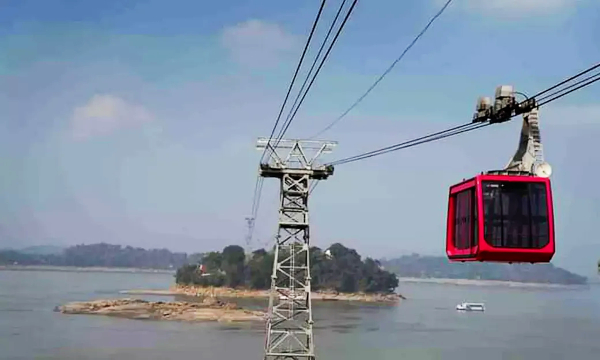
The 1.82 km bi-cable ropeway connects Guwahati and North Guwahati and has been constructed at a cost of Rs 56 crore. (India Today)
India’s longest passenger ropeway over the Brahmaputra river was formally inaugurated in Assam’s Guwahati city by state finance minister Dr Himanta Biswa Sarma on Monday.
The 1.82 km bi-cable ropeway connects Guwahati and North Guwahati and has been constructed at a cost of Rs 56 crore.
The ropeway will operate from Kachari Ghat in Panbazar up to the Dol Govinda temple in North Guwahati and it will cut down travel time across the river Brahmaputra from around 1 hour to 7-8 minutes.
The ropeway is a twin track, single haul, bi-cable, jig-back system with two cabins. Each cabin, with full safety measures, can carry 32 people (30 passengers and two operators) at a time, with an overall capacity of 250 persons per hour.
Umananda Doley, Chief Executive Officer (CEO) of Guwahati Development Department said that all the world class safety measures have been installed in the ropeway and latest Swiss technologies have been used to make it.
“This is the longest ropeway over river in the country. This ropeway is 1.82 km long across the Brahmaputra river. We have used rescue cables also and we can say that, it is 99 percent safe,” Umananda Doley said.
One way of ride will cost Rs 60 and two-way ride will cost Rs 100 to the passenger.
Overlooking the beautiful Brahmaputra river, the ropeway ride will facilitate the passengers to look out for the Urvashi island and catch a glimpse of the Umananda temple which was built by Ahom King Gadadhar Singha.
Source: IndiaToday
You may also like
-
India’s Infrastructure Expansion Shifts Focus From Kilometres Built to Hours Saved
-
India and United States Expand Indian Ocean Cooperation Through Strategic Connectivity and Maritime Initiatives
-
India Demonstrates First 5.56 km Free-Space Quantum Key Distribution Link
-
India’s Quantum-Secure Network Reaches 1,000 km as National Quantum Mission Advances Towards 2,000-km Goal
-
SCI and India’s Push for a Larger Indigenous Maritime Fleet
