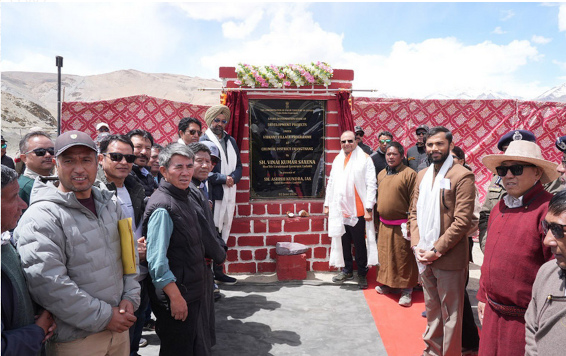
India has taken a major step in strengthening life along its Himalayan frontier with the launch of Ladakh’s first Model Border Village at Chumur, a remote settlement located near the India-China border in eastern Ladakh’s Changthang region. Sitting at an altitude of nearly 16,700 feet, Chumur represents one of the toughest inhabited landscapes in the country, where harsh winters, thin air, difficult access and limited civic facilities have long shaped the lives of local residents.
The new project aims to transform Chumur from a vulnerable frontier hamlet into a self-reliant, climate-resilient and economically active border village. The initiative is being developed under the Vibrant Village Programme, which focuses on improving habitations located along India’s northern borders. Chumur has been chosen as the first model settlement in Ladakh, setting the stage for a wider plan to develop more border villages in the region.
Chumur is home to 24 households with a population of 91 people. The community is closely linked to Pashmina rearing and production, a traditional livelihood that has sustained families in this high-altitude terrain for generations. By placing livelihood at the centre of the project, the new village plan seeks to protect local identity while creating fresh income opportunities through better infrastructure, tourism, animal care, handicrafts and market access.
One of the most important parts of the project is the creation of climate-suitable housing. The new homes are expected to use passive solar design, helping residents stay warmer in extreme cold while reducing dependence on conventional heating. These houses will also include attached bathrooms, homestay rooms, animal shelters and fodder storage facilities. This approach recognises the unique lifestyle of Ladakh’s nomadic and semi-nomadic communities, where livestock, wool, shelter and family economy are deeply connected.
The inclusion of homestay rooms gives the project a tourism dimension. Chumur’s stark landscape, frontier location and cultural richness can attract controlled, responsible tourism in the future. Instead of treating border communities only as security-sensitive populations, the model village plan presents them as active partners in local development. Tourism, when supported with proper roads, communication and basic facilities, can bring additional income to households while giving visitors a deeper understanding of life in India’s high-altitude borderlands.
Food security is another important focus. A commercial greenhouse is planned with technical support so that vegetables can be grown through the year despite the cold desert climate. This can reduce dependence on distant supply chains and improve nutrition in a region where fresh produce is difficult to access during harsh weather. In a place like Chumur, even a greenhouse is more than an agricultural asset; it becomes a symbol of survival, adaptation and local resilience.
The village plan also includes a central service centre with essential civic facilities such as a school, primary health centre, community hall, park, café and tourist information centre. These additions can improve daily life for residents and reduce the pressure to migrate from border areas to larger towns. Better education, healthcare, public gathering spaces and visitor facilities can turn Chumur into a functioning community hub rather than a distant outpost surviving on limited services.
The strategic value of the project is equally significant. Border villages are not just settlements on a map; they are living markers of national presence. When people continue to live, work and prosper in frontier areas, the border becomes socially stronger. Roads, communications, renewable energy, livelihood support and civic infrastructure create a human shield of confidence, belonging and continuity. In high-altitude regions near the Line of Actual Control, such development carries both civilian and strategic importance.
The Chumur model also reflects a shift in India’s border policy. Earlier, many frontier villages suffered from neglect because remoteness was often seen as a natural condition. The new approach treats these villages as engines of security, culture and economic participation. A vibrant border village can support local livelihoods, improve surveillance through civilian presence, encourage tourism, reduce migration and strengthen trust between residents and the administration.
For Ladakh, the project has special meaning. The region’s geography is beautiful but unforgiving. Its people have preserved delicate traditions of pastoral life, Buddhist culture, high-altitude trade memory and ecological discipline. Development in such a landscape must be sensitive, sustainable and locally rooted. Chumur’s model village plan attempts to combine modern civic facilities with traditional livelihoods like Pashmina, creating a future that does not erase the past.
The success of this project will depend on timely execution, weather-resistant construction, reliable maintenance and continuous participation of local residents. Buildings alone cannot make a village vibrant. Schools need teachers, health centres need medical staff, homestays need training, roads need upkeep, greenhouses need technical support and local products need market linkage. If these pieces come together, Chumur can become a benchmark for border development across Ladakh.
The launch of the Model Border Village at Chumur is therefore more than a construction project. It is a statement that India’s frontier citizens deserve dignity, opportunity and modern facilities without being forced to leave their ancestral landscape. In the cold silence of eastern Ladakh, Chumur is being prepared to stand as a living village of resilience, livelihood and national confidence.
You may also like
-
Indian Navy Vice Chief Inspects Japan’s Mogami-Class Stealth Frigate as India-Japan Shipbuilding Cooperation Expands
-
Philippine Marine Wargames Reportedly Show BrahMos Can Penetrate Chinese Destroyer Air Defences
-
Safran Signs 18 Agreements with Indian Aerospace Suppliers, Expanding Make in India Manufacturing Partnerships
-
Indian Army’s Vajra Corps Certifies First Batch of Drone Operators, Strengthens Battlefield Surveillance
-
India to Seek 35% Increase in Defence Modernisation Budget for FY 2027–28
