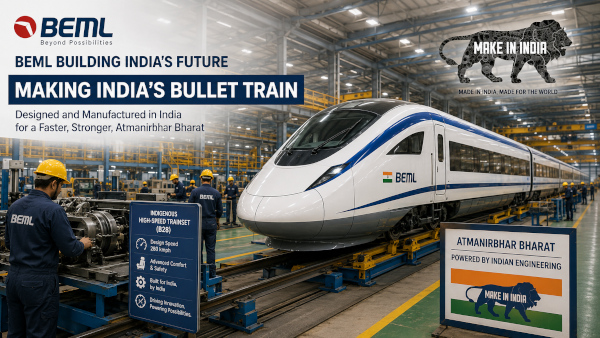
India’s high-speed rail journey is preparing for a major breakthrough with the development of the country’s first indigenous bullet train, known as the B28. The trainset is being developed by BEML at its Bengaluru facility and is expected to support the first phase of operations on the Mumbai-Ahmedabad High-Speed Rail Corridor in 2027.
The B28 marks an important step in India’s rail manufacturing capability. It is designed as a high-speed trainset with a maximum design speed of 280 kmph and an initial operational speed of around 250 kmph. The train is expected to be deployed first on the Surat-Vapi stretch, a 97-km section of the Mumbai-Ahmedabad bullet train corridor, with operations planned for August 2027.
The Mumbai-Ahmedabad High-Speed Rail Corridor is India’s first bullet train project and spans around 508 km, connecting Maharashtra and Gujarat through a modern high-speed rail network. Once fully operational, the corridor is expected to transform intercity mobility between Mumbai, Vapi, Surat, Bharuch, Vadodara, Anand and Ahmedabad. The project is being implemented by the National High Speed Rail Corporation Limited and is one of India’s most ambitious transport infrastructure programmes.
The B28 trainset is significant because it represents India’s move towards domestic capability in high-speed rolling stock. BEML was awarded the contract by the Integral Coach Factory to design, manufacture and commission two high-speed trainsets. The project is valued at around ₹866.87 crore and is being seen as a foundation for future indigenous high-speed rail development.
The train will be manufactured at BEML’s rail coach complex in Bengaluru. The company has been preparing the production ecosystem for the project, including facilities required for advanced coach manufacturing. The newly developed Aditya high-speed rail complex at BEML is expected to support the production of B28 coaches and strengthen India’s capacity to build advanced rail systems domestically.
Passenger comfort and safety are expected to be central features of the B28. The trainset will have fully air-conditioned coaches, modern seating, improved passenger amenities and provisions for passengers with restricted mobility. Features such as reclining and rotatable seats, onboard infotainment systems and upgraded interiors are expected to give passengers a premium high-speed travel experience.
The B28 is also being designed for Indian operating conditions. High-speed trains in India must perform across hot weather, humidity, dust, monsoon conditions and long-distance operational demands. This makes the project different from simply importing a foreign trainset. The B28 is expected to incorporate engineering solutions suited to India’s climate, track environment and passenger requirements.
The Mumbai-Ahmedabad corridor itself includes several complex engineering features. One of the most important is the 21-km tunnel section, which includes India’s first 7-km undersea tunnel under Thane Creek. The project also includes elevated tracks, modern stations, advanced signalling systems and dedicated high-speed infrastructure built to global standards.
The initial use of the B28 on the Surat-Vapi stretch will allow Indian Railways and project agencies to test and refine operations before larger commercial rollout. The trainset is expected to undergo extensive testing, including factory-level trials, depot-level checks, mainline testing and certification processes. These tests will be crucial for validating performance, braking, ride quality, systems integration and passenger safety.
The decision to use an India-made high-speed trainset also fits into the wider Atmanirbhar Bharat vision. Over the past decade, India has expanded its domestic railway manufacturing capabilities through Vande Bharat trains, metro coaches, semi-high-speed trainsets and advanced signalling upgrades. The B28 takes this progress into the high-speed rail category.
For India, the strategic value of the B28 goes beyond one corridor. Once domestic expertise is established, it can support future high-speed rail projects in other parts of the country. It can also create a local supply chain for advanced propulsion systems, bogies, braking systems, interiors, electronics, control systems and high-speed coach components.
The project can also help Indian manufacturers move up the technology ladder. High-speed rail requires precision engineering, advanced materials, aerodynamic design, safety validation and strict quality standards. Developing such capability within the country can strengthen India’s railway industry and open opportunities for future exports in rail technology.
The Surat-Vapi launch will be watched closely because it will mark the first operational step for India’s bullet train era. The 97-km section is expected to serve as the opening stage of the larger Mumbai-Ahmedabad corridor. As more sections are completed, high-speed connectivity can reduce travel time, improve regional integration and support economic activity across western India.
The B28 also signals a shift in how India approaches major transport technology. Instead of depending only on imported systems, the country is building the capacity to absorb, adapt and manufacture advanced mobility solutions. This approach can reduce long-term costs, improve maintenance flexibility and create a stronger domestic industrial base.
India’s first indigenous bullet train is therefore more than a new train. It represents a new phase in railway modernisation, industrial capability and high-speed mobility. With the B28 expected to move towards rollout in 2027 and the Mumbai-Ahmedabad corridor entering its first operational phase, India is preparing to join the league of nations with domestically supported high-speed rail systems.
You may also like
-
PM Dhan-Dhaanya Krishi Yojana Completes One Year: Gaya, Nagaur and Umaria Emerge as Best-Performing Districts
-
Political Protests in India: Economic Losses, Export Disruptions and the Impact on Investor Confidence
-
Jeeraphool Rice of Chhattisgarh — Surguja’s Fragrant Cumin-Shaped Heritage Grain
-
India’s E-Commerce Platforms Record ₹24,000 Crore Festive Sales in Two Days as Meesho Reports 75% Surge in Orders
-
India’s Economic Warfare Challenge: Strategic Autonomy, Energy Security and the Rise of a Global Power
