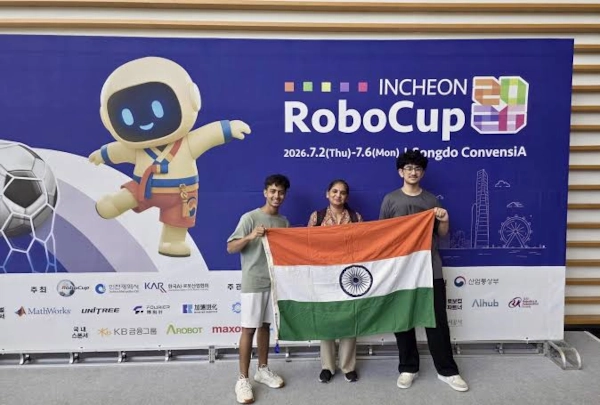
Two Class XI students from Shiv Nadar School, Noida, have brought international recognition to India by securing first place in the RoboCupJunior Rescue Line SuperTeam Challenge at RoboCup 2026 in Incheon, South Korea.
Ayaan Suri and Tanash Garg represented Team System Override in one of the championship’s most technically demanding student categories. The Indian team was paired with Croatia’s NLO Rescue CRO Team for the SuperTeam event, in which students from different countries had to integrate their independently designed robotic systems and complete a coordinated rescue mission.
The official RoboCupJunior Rescue results placed System Override and NLO Rescue CRO Team jointly in first position in the Rescue Line SuperTeam competition. The Rescue Line division itself attracted 26 teams, while 29 competed in Rescue Maze and 13 participated in Rescue Simulation.
A Global Robotics Competition
RoboCup 2026 was held in Songdo, Incheon, from July 2 to July 6, bringing together students, researchers, engineers and robotics teams from around the world.
Established in 1997, RoboCup has grown into a major international platform for robotics and artificial-intelligence research. Its long-term scientific objective is to develop a fully autonomous humanoid robot football team capable of defeating the human football World Cup champions by 2050.
Alongside its advanced research leagues, RoboCup conducts RoboCupJunior, an educational programme intended to introduce school students to robotics, programming, artificial intelligence, engineering design and collaborative problem-solving.
The junior competitions include robotic football, creative robotic performances and disaster-response simulations. Participants must design their own machines, develop control software, document the engineering process and explain their technical decisions to judges.
Simulating a Disaster-Rescue Mission
The RoboCupJunior Rescue Line challenge places autonomous robots in an environment representing a disaster zone considered too dangerous for human rescuers.
A robot must follow a marked route while negotiating ramps, uneven surfaces, intersections, obstacles, debris and gaps. After reaching the rescue area, it must locate simulated victims, transport them to a designated evacuation point and complete the mission without direct human control.
The machine must possess sufficient intelligence to interpret sensor data, adjust its route and react to unexpected conditions in real time. Accuracy, mechanical reliability, software efficiency and the ability to operate autonomously are central to the challenge.
The SuperTeam component adds another layer of complexity. Teams from different countries are grouped together and asked to make their independently built robots cooperate on a common assignment.
In the 2026 challenge, Team System Override worked with the Croatian team to perform a coordinated task involving object collection, colour recognition and communication between robots. The students had to rapidly understand each other’s machines, divide responsibilities and develop a shared strategy within the competition environment.
Technology Behind Team System Override’s Robot
Team System Override developed a compact autonomous robot combining LEGO Mindstorms EV3 components with programmable microcontrollers, machine vision, laser-based distance sensors and custom-fabricated parts.
The robot used an EV3 brick as its principal controller, supported by two Arduino Nano microcontrollers and an OpenMV programmable camera. Communication between these systems enabled the machine to collect information from several sensors while controlling its motors, rescue mechanism and navigation software.
Two Time-of-Flight infrared sensors helped the robot detect obstacles and identify openings in the evacuation zone. A gyroscopic sensor measured the robot’s roll and pitch, allowing it to recognise ramps and maintain stability while travelling over uneven sections.
Colour sensors supported line-following and intersection detection, while ultrasonic and infrared sensors provided additional information about walls, ramps, victims and reflective surfaces.
The OpenMV camera was programmed to identify simulated victims, evacuation points and goal tiles. The team trained its machine-learning model using more than 5,000 self-labelled images, allowing the robot to recognise objects under different competition conditions.
The robot’s software was distributed across several programming environments. The EV3 controller handled the principal movement logic, the Arduino boards were programmed in C++, and the OpenMV camera used MicroPython.
This multi-controller design helped the students overcome the limitations of individual hardware platforms while maintaining rapid communication among the robot’s sensors and actuators.
Engineering for Difficult Terrain
The team’s robot used tracks rather than conventional wheels to improve traction on ramps, speed bumps and irregular surfaces. Its frame was made lighter by modifying the EV3 casing and removing unnecessary material.
A removable arm-and-claw mechanism was developed to collect and transport victims. The assembly combined LEGO mechanical components with customised three-dimensional-printed parts, making it easier to repair or replace during testing.
The students also developed a Pathfinder algorithm that allowed the machine to correct its route when it lost the rescue line or encountered a sharp turn. Sensor readings were analysed continuously so that the robot could determine its position and return to the correct path.
Inside the evacuation zone, the robot used its camera to identify victims, aligned itself with the selected object and activated its mechanical arm. After depositing the victim in the required area, it used Time-of-Flight sensors to locate the exit and resume navigation.
Years of Preparation Behind the Victory
The achievement represents the culmination of several years of experimentation by the students.
Ayaan Suri, the team lead, worked on the robot’s hardware, electronics, programming, documentation, three-dimensional modelling and custom components. Tanash Garg contributed to programming, electronics, research, documentation and the development of the OpenMV camera system.
The wider System Override team also included programmer and researcher Shaurya Mahajan during its development and national competition stages. The team’s technical documentation identifies Shiv Nadar School, Noida, as its institution and Ganga Bhuvaneswari Subramanian as its mentor.
System Override had previously secured second place at the RoboCup India Nationals in 2024 and 2025. Its earlier international achievements included first place at RoboCup Asia-Pacific competitions in South Korea and China, followed by a victory at the Singapore Open in 2025.
These experiences helped the students refine their robot through repeated design changes, sensor calibration, software debugging and field testing.
Collaboration Beyond National Boundaries
The SuperTeam format tests skills extending beyond robot construction. Participants must communicate with students from another country, understand unfamiliar hardware and software, identify the strengths of each robot and develop a combined strategy within a limited period.
For Ayaan Suri and Tanash Garg, cooperation with their Croatian partners became an important part of the championship experience. Their victory demonstrated how technical knowledge must be supported by adaptability, communication and teamwork.
The RoboCupJunior Rescue Committee also emphasised that the 2026 competition assessed more than robot performance. Teams were evaluated on their engineering processes, technical papers, posters and their ability to explain and share their work.
Encouraging India’s Young Robotics Talent
Team System Override’s success reflects the expanding interest in robotics, artificial intelligence and practical engineering among Indian school students.
Competitions such as RoboCup expose young learners to disciplines that are increasingly central to autonomous vehicles, industrial automation, medical robotics, disaster response, defence technology and intelligent manufacturing.
Students learn to integrate mechanical engineering, electronics, computer vision, programming and data analysis into a functioning system. They also experience the real engineering cycle of designing, testing, failing, correcting and rebuilding.
The victory in Incheon is therefore significant beyond the medal itself. It shows that Indian school students can design sophisticated autonomous systems, compete successfully against strong international teams and collaborate across national and technological boundaries.
Team System Override’s achievement provides another example of how sustained mentorship, access to practical laboratories and student-led experimentation can nurture the next generation of Indian engineers and technology innovators.
Reference Block
RoboCupJunior Rescue League RoboCupJunior 2026 Rescue — Official Award List Rescue Line SuperTeam First Place: System Override and NLO Rescue CRO Team https://rescue.rcj.cloud/events/2026/RoboCup2026/award RoboCupJunior Rescue League RoboCup 2026 Junior Rescue Event Page Incheon, Republic of Korea https://rescue.rcj.cloud/events/2026/RoboCup2026/ RoboCup 2026 Incheon Official Championship Website
HomeRoboCupJunior Official Rescue Line Challenge Description and Rules
RCJ Rescue LineTeam System Override Official Team Website https://teamsystemoverride.godaddysites.com/ Team System Override RoboCup Nationals 2026 Team Description Paper https://img1.wsimg.com/blobby/go/4c9997da-0e15-49da-9825-da2b4a295576/Nationals%202026-4.pdf
You may also like
-
Indian Physicist Ashoke Sen Becomes First Indian to Receive Prestigious Oskar Klein Medal
-
Indian Army’s Northern Command Opens 75-Day Defence Technology Internship Programme for Young Innovators
-
Ayush Patent Filings Rise Eightfold as India Records 4,077 Applications and 711 Grants in 12 Years
-
DRDO Announces Paid Research Internships at Gwalior for Science and Engineering Students
-
PM-SETU: Government Approves ₹1,194.92 Crore to Modernise 25 ITIs Across Maharashtra, Odisha and Jammu & Kashmir
