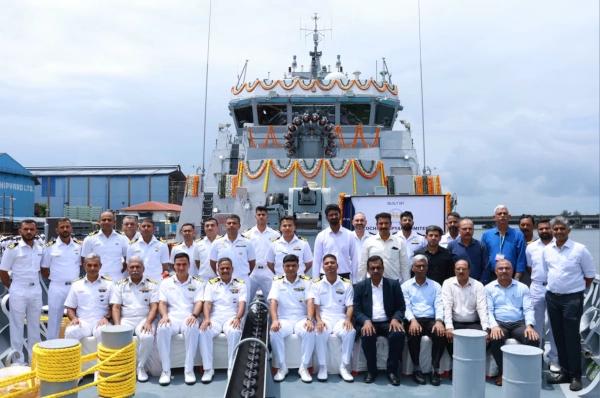
The Indian Navy has taken delivery of Mangrol, the third Anti-Submarine Warfare Shallow Water Craft (ASW-SWC) constructed by Cochin Shipyard Limited (CSL), Kochi. The vessel was formally delivered to the Navy on 21 August 2026, marking another step forward in India’s effort to strengthen indigenous naval shipbuilding and coastal anti-submarine warfare capabilities.
With more than 80 percent indigenous content, Mangrol reflects the increasing participation of Indian industry in the development and construction of specialised naval platforms. The vessel has been designed primarily for operations in India’s coastal waters, where shallow-water environments present unique challenges for detecting and tracking underwater threats.
Designed for Coastal Anti-Submarine Warfare
Mangrol is equipped to conduct a range of maritime security missions, with a particular emphasis on underwater surveillance and Anti-Submarine Warfare operations in coastal waters. Its capabilities also extend to Low-Intensity Maritime Operations (LIMO) and mine warfare missions.
The vessel incorporates modern sensors and weapons designed to detect and engage underwater threats. Its equipment includes advanced radars and sonars, along with torpedoes and anti-submarine rockets, providing it with the ability to undertake both surveillance and offensive ASW missions.
The craft is propelled by waterjets, a propulsion arrangement well suited to fast manoeuvring in coastal and shallow-water environments. This enables the vessel to respond rapidly to changing operational situations while operating in confined maritime areas.
Continuing a Distinguished Naval Name
The vessel has been named after Mangrol, a coastal town and minor port in Gujarat’s Junagadh district. The town is an important harbour for the region’s marine fishing industry and has a long association with India’s western coastline.
The name also carries a naval legacy. The present vessel continues the tradition of INS Mangrol, an Indian Naval minesweeper that served in the Indian Navy until 2004. By retaining the name, the Navy has carried forward the legacy of an earlier generation of warships while assigning it to a modern platform designed for contemporary maritime security requirements.
Strengthening India’s Indigenous Naval Fleet
The delivery of Mangrol is significant not only from an operational perspective but also for India’s expanding indigenous defence manufacturing ecosystem.
The vessel’s high level of indigenous content demonstrates the increasing ability of Indian shipyards and domestic defence companies to design, manufacture and integrate sophisticated equipment for the Indian Navy. The growing use of locally produced systems also supports the Government’s broader Aatmanirbhar Bharat initiative in defence.
For the Indian Navy, the induction of specialised shallow-water combatants is particularly important as maritime security increasingly requires persistent surveillance of India’s extensive coastline, approaches to major ports and other strategically important coastal areas.
The delivery of Mangrol therefore adds another specialised capability to the Navy’s fleet while reinforcing India’s long-term transition towards greater self-reliance in naval platform construction and defence technology.
As more indigenously built vessels enter service, India’s naval shipbuilding ecosystem is steadily expanding its ability to deliver platforms tailored to the country’s specific maritime requirements. Mangrol represents another milestone in that continuing journey.
Source: https://www.pib.gov.in/PressReleaseDetail.aspx?PRID=2302253®=48&lang=1
You may also like
-
Indian Semiconductor Companies Propose New Manufacturing and Chip Design Investments in Madhya Pradesh
-
CSIR-CRRI Partners with Industry to Develop Advanced Indigenous Airport Runway and Pavement Materials
-
Paras Semiconductors Secures 43 Acres in Madhya Pradesh for Proposed ₹6,200 Crore Advanced Chip Packaging Facility
-
Indian Army Special Forces Depart for Indonesia for Exercise Garuda Shakti 2026
-
India to Train 600 Nigerian Army Soldiers in Specialised Jungle and Mountain Warfare
