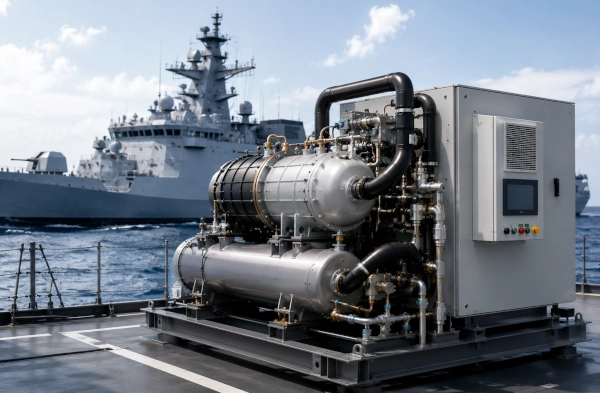
The Indian Navy has placed a ₹3.93-crore order with Shree Refrigerations Limited for the supply of a Magnetic Bearing Compressor Based Air-Conditioning Plant, adding another specialised naval cooling-system contract to the Indian company’s growing defence portfolio.
Shree Refrigerations disclosed the order to the stock exchanges on 29 August 2026. According to the regulatory disclosure, the contract was awarded by the Controller of Procurement, Material Organisation, Mumbai, Indian Navy. The order is valued at ₹3.93 crore excluding GST and is to be completed within 365 days, with delivery scheduled by 28 August 2027. The underlying order is dated 28 August 2026.
Although comparatively modest in monetary value when measured against major warship, missile or radar contracts, the order is technologically noteworthy. Magnetic-bearing compressors represent an advanced form of high-capacity cooling technology in which the rotating compressor shaft is supported using magnetic fields rather than conventional lubricated mechanical bearings. This allows the compressor to operate without the traditional oil-lubrication system and significantly reduces mechanical contact within the machine.
For a modern naval fleet increasingly dependent on high-power electronics, sensors, communications systems and tightly controlled onboard environments, cooling equipment is an essential part of the platform’s operational infrastructure.
Magnetic Bearings Replace Conventional Mechanical Contact
Traditional compressor systems generally depend on mechanical bearings and lubricating oil to support high-speed rotating components. Magnetic-bearing compressors use actively controlled electromagnetic bearings to suspend the rotating shaft, eliminating physical contact between the shaft and bearing surfaces during normal operation.
The resulting architecture can reduce frictional losses, eliminate the need for compressor lubrication oil and reduce several maintenance requirements associated with conventional oil systems.
The United States Department of Energy’s evaluation of magnetic-bearing chiller compressors notes that these systems operate without lubricating oil and can achieve particularly strong efficiency at partial loads when combined with variable-speed drives. Removing oil also avoids performance degradation associated with oil entering heat exchangers and reduces maintenance associated with lubrication systems.
Magnetic-bearing compressors can additionally offer quieter operation, reduced vibration, relatively low starting current and lower maintenance requirements because several mechanically contacting components present in conventional compressors are eliminated.
These characteristics make the technology particularly interesting for applications where reliability, space utilisation, energy efficiency and continuous operation are important.
Why Air Conditioning Is Critical Aboard Warships
Air conditioning aboard a naval vessel performs a much broader function than simply providing crew comfort.
Modern warships contain substantial concentrations of electrical and electronic equipment. Combat-management systems, radar processors, communications equipment, electronic-warfare systems, power electronics, computers and other onboard machinery generate considerable heat and may require controlled environmental conditions for reliable operation.
A ship operating for prolonged periods in tropical waters must also manage high ambient temperatures and humidity while operating within a confined structure containing machinery, personnel and heat-generating equipment.
HVAC and chilled-water systems consequently form part of a warship’s essential auxiliary infrastructure. Failure or degraded performance of those systems can affect habitability and the environmental conditions required by onboard equipment.
Shree Refrigerations itself describes naval HVAC and refrigeration equipment as mission-critical infrastructure serving both warships and submarines. Its systems include AC plants, refrigeration plants, turnkey HVAC&R installations and associated electrical control panels.
Shree Refrigerations Has Already Introduced Magnetic-Bearing Cooling to Indian Naval Programmes
The latest order is not Shree Refrigerations’ first engagement with magnetic-bearing compressor technology.
The company entered the marine HVAC business in 2012 and subsequently expanded rapidly into specialised Indian Navy requirements. Its corporate disclosures indicate that it secured its first tender for magnetic-bearing chillers for Project 17A frigates in 2019, after developing and demonstrating the technology for naval applications.
The company’s list of naval programmes states that it has supplied or is supplying magnetic-bearing compressor AC plants for Project 17A stealth frigates, while magnetic-bearing AC plants and refrigeration plants also feature in its work associated with the Indian Navy’s Fleet Support Ship programme.
Project 17A is producing India’s new generation of Nilgiri-class stealth frigates through Mazagon Dock Shipbuilders Limited and Garden Reach Shipbuilders & Engineers. The programme incorporates extensive indigenous equipment across propulsion auxiliaries, electrical systems, weapons, sensors and ship services.
The company has stated that it introduced an oil-free compressor-based chiller solution to the Indian Navy, describing the development as one of the important technological milestones in its expansion into naval cooling systems.
The latest ₹3.93-crore order therefore appears within an established technological line rather than representing Shree Refrigerations’ first magnetic-bearing system.
However, the company’s 29 August disclosure does not identify the warship class, submarine, shipyard or naval platform for which the newly ordered AC plant is intended. It would therefore be incorrect to associate this particular order with Project 17A, the Fleet Support Ships or any other specific naval programme unless the Navy or the company makes a subsequent disclosure.
From Scorpene Submarines to Frontline Warships
Shree Refrigerations’ involvement in Indian naval programmes has expanded considerably over the past decade.
One of its important indigenisation projects was the development of air-conditioning equipment for India’s Scorpene-class submarines. Company management has stated that it developed an indigenous submarine HVAC system and supplied locally manufactured air conditioners and control panels for the Scorpene programme.
Its disclosed naval portfolio also includes cooling equipment associated with INS Dhruv, INS Jalashwa, Project 17A frigates, anti-submarine warfare vessels, cadet training ships, Fast Patrol Vessels, Next Generation Offshore Patrol Vessels and Fleet Support Ships.
The company has progressively moved from supplying individual refrigeration and AC equipment towards offering complete HVAC solutions, control panels, installation, commissioning, spares and lifecycle support.
This is important in naval shipbuilding because HVAC systems extend through a considerable portion of a vessel. They involve chillers and refrigeration equipment as well as pumps, ducting, piping, electrical controls, air-handling equipment, monitoring systems and integration with the ship’s broader electrical and machinery architecture.
Three Indian Navy Registrations Support End-to-End Capability
Shree Refrigerations has highlighted its approvals from multiple professional directorates associated with Indian naval procurement.
The company’s FY2026 investor presentation lists registrations covering AC and refrigeration plants, HVAC systems and motor-starter/control panels. These approvals allow it to participate across several components of naval cooling-system requirements rather than supplying only a single category of equipment.
According to the company, this combination provides it with an end-to-end capability covering equipment manufacture, complete HVAC systems and electrical control panels.
That capability is particularly relevant as India’s naval shipbuilding programmes seek to increase the percentage of domestically sourced equipment incorporated into new vessels.
Local Capability Extends to Magnetic-Bearing Compressor Servicing
An important development took place in March 2026 when Danfoss Turbocor selected Shree Refrigerations as a Turbocor Authorised Service Partner in India.
According to Shree Refrigerations’ FY2026 annual report, the agreement was signed on 17 March 2026 and allows the company to undertake specialised support associated with Turbocor magnetic-bearing compressors. Shree Refrigerations said the facility would support the Indian Navy’s use of oil-free magnetic-bearing compressor-based chillers aboard frontline ships.
The development has implications beyond initial equipment manufacturing.
A defence system cannot be considered truly sustainable merely because it is assembled domestically. Availability of maintenance, repair, spares, trained engineers, diagnostics and lifecycle support within India is equally important, particularly for naval vessels that may remain operational for several decades.
Building local servicing capability for specialised compressor technology can therefore reduce dependence on overseas maintenance and shorten repair and turnaround cycles.
A Growing Defence HVAC Order Book
Shree Refrigerations entered FY2026-27 with an order book exceeding ₹271 crore, according to its annual report. The company has identified defence-oriented refrigeration and HVAC systems as one of its principal areas of growth.
Earlier in February 2026, the company announced that it had secured more than ₹40 crore in fresh Indian Navy orders within approximately two months. Those contracts largely concerned retrofitting and upgrading existing equipment with higher-performance systems as well as supplying replacement spares. At that point, its total order book exceeded ₹320 crore.
This mix of new-build, retrofit, spares, commissioning and lifecycle-support contracts is significant because India’s naval expansion is creating demand not only for equipment fitted aboard new warships but also for the continued modernisation and maintenance of vessels already in service.
Naval HVAC Is Becoming More Technologically Demanding
The requirements placed on naval cooling systems are also increasing.
Modern naval vessels carry more electronically intensive systems than previous generations. Phased-array radars, electronic-warfare suites, computers, communications equipment and power electronics can create substantial thermal loads. Future warships are expected to carry still greater electrical demand as directed-energy systems, more powerful sensors, unmanned systems and increasingly extensive computing infrastructure become commonplace.
Cooling architecture therefore becomes part of the broader challenge of managing energy aboard a warship.
Variable-speed and magnetic-bearing technologies can offer advantages when cooling demand changes considerably during different operating conditions. Instead of operating continuously at full output, a variable-speed compressor can modify its operation according to actual cooling requirements.
Research and operational evaluations of magnetic-bearing chillers have shown particularly strong efficiency improvements under partial-load conditions.
For a ship with changing operational and environmental loads, such flexibility can potentially contribute to more efficient electrical-power utilisation.
The exact performance specifications of the equipment covered by Shree Refrigerations’ latest Navy contract—including its cooling capacity, refrigerant, electrical consumption, redundancy arrangement and compressor configuration—have not been publicly disclosed.
Indigenous Auxiliary Systems Matter as Much as Major Weapons
Defence indigenisation is often discussed primarily in connection with missiles, aircraft, guns, radars and combat vehicles. Warships, however, are enormously complex integrated systems containing thousands of components, many of which are not weapons but are nevertheless essential to remaining operational at sea.
Pumps, compressors, chillers, electrical panels, valves, ventilation equipment, power-conversion systems, firefighting equipment and machinery-control systems form the supporting architecture that enables a combat vessel to function.
Reducing import dependence in these categories is consequently an important part of increasing the indigenous content of Indian-built ships.
The development of domestic suppliers capable of designing specialised equipment to naval requirements also makes it easier to sustain vessels over long service lives, modify systems during mid-life upgrades and obtain replacement components without relying exclusively on foreign original-equipment manufacturers.
A Small Contract with Wider Technological Significance
At ₹3.93 crore, the latest Indian Navy contract is small compared with the multi-thousand-crore acquisition programmes usually associated with naval modernisation. Its importance lies instead in the technology being procured and in the expanding domestic industrial base supporting India’s warships.
Magnetic-bearing compressor technology removes conventional lubricated bearing contact from the compressor, enabling an oil-free cooling architecture with potential advantages in efficiency, maintenance, vibration and noise.
Shree Refrigerations has already introduced such systems into Indian naval programmes and has built a wider portfolio encompassing warships, submarines, refrigeration plants, control panels and complete HVAC installations.
The latest order from the Indian Navy’s Controller of Procurement, Material Organisation, Mumbai, therefore represents another incremental step in that process. The ₹3.93-crore system is scheduled for delivery by 28 August 2027, while the specific vessel or programme for which it is intended remains undisclosed.
Seen within the larger trajectory of India’s naval indigenisation programme, such contracts demonstrate that self-reliance is spreading beyond visible combat systems into the specialised machinery and auxiliary technologies that keep increasingly sophisticated Indian-built warships operational at sea.
Sources
Shree Refrigerations Limited — Stock Exchange Disclosure on Indian Navy Order, 29 August 2026:
https://in.marketscreener.com/news/shree-refrigerations-limited-receives-order-from-indian-navy-controller-procurement-material-organis-ce7858dcdb8cf62d
Shree Refrigerations Limited — Company Milestones and Naval HVAC Programmes:
https://shreeref.com/milestone.php
Shree Refrigerations Limited — Investor Presentation, Naval and Defence Programmes:
https://www.shreeref.com/img/MT/Reg%2030_Investor%20Presentation_November%202025_26.11.2025.pdf
Shree Refrigerations Limited — FY2026 Investor Presentation:
https://www.shreeref.com/img/MT/Reg%2030%20Investor%20Presentation%20Intimation%20H2%20%26%20FY26_sd.pdf
Shree Refrigerations Limited — FY2026 Earnings Conference Call Transcript:
https://www.shreeref.com/img/Webcast/Reg%2030.%20Transcript%20of%20Earnings%20Conference%20Call%2026.05.2026.pdf
Shree Refrigerations Limited — February 2026 Indian Navy Order Disclosure:
https://shreeref.com/img/MT/Reg%2030_Receiving%20of%20Order_06.02.2026.pdf
Shree Refrigerations Limited — Annual Report 2025–26:
https://financialfilings.com/filings/shree-refrigerations-limited/annual-report/2026/52274879/
U.S. Department of Energy — Magnetic-Bearing Chiller Compressors:
https://www.energy.gov/cmei/femp/magnetic-bearing-chiller-compressors
You may also like
-
Exercise Tarang Shakti 2026 Concludes in Jodhpur, Showcasing India’s Air Power, Indigenous Defence Technology
-
Indian Navy Vice Chief Inspects Japan’s Mogami-Class Stealth Frigate as India-Japan Shipbuilding Cooperation Expands
-
India and Russia Explore Joint Icebreaker Construction as Maritime Industrial Cooperation Expands
-
Philippine Marine Wargames Reportedly Show BrahMos Can Penetrate Chinese Destroyer Air Defences
-
Safran Signs 18 Agreements with Indian Aerospace Suppliers, Expanding Make in India Manufacturing Partnerships
