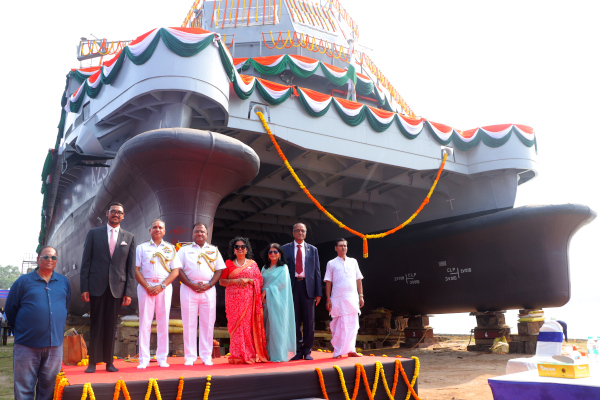
Kolkata – The Indian Navy launched DSC A 23, the fourth ship in its five-vessel Diving Support Craft (DSC) project, on 19 April 2026 at Titagarh, Kolkata. The launch was conducted with full naval traditions and ceremonial splendour, attended by Mrs. Deepa Sivakumar and Vice Admiral B Sivakumar, Chief of Materiel, along with senior officials from the Indian Navy and Titagarh Rail Systems Limited (TRSL).
Constructed by TRSL, the 30-meter-long catamaran-hull ship has an approximate displacement of 380 tons, offering superior stability, enhanced deck area, and improved sea-keeping characteristics, making it ideal for diving operations in coastal waters and harbors.
Diving Support Crafts (DSCs) are specialized vessels designed to assist naval diving operations, underwater inspections, and salvage missions. They provide a stable platform for divers to work safely in coastal and harbor waters and are equipped to support rescue operations, underwater maintenance, and emergency interventions. Their design allows for enhanced maneuverability and operational efficiency in shallow and congested waters where conventional ships cannot operate effectively.
The DSC vessels are designed and built according to the Naval Rules and Regulations of the Indian Register of Shipping (IRS). The project involved extensive model testing and hydrodynamic analysis at the Naval Science and Technological Laboratory (NSTL) in Visakhapatnam.
With the induction of DSC A 23, the Indian Navy’s capabilities in diving support, underwater inspection, salvage assistance, and coastal operational deployment will be significantly enhanced. Around 70% of the main and auxiliary equipment are sourced from indigenous manufacturers, highlighting the initiative’s alignment with the Government of India’s Aatmanirbhar Bharat and Make in India programs.
Reference: PIB
You may also like
-
DIAT and BITS Pilani Forge 20 Industry Partnerships to Accelerate Indigenous Defence Technologies
-
Flying Wedge’s Indigenous Kaala Bhairav Lite Completes 100 Hours of Flight Testing
-
USAF F-35A Stealth Fighters to Exercise With Indian Air Force for First Time at Tarang Shakti 2026
-
Tripathi Aerotech Secures Multi-Billion-Dollar 155mm ERFB-BB Ammunition Contract From Western Nation
-
RFLY Innovations Delivers Indigenous RFLY-PRO High-Altitude Surveillance UAVs to Indian Army
