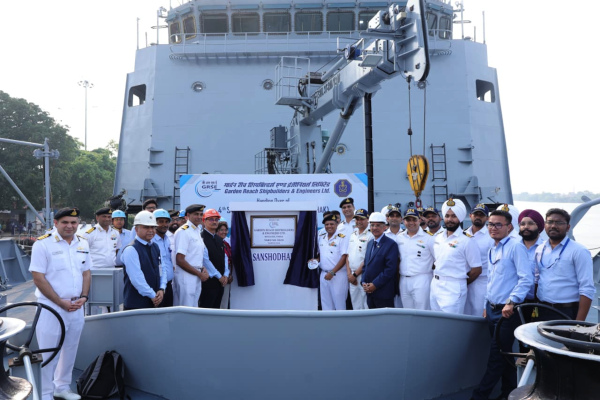
The Indian Navy has taken delivery of Sanshodhak, the fourth and final Survey Vessel (Large) built under a four-ship programme by Garden Reach Shipbuilders & Engineers Ltd. (GRSE), Kolkata, marking the completion of an important indigenous capability project in the hydrographic and oceanographic domain. The vessel was delivered on March 30, 2026, while the Ministry of Defence announced the milestone on March 31, 2026. The contract for the four ships had originally been signed on October 30, 2018.
With the induction of Sanshodhak, the Navy has now closed out the full class that began with INS Sandhayak, followed by INS Nirdeshak and INS Ikshak, commissioned on February 3, 2024, December 18, 2024, and November 6, 2025, respectively. That sequence gives India a fully delivered set of large survey ships intended to strengthen maritime charting, navigational safety, seabed mapping, and the collection of hydrographic, oceanographic and geophysical data across coastal and deeper waters.
Designed by the Indian Navy’s Warship Design Bureau and built by GRSE to Indian Register of Shipping classification rules, Sanshodhak is meant for full-scale coastal and deep-water hydrographic surveys, including surveys of harbour approaches, port channels and navigational routes. Its mission profile also extends beyond navigation support, since the vessel is intended to collect scientific and geophysical data that can be used for both defence and civilian applications.
In technical terms, Sanshodhak has a displacement of about 3,400 tonnes, an overall length of 110 metres, and is powered by two diesel engines that give it a speed of more than 18 knots. The ship is fitted with modern hydrographic systems including a Data Acquisition and Processing System, Autonomous Underwater Vehicle (AUV) capability, Remotely Operated Vehicle (ROV) capability, DGPS long-range positioning systems, and Digital Side Scan Sonar. These systems are central to precision seabed survey work, underwater mapping and maritime data gathering in both routine and strategically sensitive waters.
The vessel’s delivery also carries industrial significance. According to the Ministry of Defence, Sanshodhak has more than 80 per cent indigenous content by cost, making it another example of the Navy’s push to expand domestic shipbuilding under the broader Aatmanirbhar Bharat framework. The programme links naval design, a public-sector shipyard, and a wider vendor ecosystem that includes Indian industry and MSMEs, while also reinforcing India’s long-term maritime presence in the Indian Ocean Region.
From a defence perspective, survey ships rarely attract the same attention as destroyers, frigates or submarines, but they perform a foundational role. Accurate hydrographic data underpins naval operations, safer navigation, amphibious planning, submarine movement, port access, maritime infrastructure development and even disaster-relief response. In that sense, the completion of the Sanshodhak delivery is not merely the handover of another auxiliary platform; it is the completion of a specialist capability set that supports both operational readiness and maritime statecraft. This broader role is reflected in official descriptions of the class as a platform for hydrographic survey, oceanographic data collection and wider civil-defence utility.
You may also like
-
Indian Navy Vice Chief Inspects Japan’s Mogami-Class Stealth Frigate as India-Japan Shipbuilding Cooperation Expands
-
Philippine Marine Wargames Reportedly Show BrahMos Can Penetrate Chinese Destroyer Air Defences
-
Safran Signs 18 Agreements with Indian Aerospace Suppliers, Expanding Make in India Manufacturing Partnerships
-
Indian Army’s Vajra Corps Certifies First Batch of Drone Operators, Strengthens Battlefield Surveillance
-
India to Seek 35% Increase in Defence Modernisation Budget for FY 2027–28
)