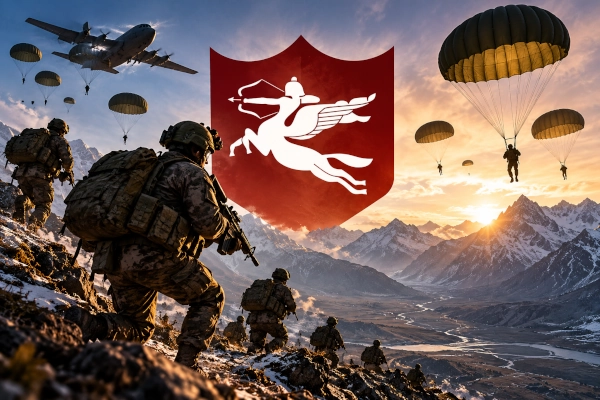
The Indian Army’s Shatrujeet Brigade has successfully conducted an intensive airborne military exercise in challenging high-altitude terrain, demonstrating its combat proficiency, rapid deployment capabilities and operational readiness. The exercise, announced by the Indian Army’s Central Command on October 13, 2026, focused on validating the ability of airborne forces to respond swiftly, integrate effectively and undertake mission-oriented operations in demanding operational environments.
The exercise demonstrated the importance of maintaining highly trained airborne formations capable of rapid mobilisation and coordinated military action. Operating in mountainous environments requires specialised preparation, physical endurance and precise coordination between different elements of an airborne force. The Indian Army highlighted the brigade’s ability to combine speed, precision and operational effectiveness while executing demanding airborne training activities.
The Shatrujeet Brigade, formally designated the 50 (Independent) Parachute Brigade, is one of the Indian Army’s specialised airborne formations. Its successful completion of the exercise reflects the Army’s continuing emphasis on maintaining combat readiness and developing the ability to undertake rapid-response operations across challenging geographical environments.
Shatrujeet Brigade Validates Rapid Airborne Deployment Capabilities
The Indian Army’s Central Command described the exercise as an important demonstration of the Shatrujeet Brigade’s operational capabilities in high-altitude terrain. The training focused on the ability of airborne forces to deploy rapidly, establish effective coordination and undertake assigned military missions under demanding environmental conditions.
Airborne operations require precise planning and close coordination because troops must transition from aerial deployment to ground-based military activities within a limited period. Maintaining readiness for such operations involves regular training, familiarity with deployment procedures and the ability to adapt quickly to changing operational circumstances.
The exercise enabled the Shatrujeet Brigade to demonstrate its ability to undertake these responsibilities as a coordinated military formation. The Indian Army emphasised that the training validated the brigade’s capacity to achieve seamless integration during airborne missions while maintaining the operational effectiveness necessary for demanding battlefield environments.
The successful exercise reinforces the importance of maintaining specialised formations capable of responding quickly to evolving security requirements. Such capabilities are particularly relevant in geographically challenging regions where conventional movement and deployment may require considerable time and logistical preparation.
High-Altitude Terrain Presents Unique Challenges for Airborne Forces
High-altitude military operations involve demanding environmental conditions that require specialised training and preparation. Mountainous terrain can restrict movement, complicate communications and create additional challenges for personnel and equipment. Reduced oxygen availability, changing weather conditions and difficult ground access can also influence the planning and execution of military activities.
Airborne forces operating in these environments must maintain physical fitness, operational discipline and the ability to respond effectively after deployment. The transition from aerial insertion to ground operations requires personnel to remain alert, coordinate with other units and adapt to the terrain surrounding their deployment area.
The Shatrujeet Brigade’s high-altitude exercise provided an opportunity to validate the formation’s ability to undertake mission-oriented activities under such conditions. By conducting training in demanding terrain, the Indian Army continues to develop the operational flexibility required for specialised airborne deployments.
The exercise also highlighted the importance of maintaining cohesion among personnel during operations involving rapid movement and coordinated action. Effective integration of deployed elements allows an airborne formation to maintain its operational momentum while carrying out assigned responsibilities.
Speed, Precision and Operational Coordination Remain Central to Airborne Warfare
Airborne forces provide military commanders with the ability to deploy trained personnel rapidly to locations where immediate action may be required. Their operational effectiveness depends on coordinated planning, timely deployment and the ability to establish organised ground operations after arrival.
The Indian Army’s announcement emphasised the Shatrujeet Brigade’s speed, precision and combat proficiency during the exercise. These characteristics are central to the employment of airborne formations, which must maintain readiness for operations requiring rapid mobilisation and coordinated execution.
Precision in airborne operations extends beyond the initial deployment phase. Personnel must maintain effective communication, establish coordination between different elements and respond to mission requirements in a disciplined manner. Training in these activities strengthens a formation’s ability to function effectively under demanding operational conditions.
The exercise demonstrated the Shatrujeet Brigade’s preparedness to undertake mission-oriented operations while maintaining integration among its participating elements. Such training contributes to the Indian Army’s broader objective of sustaining formations capable of responding effectively across different terrain and operational environments.
Shatrujeet Brigade Strengthens the Indian Army’s Airborne Capabilities
The Shatrujeet Brigade, officially known as the 50 (Independent) Parachute Brigade, forms an important component of the Indian Army’s airborne capability. The formation is trained for rapid deployment and specialised military operations that require coordinated action within demanding operational environments.
Airborne formations differ from conventional ground forces in their ability to deploy personnel through aerial means. This capability provides additional operational flexibility by enabling military forces to reach locations where rapid ground movement may be difficult or time-consuming.
Maintaining such capabilities requires sustained investment in training, personnel readiness and coordination. Airborne units must develop expertise in deployment procedures, equipment handling, operational communication and ground-based mission execution.
The Shatrujeet Brigade’s latest training activity reflects these requirements and demonstrates the importance placed on maintaining a highly prepared airborne formation. Through regular exercises, specialised units can refine their procedures and strengthen the coordination needed for demanding military assignments.
Mission-Oriented Training Supports Operational Readiness
The Indian Army’s Central Command highlighted the ability of the Shatrujeet Brigade to undertake mission-oriented operations as a major outcome of the exercise. This approach places emphasis on achieving defined operational objectives while maintaining coordination and effectiveness throughout a military activity.
Mission-oriented training allows participating personnel to practise the transition between different stages of an operation. In airborne warfare, this includes preparing for deployment, executing assigned tasks and maintaining effective coordination among personnel once operations begin on the ground.
Training under challenging environmental conditions adds complexity by requiring personnel to adapt their procedures to terrain, weather and operational constraints. Repeated exposure to such conditions contributes to greater familiarity with the demands of specialised military operations.
The Shatrujeet Brigade’s successful exercise demonstrated its ability to undertake coordinated activities in high-altitude terrain while maintaining the standards of proficiency expected of an airborne formation.
Such exercises form an important part of the Indian Army’s preparedness framework by enabling military units to validate their capabilities through practical training.
Integrated Airborne Operations Enhance Military Flexibility
The effectiveness of an airborne formation depends on the ability of its different elements to function as a coordinated force. Rapid deployment alone does not determine the success of an operation. Personnel must also establish effective communication, maintain cohesion and carry out assigned responsibilities once they reach the operational area.
The Indian Army identified seamless integration as one of the capabilities validated during the Shatrujeet Brigade’s high-altitude exercise. This reflects the importance of coordination during operations that require personnel to move quickly from deployment into mission execution.
Effective integration enables airborne forces to maintain operational continuity while responding to changing circumstances. In difficult terrain, such coordination becomes particularly important because environmental conditions may affect movement, communication and the availability of logistical support.
The exercise demonstrated the brigade’s ability to undertake integrated mission-oriented activities in a demanding setting. Continued training in these areas strengthens the Indian Army’s capacity to employ specialised formations across a range of operational environments.
High-Altitude Training Reinforces the Indian Army’s Preparedness
The successful completion of the Shatrujeet Brigade’s airborne exercise reflects the Indian Army’s continuing emphasis on maintaining operational readiness through realistic and demanding training activities.
High-altitude environments require military personnel to develop physical resilience, familiarity with difficult terrain and the ability to operate under environmental constraints. Exercises conducted in such conditions help specialised formations maintain their proficiency and improve coordination during complex activities.
The Shatrujeet Brigade’s training demonstrated the importance of combining individual preparedness with collective operational effectiveness. Its ability to undertake rapid deployment and coordinated mission-oriented operations highlights the value of sustained airborne training.
The exercise also reinforces the role of specialised military formations in providing operational flexibility to the Indian Army. Maintaining such capabilities allows the force to respond to a wide range of military requirements while adapting to the geographical diversity of India’s operational environment.
Shatrujeet Brigade Demonstrates Combat Readiness and Operational Excellence
The Indian Army’s announcement of the Shatrujeet Brigade’s successful high-altitude airborne exercise marks another development in the continuing training and preparedness of its specialised forces.
The exercise validated the brigade’s ability to deploy rapidly, maintain effective integration and undertake mission-oriented operations under demanding conditions. These capabilities remain fundamental to modern airborne warfare, where speed, precision, coordination and operational flexibility are essential.
The Shatrujeet Brigade’s performance demonstrates the importance of maintaining highly trained personnel capable of operating effectively in challenging terrain. The exercise also highlights the Indian Army’s emphasis on developing combat-ready formations through regular and demanding training.
By continuing to strengthen its airborne capabilities, the Indian Army is enhancing its ability to undertake specialised operations while maintaining a high standard of operational preparedness. The Shatrujeet Brigade’s successful exercise reflects this commitment to professional excellence, military readiness and the development of versatile combat capabilities.
References
1. Indian Army — Surya Command (Central Command)
Official announcement concerning the Shatrujeet Brigade’s high-altitude airborne exercise.
Published: October 13, 2026.
Official Facebook post:
https://www.facebook.com/SuryaCommand/posts/1847033519788800/
2. Indian Army — Surya Command
Official X account of the Indian Army’s Central Command.
https://x.com/suryacommand
3. Ministry of Defence, Government of India
Official information on Indian Army operations, exercises and operational preparedness.
https://mod.gov.in/
You may also like
-
Rolls-Royce and Reliance Advance Indigenous 120 kN AMCA Engine Plans with Focus on Indian Design and Manufacturing
-
Indian Coast Guard and Korea Coast Guard Strengthen Maritime Cooperation at 14th High-Level Meeting in Incheon
-
Ministry of Defence Signs ₹4,106 Crore Contracts for GSAT-7C Satellite and Varunastra Torpedoes
-
AVNL, Indian Army and Russian Delegation Explore Modernisation of Armoured Vehicles
-
JSR Dynamics Develops Indigenous Miniature Ground-Launched Decoy for Electronic Warfare Applications
