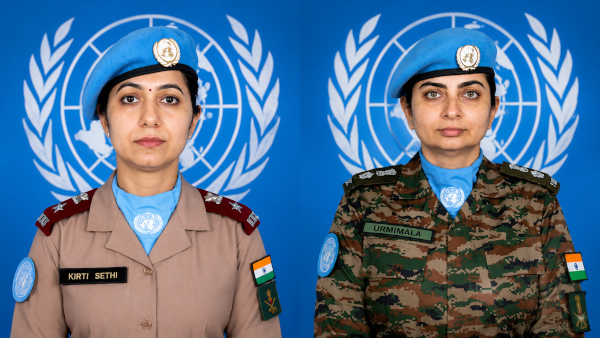
Two Indian Army women doctors serving on United Nations duty have turned a routine international flight into a powerful example of calm courage, medical skill and military professionalism. Lieutenant Colonel Urmimala Bhattacharya and Lieutenant Colonel Kirti Sethi, both associated with the Indian Level 2+ Hospital under the United Nations Mission in South Sudan, stepped forward during a serious medical emergency aboard Ethiopian Airlines Flight ET334 and helped save a passenger’s life mid-air.
The incident took place while the aircraft was flying over Africa at around 30,000 feet. A passenger reportedly developed seizure-like symptoms, suspected to have been caused by hypoglycaemia, a sharp fall in blood sugar levels. In an aircraft cabin, such a situation can quickly become dangerous because there is no immediate hospital access, medical resources are limited, and any delay can force an emergency diversion.
Both officers quickly assessed the passenger, identified the probable medical cause and administered the necessary treatment using the available onboard support. Their timely intervention stabilised the passenger, prevented further complications and allowed the flight to continue safely without diversion.
The medical condition involved was not minor. Authoritative medical guidance notes that severe hypoglycaemia can affect brain function and may lead to seizure or loss of consciousness if not treated promptly. That is why the doctors’ ability to recognise the danger, act quickly and manage the emergency in the confined space of an aircraft was crucial.
What makes the episode even more significant is the background of the two officers. Lt Col Bhattacharya and Lt Col Sethi are posted with the Indian hospital component in UNMISS, where Indian military medical personnel provide advanced healthcare support to UN staff and peacekeeping operations in South Sudan.
India’s role in UN peacekeeping gives this story a larger meaning. According to PIB, India has contributed more than 2,90,000 peacekeepers to over 50 UN missions, and more than 5,000 Indian peacekeepers are currently deployed across nine active missions. UNMISS in South Sudan is one of the missions where India has contributed infantry, medical personnel and engineering units.
The episode also highlights the growing role of Indian women in global peacekeeping. PIB notes that India has been a strong advocate of women’s participation in UN peacekeeping and that, as of February 2025, more than 150 Indian women peacekeepers were serving across six critical missions, including South Sudan.
This is why the mid-air rescue should not be seen only as an isolated act of medical response. It reflects the training culture of the Indian Armed Forces Medical Services, the operational readiness of Indian peacekeepers and the quiet humanitarian role played by Indian personnel far from home. In conflict zones and fragile regions, Indian medical teams do not only support military contingents; they often become a lifeline for civilians, UN personnel and vulnerable communities.
The two doctors’ conduct also reinforces an important truth about military medicine. A uniformed doctor is trained not only for hospital wards, but also for pressure, uncertainty and limited-resource environments. Whether in a field hospital, a UN mission area or an aircraft cabin at cruising altitude, the first requirement is composure. Lt Col Bhattacharya and Lt Col Sethi displayed exactly that.
For India, the story carries a deeply positive message. It shows Indian women officers serving with distinction on international duty, Indian Army doctors demonstrating world-class professionalism, and India’s peacekeeping legacy expressing itself through a direct act of saving a human life. At a time when global peacekeeping is becoming more complex, such moments remind the world that India’s contribution is not only measured in troop numbers, deployments and missions, but also in compassion, competence and service.
The rescue aboard Ethiopian Airlines Flight ET334 is therefore more than a good-news story. It is a portrait of India’s peacekeeping spirit in action: disciplined, humane, prepared and quietly heroic.
You may also like
-
PRAHAAR: India’s First National Counter-Terrorism Policy and Strategy
-
Takshak Heavyweight Torpedo: How India’s Indigenous Submarine Weapon Compares With the World’s Leading Torpedoes
-
Embraer Builds Dual Aerospace Strategy in India Through C-390 Military and E175 Regional Aircraft Programmes
-
NextLeap Tests Indigenous Jet Engine for Long-Range Stryker Kamikaze UAV
-
Côte d’Ivoire Military Delegation Visits HAL, Shows Interest in India’s Indigenous Aerospace Platforms
