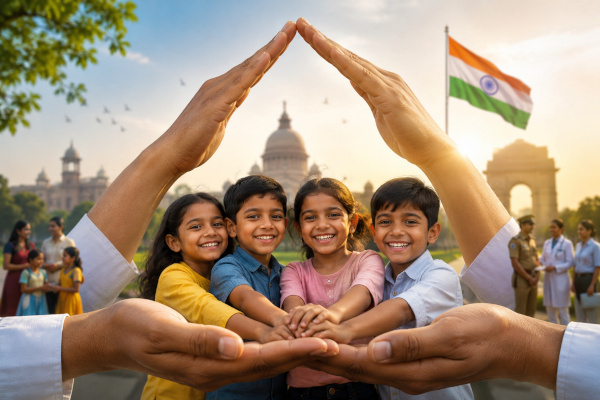
India has emerged as the top-ranked South Asian country in the 2026 Out of the Shadows Index, a global benchmark that measures how national governments are preventing and responding to sexual violence against children and adolescents. The latest index places India first in South Asia overall, while also ranking the country first in the region for prevention, healing and justice-related indicators.
The ranking is significant because the Out of the Shadows Index is not a casual perception survey. It is a structured international benchmark developed by Economist Impact, with advocacy and engagement led by Together for Girls. The 2026 edition assesses 60 countries across six regions, covering countries that together are home to around 83 percent of the world’s children. It scores countries across 23 indicators linked to laws, policies, programmes and services required to prevent and respond to sexual violence against children and adolescents.
India’s overall score in the 2026 index is 66.5 out of 100, placing it in the top third of assessed countries. In South Asia, India is ranked first overall, ahead of other countries in the region. The index also notes that India is ranked first among lower-middle-income countries assessed, a particularly important achievement because it shows that strong child-protection systems are not only a function of wealth, but also of legal design, institutional effort and political priority.
India’s strongest performance comes in three practical pillars: prevention, healing and justice. The country scored 70.0 in prevention, 85.0 in healing and 78.4 in justice. Within South Asia, India is ranked first in all three of these areas. These scores indicate that India has built a relatively strong legal and institutional framework for awareness, response, victim support, recovery pathways and prosecution mechanisms.
The result also reflects the importance of India’s Protection of Children from Sexual Offences Act, 2012, commonly known as POCSO. The law was enacted to protect children from sexual assault, sexual harassment and child pornography, and to provide for Special Courts to try such offences. India Code records that the POCSO Act came into force on 14 November 2012, under the Ministry of Women and Child Development.
POCSO remains the backbone of India’s child-protection response because it does not treat offences against children as ordinary criminal cases. It provides child-friendly procedures for reporting, recording of evidence, investigation and trial, along with the appointment of Special Public Prosecutors and designated Special Courts. This has helped shift the system toward recognising the vulnerability of child victims and the need for quicker, more sensitive handling of such cases.
Another major factor behind India’s stronger justice score is the expansion of Fast Track Special Courts for rape and POCSO cases. According to the Department of Justice, the centrally sponsored FTSC scheme was launched in October 2019 for time-bound trial and disposal of pending rape and POCSO cases. As of 31 January 2026, 774 Fast Track Special Courts, including 398 exclusive POCSO courts, were functional across 29 States and Union Territories. These courts had collectively disposed of 3,71,849 cases since the scheme began.
This is a major institutional development. In sensitive cases involving children, justice delayed can deepen trauma for victims and families. Dedicated courts, trained support systems and faster disposal mechanisms help reduce uncertainty, prevent prolonged re-traumatisation, and send a stronger message that offences against children will be pursued seriously.
India has also strengthened its child-protection ecosystem through Mission Vatsalya, which supports children in need of care and protection as well as children in conflict with law. The Ministry of Women and Child Development has developed an integrated Mission Vatsalya Portal, bringing together systems such as TrackChild, Khoya-Paya and CARINGS. The scheme also provides emergency outreach through the Child Helpline 1098, a 24x7x365 service integrated with the Emergency Response Support System 112.
This digital integration matters because child protection depends on speed, coordination and traceability. A case may involve the police, child welfare committees, district child protection units, legal services authorities, health professionals, counsellors and shelter systems. When these actors work in silos, children suffer. A unified portal and integrated helpline architecture can reduce delays, improve case tracking and make the system more responsive at district level.
The National Commission for Protection of Child Rights has also published practical POCSO resources, including model guidelines for support persons under Section 39 of the POCSO Act, an easy guide for implementation, district administration guidance, a cybercrime legal toolkit for child victims and internet safety material. These resources are important because a strong law must be supported by training, awareness and field-level capacity.
The positive reading is that India has already built the harder foundations: a specialised law, dedicated courts, child helplines, digital child-protection systems, legal aid architecture, victim-support pathways and a growing network of trained stakeholders. The next challenge is to make these systems more transparent, better funded, more survivor-informed, and more evenly implemented across states.
India’s position is especially important because of scale. The Out of the Shadows Index notes that India has about 436.6 million children, representing 70.4 percent of South Asia’s under-18 population. In other words, progress in India is not merely a national achievement; it affects the child-protection profile of the entire region.
Global Country Rankings Add-on
At the global level, the 2026 Out of the Shadows Index shows that even the best-performing countries still have work to do. The index average is only 52.6/100, and no country scored above 83/100, underlining that child protection remains an unfinished global challenge even in advanced economies. Australia leads the index with 83/100, followed by the United Kingdom at 78/100. Germany scored 74.1/100, France scored 73.7/100, Canada scored 71.4/100, Colombia scored 69.7/100, the United States scored 67.2/100, and India scored 66.5/100. India’s performance is therefore especially notable because it is not only No. 1 in South Asia, but also No. 1 among lower-middle-income countries assessed and 8th among G20 countries in the index.
| Country | Score | Ranking Highlight |
|---|---|---|
| Australia | 83.0 | 1st globally; 1st in G20 |
| United Kingdom | 78.0 | 2nd globally; 1st in Europe & Central Asia |
| Germany | 74.1 | 3rd in G20; 2nd in Europe & Central Asia |
| France | 73.7 | 4th globally; 3rd in Europe & Central Asia |
| Canada | 71.4 | 1st in Americas & Caribbean; 5th in G20 |
| Colombia | 69.7 | 8th globally; 2nd in Americas & Caribbean |
| United States | 67.2 | 7th in G20 |
| India | 66.5 | 1st in South Asia; 1st among lower-middle-income countries; 8th in G20 |
This comparison gives India’s ranking a stronger international context. While countries such as Australia, the United Kingdom and Germany lead the global table, India’s result stands out because of the country’s scale, with 436.6 million children, representing more than 70 percent of South Asia’s under-18 population. A high score in prevention, healing and justice therefore does not merely improve India’s national child-protection profile; it also has regional significance for South Asia as a whole.
The larger message is encouraging. India is not being recognised because the problem has disappeared. No country has achieved a perfect score in the index, and the index itself cautions that gaps remain. But India’s South Asia-leading position shows that the country has moved from denial and fragmented response toward a more structured, law-backed and institution-driven child-protection framework.
The road ahead should focus on five priorities: stronger accountability dashboards, faster state-level implementation, more trained counsellors and support persons, better survivor-centred rehabilitation, and stronger online safety systems for children. If India builds on its current progress, the country can move from being a regional leader to becoming one of the world’s strongest models for protecting children through law, technology, justice delivery and community awareness.
For now, the 2026 Out of the Shadows Index offers India a positive but serious message: the country has made visible progress, especially in prevention, healing and justice, but the next generation of child protection must be more transparent, more accountable and more survivor-centred. That is where India’s real opportunity lies.
You may also like
-
PRAHAAR: India’s First National Counter-Terrorism Policy and Strategy
-
Jawahar Dweep Becomes India’s First Plastic-Free Oil Terminal at Mumbai Port
-
Indian Captain’s Courage Helps Save Flydubai Flight During Mid-Air Cockpit Crisis
-
India Simplifies Foreign Guest Reporting for Hotels Under New Immigration Framework
-
Centre Expands Coastal Storage List to 26 Petroleum and Chemical Products Under CRZ Rules
