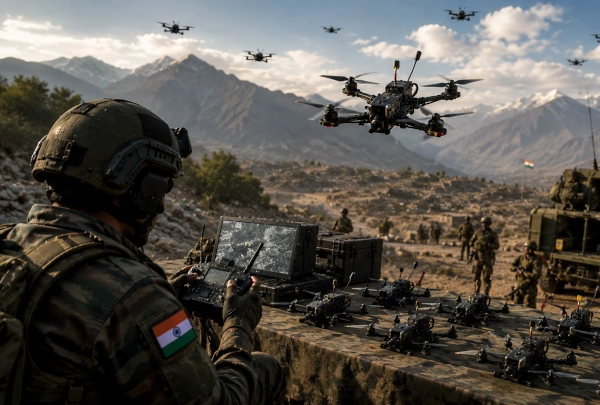
The Indian Army is moving to expand the offensive role of low-cost First-Person View drones, with a reported procurement requirement for 2,405 anti-armour payloads intended for FPV systems under Northern Command. iDEX records establish that the Army is actively developing and industrialising precisely this class of drone-launched anti-armour ammunition.
The requirement reflects the rapid transformation of small drones from surveillance platforms into frontline precision-strike weapons.
FPV drones allow an operator to fly towards a target using a live video feed from the aircraft. When fitted with an explosive warhead, a relatively inexpensive drone can become a precision attack system capable of engaging vehicles, fortified positions and other battlefield targets.
For Northern Command, which operates across demanding mountainous and high-altitude sectors, lightweight strike drones can provide troops with a comparatively inexpensive means of attacking targets without exposing soldiers carrying conventional short-range anti-armour weapons.
DRDO Already Has an Indigenous FPV Anti-Armour Warhead
The strongest official confirmation of India’s work in this area comes from DRDO’s Terminal Ballistics Research Laboratory (TBRL).
DRDO has developed a 400-gram Type-1 Anti-Armour Payload specifically for lightweight, fast-manoeuvring kamikaze-class FPV drones and opened the technology to Indian industry for transfer.
The payload combines onboard electronics with an anti-armour warhead incorporating a copper liner and an explosive assembly. It is electrically integrated with the drone so that the operator can control payload activation during the mission.
DRDO says the system is intended to defeat substantial mild-steel armour when employed in impact mode.
The technology was formally listed by DRDO for industry participation in July 2025, demonstrating that India is already preparing domestic manufacturers to produce specialised FPV munitions rather than relying solely on improvised imported solutions.
Army Wants Modular Drone Ammunition
The Indian Army has since gone considerably further.
Under the Ministry of Defence’s Defence India Startup Challenge 14, the Army issued an official problem statement seeking modular and scalable multi-role ammunition for unmanned aerial systems.
The Army specifically identified the need for payloads capable of performing anti-personnel, anti-materiel and anti-armour missions. It noted that existing fixed-payload systems reduce battlefield flexibility and increase logistical complexity.
The requirement calls for technologies including smart fuzes, shaped-charge warheads, miniaturised guidance systems and modular electronic interfaces.
The Army’s stated objective is a production-ready precision-ammunition family capable of operating from multiple UAS platforms while achieving at least 70% indigenisation.
This provides important official context for the reported Northern Command procurement.
Northern Command Already Expanding FPV Strike Capability
Northern Command has already moved quickly to introduce combat FPV drones.
In April 2026, reports said the Army had received hundreds of kamikaze drones from Surat-based InsideFPV under a ₹10-crore emergency procurement contract.
The exact number was withheld for security reasons, but the systems were destined for Northern Command and were designed for precision attack missions in difficult environments. The report was subsequently included in DRDO’s official DESIDOC defence-news compilation.
The drones were reportedly configured with detonation mechanisms and waypoint navigation and designed to function in extreme cold.
A separate anti-armour payload procurement would therefore represent the next logical step: expanding the number and types of warheads available to an FPV fleet that is already entering operational service.
Low-Cost Drones Change Anti-Tank Warfare
The military attraction of an FPV anti-armour system is straightforward.
Traditional anti-tank guided missiles are highly effective but can be expensive and require specialised launchers and trained crews. Their operators may also need direct or near-direct line of sight to the target.
An FPV drone approaches the problem differently.
The operator can manoeuvre the aircraft around terrain, approach a vehicle from a vulnerable direction and strike without physically moving an anti-tank team close to the target.
That does not make FPV drones substitutes for conventional anti-tank missiles. Electronic warfare, jamming, adverse weather and short endurance can all limit their effectiveness.
Instead, they add another layer to the Army’s anti-armour arsenal — particularly against vehicles, field fortifications and other tactical targets where using a much more expensive missile may not always be necessary.
An Indigenous Ammunition Ecosystem Is Emerging
The larger significance of the reported 2,405-payload requirement lies in scale.
India is not merely experimenting with a handful of armed drones. DRDO is transferring FPV warhead technology to industry, the Army is asking Indian companies to develop modular UAS ammunition, and Northern Command has already inducted substantial numbers of tactical FPV systems.
These developments suggest a transition towards large-volume expendable drone warfare, where the drone itself and its payload are treated as consumable battlefield munitions.
That requires an industrial base capable of manufacturing thousands of airframes, motors, batteries, communication systems, fuzes and warheads at relatively low cost.
If the reported 2,405-unit Northern Command requirement is confirmed, it would be another important indication that the Indian Army is moving FPV strike drones from limited experimentation towards routine frontline inventory.
Sources
DRDO – Terminal Ballistics Research Laboratory: Official technology-transfer listing for the FPV Drone Based 400g Payload, Type-1 Anti-Armour.
Defence Innovation Organisation / Ministry of Defence – DISC 14: Indian Army requirement for modular UAS ammunition covering anti-personnel, anti-materiel and anti-armour missions.
DRDO DESIDOC, April 7, 2026: Defence-news compilation recording the reported delivery of hundreds of kamikaze drones to Indian Army Northern Command under emergency procurement.
You may also like
-
ICAR Scientists Develop Indigenous Protective Gloves for Cotton Farmers, Sign Commercial Manufacturing Agreement
-
India Moves Towards Five-Year Assured Orders for Defence Startups Under New Procurement Reforms
-
BHEL–Coal India Joint Venture Begins Construction of ₹25,016 Crore Indigenous Coal Gasification Project in Odisha
-
Zen Technologies Introduces Indigenous Hyper-Strike Falcon AI-Guided Counter-Drone Interceptor
-
L&T and Germany’s SCHOTTEL Expand Partnership for Controllable Pitch Propeller Systems in Indian Shipbuilding
