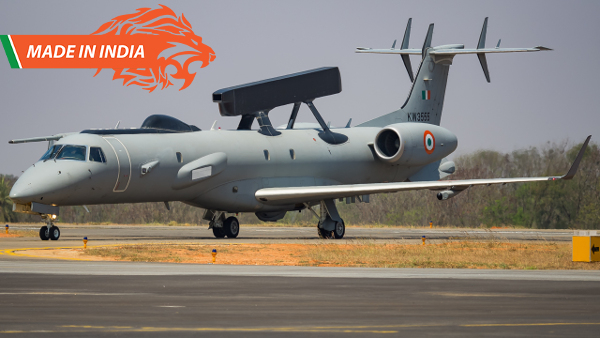
India’s indigenous Netra Mk1 Airborne Early Warning and Control system is demonstrating an advantage that is often overlooked when defence systems are judged purely by range, payload or headline specifications: the ability to upgrade a complex combat system because India controls its underlying architecture.
Recent public reporting, citing former DRDO Chairman and Netra programme architect Dr S. Christopher, indicates that one of the Indian Air Force’s three existing Netra Mk1 aircraft has flown with a newer Gallium Nitride, or GaN, based AESA radar configuration, with similar modernisation envisaged for the remaining aircraft.
DRDO designed Netra’s primary radar, antenna array, critical electronics, transmit/receive modules, mission computing and several supporting systems in India. That ownership gives Indian engineers something extremely valuable: the ability to modify the system as technologies and operational requirements evolve.
The reported transition towards GaN therefore represents more than a radar-performance upgrade. It demonstrates the long-term strategic value of indigenous system design.
Netra Was Designed in India Around an Imported Aircraft
The Netra Mk1 is based on the Brazilian Embraer EMB-145 regional jet, but the aircraft itself is only the platform carrying the mission system.
The real heart of an AEW&C aircraft lies in its sensors, electronic warfare equipment, mission computers, communications systems, data links and the software that combines information from those systems into a coherent battlefield picture.
DRDO’s Centre for Airborne Systems developed and integrated these capabilities for Netra with contributions from laboratories including the Electronics and Radar Development Establishment and Defence Electronics Applications Laboratory.
DRDO describes Netra’s primary radar as India’s first fully active-array airborne surveillance radar developed indigenously. The organisation states that the system’s complete electronics and antenna array were designed and manufactured domestically, while critical components such as its transmit/receive modules were designed by DRDO and productionised through Indian industry.
From GaAs to GaN
Active Electronically Scanned Array radars consist of large numbers of transmit/receive modules distributed across the antenna.
Each module contributes to transmitting radar energy and receiving the reflected signals. By electronically controlling these modules, an AESA radar can steer its beam extremely rapidly without mechanically rotating the antenna.
Earlier generations of modern AESA radars extensively used Gallium Arsenide, or GaAs, semiconductor technology.
GaN represents an important technological step forward.
DRDO’s own semiconductor technology publications describe GaN devices as capable of operating with higher power at high frequencies, high efficiency and high linearity. Their higher breakdown voltage allows greater power handling, while improved efficiency can reduce the power consumed by cooling systems.
DRDO research on transmit/receive modules also identifies GaN as the newer generation of RF power-amplifier technology, offering advantages including higher power density and improved efficiency compared with earlier semiconductor approaches.
An aircraft has finite electrical power and finite cooling capacity. Radar engineers cannot simply increase transmitter power indefinitely without considering heat, weight and power generation.
GaN allows designers to extract more performance from those constraints.
Does GaN Automatically Mean a Huge Increase in Netra’s Range?
Some open-source analyses have suggested that GaN could substantially increase the Netra radar’s detection range. Those estimates should be treated cautiously because DRDO has not publicly released the specifications of the reported upgraded radar.
Radar detection range depends on far more than the semiconductor material inside the transmit/receive modules.
It also depends on antenna aperture, transmitted power, waveform design, receiver sensitivity, signal processing, target radar cross-section, altitude, electronic countermeasures and the operating mode being used.
GaN can provide the radar designer with a better technological foundation. How DRDO chooses to exploit that advantage is another matter.
It might be used for greater detection range.
It could also improve reliability, electronic-counter-countermeasure performance, target discrimination or the ability to operate demanding radar modes.
Alternatively, engineers may use some of the additional efficiency to reduce thermal stress rather than maximising output power.
The Bigger Achievement Is That the Existing Netra Can Evolve
A foreign-built AEW&C system normally leaves the operator dependent on the original manufacturer for many significant modifications.
Replacing radar hardware may require access to proprietary interfaces, mission software, integration documentation and source code. Even when an upgrade is technically possible, the original equipment manufacturer may need to approve, develop and certify it.
That introduces cost, time and foreign-supply-chain dependency.
Netra changes that equation because India developed the mission system itself.
The Manohar Parrikar Institute for Defence Studies and Analyses highlighted precisely this advantage after Netra received FOC. Its July 2026 assessment noted that the indigenous platform’s systems can be adapted through software and hardware upgrades without depending on foreign OEMs or supply chains.
That may ultimately be more important than the difference between GaAs and GaN.
India does not need to discard a functioning AEW&C platform simply because radar technology has advanced.
It can progressively modernise the system it already owns.
Netra’s Original TR Modules Were Already a Major Indigenous Achievement
The importance of transmit/receive technology was understood from the beginning of India’s AEW&C programme.
A DRDO Defence Science Journal paper describing the indigenous radar development noted that eight transmit-receive modules were combined into compact assemblies, with 160 such modules used in the Active Antenna Array Unit.
The paper also noted that Indian industry could manufacture the required modules at less than one-fourth the cost of imported equivalents at the time.
This meant India was not simply integrating an imported AESA radar onto the Embraer.
It was creating the underlying radar electronics itself.
That investment made later technological evolution possible.
Netra Mk1A Was Already Moving Toward GaN
The direction of development is also visible in India’s plans for the next batch of Embraer-based AEW&C aircraft.
The proposed Netra Mk1A systems are intended to incorporate GaN-based AESA transmitter modules along with software upgrades.
MP-IDSA notes that six additional Netra Mk1A aircraft were cleared by the Defence Acquisition Council in March 2025 and that their radar systems are expected to use GaN transmitter technology while retaining the basic EMB-145-based architecture.
Earlier DRDO material likewise recorded plans for advanced Netra variants using GaN-based transmit/receive modules.
If technology developed for Mk1A can also migrate backwards into the three operational Mk1 aircraft, the distinction between a new-build aircraft and an upgraded earlier aircraft begins to narrow.
That is precisely what modular indigenous development should achieve.
Software Is Just as Important as the Radar Hardware
A modern AEW&C aircraft is ultimately a flying information network. Its value depends not only on detecting enemy aircraft, but also on converting those detections into usable combat information and transmitting that information rapidly to fighters, surface-to-air missile units and command centres. Netra combines its AESA radar with electronic support measures, identification-friend-or-foe equipment, line-of-sight communications, satellite communications and mission computers to build a broader picture of the air battle.
This architecture means that future improvements do not always require major physical changes to the aircraft. Better software can improve track management, sensor fusion, threat identification and networking, while electronic-warfare libraries can be updated as new threats emerge. New data links can also be introduced to improve connectivity with other aircraft, ground stations and air-defence systems.
Algorithms can be refined to improve the way the radar processes clutter, identifies difficult targets and manages multiple tracks. Mission computers can be upgraded as processing requirements increase, while new indigenous sensors can be integrated into the existing system architecture. This ability to modify both hardware and software gives Netra a much longer and more flexible development path than a closed imported system that depends heavily on a foreign manufacturer for every major upgrade.
Operational Experience Can Feed Directly Back Into Development
Another major advantage of domestic ownership is the feedback loop it creates between the Indian Air Force and DRDO. Netra entered operational service in 2017 and has since accumulated years of real-world experience, including during periods of heightened operational activity such as the 2019 Balakot episode and the 2025 India-Pakistan confrontation associated with Operation Sindoor. This operational exposure gives the IAF a much clearer understanding of how the system performs under demanding conditions and where improvements may be needed.
That experience can then be fed directly back to DRDO. MP-IDSA has noted that Netra’s development path allowed later refinements to incorporate operational lessons, while the Final Operational Clearance process validated key elements including the radar, electronic-warfare suite, communications, data links and compatibility with India’s wider command-and-control architecture. In practice, this means that shortcomings, changing threat patterns or new mission requirements can be identified by the operator and translated into hardware or software improvements by the domestic developer.
This continuous cycle is one of the strongest arguments for indigenous system ownership. The IAF operates the platform, identifies areas for improvement, DRDO develops the required changes, and the upgraded configuration can then return to service. That process can continue throughout the aircraft’s operational life, allowing the system to evolve rather than remain frozen at the standard in which it was originally inducted.
With a fully imported mission system, the same upgrade cycle may depend heavily on the foreign original equipment manufacturer for access to proprietary software, interfaces, integration data and certification support. Indigenous control therefore gives India greater freedom to respond to operational experience quickly and shape Netra around its own evolving combat requirements.
GaN Is Becoming a Wider DRDO Radar Technology
The Netra development is also not occurring in isolation.
DRDO has steadily invested in indigenous Gallium Nitride technology for radar and electronic-warfare applications.
Its Solid State Physics Laboratory has developed indigenous AlGaN/GaN High Electron Mobility Transistor materials, fabrication technologies and MMICs specifically for strategic RF applications.
Other newer Indian radar programmes are also moving toward GaN transmit/receive modules.
That creates an important technological ecosystem.
Lessons learned in semiconductor fabrication can support radar development. Improvements in radar modules can migrate between airborne, naval and ground-based systems. Indian industry gains manufacturing experience as production volumes increase.
Netra therefore benefits from a much broader national investment in indigenous microwave and semiconductor technology.
The Imported Airframe No Longer Defines How Indigenous the System Is
Netra is sometimes described as only partially indigenous because the EMB-145 aircraft comes from Brazil.
That description misses the distinction between the platform and the mission system.
India did not need to design a new jetliner merely to prove that it could develop airborne battle-management technology.
Using an established civilian aircraft allowed DRDO to concentrate resources on the areas carrying the greatest strategic technology value: radar, electronic warfare, communications, mission computing and system integration.
The same approach is being used for the much larger Netra MkII, which will place indigenous mission systems aboard modified Airbus A321 aircraft.
MP-IDSA notes that MkII will employ larger DRDO-developed AESA radar arrays and offer greater power, endurance and payload capacity than the EMB-145-based Netra.
The airframe is therefore best understood as the vehicle.
The strategic intellectual property resides in what India puts inside and on top of it.
Netra MkII Can Benefit From Mk1’s Evolution
The GaN retrofit also has implications for the future Netra MkII programme.
An airborne radar cannot be developed entirely on a laboratory bench. Engineers need years of experience with vibration, electromagnetic interference, cooling, signal processing, flight testing and real operational use.
Netra Mk1 has provided that experience.
A GaN upgrade adds another generation of knowledge.
The technologies proven through Mk1 and Mk1A can therefore reduce risk when DRDO develops the larger arrays required for MkII.
The progression becomes:
Netra Mk1 → upgraded Mk1 → Netra Mk1A → Netra MkII
rather than four completely independent systems.
This creates technological continuity.
An AEW&C Fleet That Improves Instead of Becoming Obsolete
India still needs significantly more airborne early-warning aircraft.
Three operational Netra Mk1 systems and the existing Phalcon AWACS fleet are not sufficient for the surveillance demands created by India’s extensive land borders, maritime approaches and potential two-front security environment.
That is why the planned expansion through Mk1A and MkII remains essential.
But numbers are only part of the equation.
A fleet of aircraft that cannot be affordably modernised begins losing effectiveness long before the airframes themselves reach the end of their lives.
An indigenous architecture changes that.
India can potentially keep the original Netra aircraft relevant through successive radar, electronic-warfare, communications and software improvements while simultaneously inducting newer Mk1A and MkII platforms.
The oldest aircraft do not necessarily have to remain frozen at 2017 technology.
The Hidden Dividend of Atmanirbharta
Defence indigenisation is often measured through percentages: how much of a weapon was manufactured in India, how many imported components remain, or how much foreign exchange was saved.
Netra demonstrates another measure that may be more strategically important:
Who controls the design?
If India controls the radar architecture, mission software, interfaces and integration knowledge, it controls the system’s future.
A new threat does not automatically require a foreign upgrade package.
A new semiconductor generation does not necessarily require a new aircraft.
A new data link can potentially be integrated domestically.
Operational lessons can be converted directly into software and hardware changes.
Indian industry can manufacture replacement and upgraded subsystems.
That freedom has enormous military value.
GaN Retrofit Is the Proof of the Original Design Philosophy
Netra Mk1 was conceived more than two decades ago. Its first operational configuration entered the Indian Air Force in 2017. It finally received Final Operational Clearance in June 2026, with the Ministry of Defence describing the programme as a major achievement in indigenous airborne surveillance, situational awareness and battle management.
Yet the system has not remained frozen at the technological level at which it began.
The reported integration of GaN radar technology illustrates precisely why indigenous development matters.
It would be inaccurate to describe such a sophisticated radar conversion as literally plug-and-play. Engineers still have to address power, cooling, calibration, software, electromagnetic compatibility and certification.
But the fact that an existing Indian AEW&C architecture can apparently absorb a new generation of radar transmitter technology without requiring India to discard the aircraft or procure an entirely new foreign mission system is the larger achievement.
Netra was not merely built in India. It was designed so that India could continue building upon it.
That is the hidden strategic advantage of indigenous defence technology.
The most important capability may not be the radar specification Netra possesses today.
It is the fact that India retains the ability to decide what Netra becomes tomorrow.
References
Press Information Bureau – IAF Gets Final Operational Clearance of Indigenous Airborne Early Warning & Control System ‘Netra’
https://www.pib.gov.in/PressReleaseIframePage.aspx?PRID=2277899
DRDO – NETRA Airborne Early Warning and Control System
https://drdo.gov.in/drdo/en/offerings/products/netra
DRDO Technology Focus – NETRA: The Indigenous AEW&C
https://www.drdo.gov.in/drdo/sites/default/files/technology-focus-documrnt/TF_April2021.pdf
Manohar Parrikar Institute for Defence Studies and Analyses – Netra’s Final Operational Clearance: Enhancing Mission Sudarshan Chakra
https://idsa.in/publisher/issuebrief/netras-final-operational-clearance-enhancing-mission-sudarshan-chakra
DRDO Technology Focus – Indigenous Gallium Nitride MMIC Technology
https://www.drdo.gov.in/drdo/sites/default/files/technology-focus-documrnt/TF_June2023.pdf
Defence Science Journal – Evolutionary Trends in Transmit/Receive Modules for Active Phased Array Radars
https://publications.drdo.gov.in/ojs/index.php/dsj/article/download/12628/6384
You may also like
-
ICAR Scientists Develop Indigenous Protective Gloves for Cotton Farmers, Sign Commercial Manufacturing Agreement
-
India Moves Towards Five-Year Assured Orders for Defence Startups Under New Procurement Reforms
-
BHEL–Coal India Joint Venture Begins Construction of ₹25,016 Crore Indigenous Coal Gasification Project in Odisha
-
Zen Technologies Introduces Indigenous Hyper-Strike Falcon AI-Guided Counter-Drone Interceptor
-
L&T and Germany’s SCHOTTEL Expand Partnership for Controllable Pitch Propeller Systems in Indian Shipbuilding
