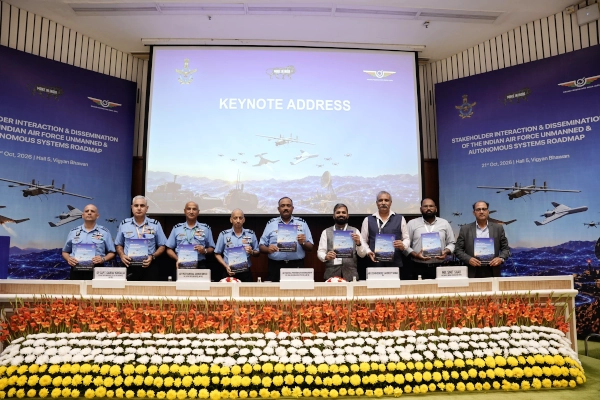
The Indian Air Force (IAF) has intensified its engagement with India’s defence technology industry to accelerate the development of indigenous unmanned and autonomous systems. On October 21, 2026, the IAF organised an Industry Outreach Programme at Vigyan Bhawan, New Delhi, bringing together approximately 100 representatives from drone manufacturers, Micro, Small and Medium Enterprises (MSMEs), startups and associated technology companies.
The programme provided an opportunity for the Air Force to communicate its long-term operational requirements and technological priorities directly to Indian industry. The initiative aims to encourage domestic companies to develop reliable, resilient and operationally relevant unmanned capabilities that can complement India’s existing and future manned combat aircraft.
Air Marshal Premkumar K, VM, VSM, Director General (Weapon Systems), Air Headquarters, chaired the programme, which highlighted the growing importance of indigenous drone technologies in India’s future air power capabilities.
IAF Shares Long-Term Unmanned and Autonomous Systems Roadmap
The industry outreach programme built upon the IAF Unmanned and Autonomous Systems Roadmap, released during IAF Dronathon 2026 at Pokhran on September 14, 2026.
During the New Delhi programme, IAF officials explained the operational requirements and technological priorities outlined in the roadmap. The Air Force also distributed copies of the roadmap booklet to participating industry representatives, enabling companies to gain a clearer understanding of the capabilities required for future unmanned operations.
The roadmap envisages the development of a layered and networked family of unmanned systems capable of operating alongside existing and future manned aircraft. This approach reflects the changing nature of air warfare, where unmanned platforms, autonomous technologies and networked operations are becoming increasingly important.
The IAF’s emphasis is on developing indigenous systems that meet operational requirements while maintaining reliability, resilience and compatibility with its broader air power capabilities.
Indigenous Propulsion and Autonomous Software Identified as Key Priorities
A major focus of the programme was the need to strengthen domestic capabilities in critical technologies that determine the effectiveness and operational independence of unmanned systems.
The IAF identified indigenous propulsion, autonomous software, resilient navigation and standardised interfaces as priority technology areas requiring focused industrial development.
Indigenous propulsion systems are essential for reducing dependence on imported technologies and supporting the development of domestically manufactured unmanned platforms. Reliable propulsion also contributes to operational endurance, maintainability and the overall effectiveness of unmanned aircraft.
Autonomous software plays an important role in enabling unmanned systems to perform assigned functions with varying degrees of independence. Advances in onboard processing, intelligent control and autonomous decision-support technologies are increasingly relevant to the development of future aerial platforms.
Resilient navigation represents another important capability, particularly for operations in environments where satellite-based navigation or communication signals may face interference or disruption. Developing dependable navigation technologies can strengthen the operational reliability of indigenous unmanned systems.
The Air Force also highlighted the importance of standardised interfaces, which can improve compatibility between different unmanned platforms and associated systems. Common technical interfaces can support more effective integration, upgrades and collaborative development across the domestic defence industry.
Layered and Networked Unmanned Systems for Future Air Operations
The IAF’s roadmap reflects a broader shift towards integrating unmanned technologies into modern air operations through a layered and networked approach.
Rather than viewing individual drones as isolated platforms, the roadmap envisages a family of unmanned systems that can complement existing and future manned aircraft.
Such an approach places importance on interoperability, coordinated operations and reliable communication between different platforms. It also highlights the need to develop technologies that can operate effectively within the Air Force’s evolving operational environment.
The integration of unmanned platforms with manned aircraft is becoming an important element of modern air power development. Autonomous technologies can expand the range of capabilities available to an air force while supporting operational flexibility and more effective use of available resources.
By communicating its long-term requirements to industry, the IAF aims to encourage the development of solutions aligned with its operational priorities rather than isolated technological demonstrations.
Aatmanirbhar Bharat in Drone Technology Is an Operational Necessity
The outreach programme placed particular emphasis on self-reliance in critical unmanned technologies.
IAF officials underscored that Aatmanirbharta in unmanned systems is an operational necessity, not merely an aspiration. The statement reflects the strategic importance of developing domestic capabilities in technologies essential to the operation, maintenance and future development of unmanned platforms.
Dependence on external suppliers for critical components, software and navigation systems can create constraints on technological development and long-term operational independence.
Strengthening India’s indigenous technology base can help address these challenges by improving domestic design, manufacturing, integration and maintenance capabilities.
The IAF’s focus on propulsion, autonomous software, navigation resilience and technical standardisation also provides Indian companies with clearer development priorities. This can support investment in technologies directly relevant to future operational requirements.
Indian Drone Startups and MSMEs to Play a Greater Role
The participation of around 100 industry representatives highlights the expanding contribution of Indian private enterprises to unmanned defence technology.
India’s drone ecosystem increasingly includes specialised startups, MSMEs, established defence manufacturers, electronics companies and software developers working across different technological disciplines.
The IAF’s structured engagement provides these organisations with a clearer understanding of the Air Force’s long-term capability requirements. Such interactions can help companies align research, product development and technology investments with future defence applications.
Startups can contribute specialised expertise in autonomous systems, embedded software, sensors and emerging technologies. MSMEs can support the development and production of components, subsystems and engineering solutions required by larger unmanned platforms.
Established defence companies can contribute manufacturing infrastructure, systems integration capabilities and experience in developing equipment for military applications.
Collaboration among these organisations can strengthen the domestic supply chain and support the creation of more comprehensive indigenous unmanned systems.
Industry and Academia Collaboration to Accelerate Defence Innovation
The Indian Air Force also emphasised sustained engagement with academic institutions and research organisations as an important component of its unmanned systems development strategy.
Academic institutions can contribute fundamental research, advanced engineering expertise and technological innovation, while industry partners can translate emerging technologies into practical systems.
Closer cooperation between researchers, startups, MSMEs and established manufacturers can support the development of operationally relevant solutions across multiple technology areas.
The IAF aims to encourage collaborative development that moves beyond individual prototypes towards dependable capabilities suitable for military requirements.
By establishing clearer communication between operational users and technology developers, the outreach initiative can also help companies identify technical challenges early in the development process and direct their resources towards relevant solutions.
Strengthening India’s Indigenous Unmanned Defence Ecosystem
The October 21 outreach programme represents an important continuation of the Indian Air Force’s engagement with the country’s expanding unmanned systems industry.
The release of the roadmap during Dronathon 2026 at Pokhran established the Air Force’s long-term vision, while the subsequent interaction at Vigyan Bhawan provided an opportunity to communicate its requirements directly to prospective technology partners.
The emphasis on indigenous propulsion, autonomous software, resilient navigation and standardised interfaces identifies critical areas where domestic industrial capabilities must expand.
Through sustained cooperation with industry, MSMEs, startups and academia, the Indian Air Force aims to accelerate technological innovation and translate emerging developments into credible operational capabilities.
The initiative reinforces India’s commitment to building a robust indigenous defence technology ecosystem capable of supporting future air operations. It also provides a clearer direction for Indian enterprises seeking to contribute to the next generation of unmanned and autonomous military systems.
References
Press Information Bureau, Ministry of Defence, Government of India
Indian Air Force Engages Industry Outreach Programme on Unmanned and Autonomous Systems Roadmap on 21 Oct 26.
Published: October 21, 2026, 8:29 PM IST.
Indian Air Force
IAF Unmanned and Autonomous Systems Roadmap, released during IAF Dronathon 2026 at Pokhran on September 14, 2026, as referenced in the Ministry of Defence press release.
You may also like
-
DRDO Seeks Indian Industry Partners for Development and Production of R-59 Air-Launched Weapon System
-
Ministry of Defence Signs ₹770 Crore Contract with BEL for Advanced Low-Level Radars to Strengthen Indian Army Air Defence
-
India’s Indigenous Firefighting Robot Moves from INS Vikrant to Army and Air Force
-
India and Singapore Begin SIMBEX 2026 Naval Exercise in Bay of Bengal, Focus on Anti-Submarine Warfare
-
IBSAMAR IX 2026 Concludes in South Africa, Strengthening Maritime Cooperation Between India, Brazil and South Africa
