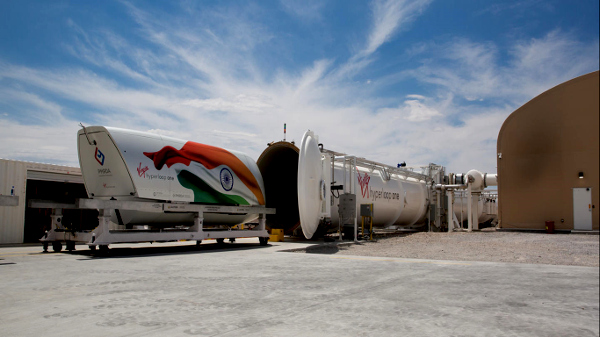
India is preparing to take its indigenous hyperloop programme into a practical freight environment, with the Central Warehousing Corporation planning a trial in Mumbai to demonstrate the movement of a fully loaded shipping container using technology developed by IIT Madras-incubated startup TuTr Hyperloop.
The project marks an important transition for India’s hyperloop effort from university-scale experimentation towards testing technology against the demands of actual container logistics. CWC has already placed an order with TuTr for the demonstration, which is expected to involve an investment of around ₹20–23 crore.
From Experimental Technology to Container Freight
The immediate objective is deliberately practical. Instead of attempting passenger transportation or demonstrating extreme speeds, the project will initially establish whether the system can reliably move a single fully loaded freight container.
CWC Managing Director Santosh Sinha said the corporation is treating the initiative as a research and development exercise. The first stage will concentrate on one container, providing the engineering and operational experience needed before considering movement of multiple containers at higher throughput.
The proposed application is being examined around CWC’s logistics infrastructure in Mumbai, with the longer-term possibility of connecting port operations with a CWC facility. The project is expected to be funded from CWC’s own resources.
₹23-Crore Indigenous Technology Demonstration
According to Sinha, CWC placed the order for the project around March or April 2026. TuTr has indicated a tentative development and implementation period of approximately one year, although CWC is not treating the schedule as a rigid commercial deadline because the programme remains an R&D undertaking.
The collaboration has already progressed beyond an initial proposal. TuTr Hyperloop earlier confirmed that CWC had handed the company a Letter of Acceptance for developing a Linear Induction Motor-based cargo mobility system at its Container Freight Station facility. The LoA was presented at IIT Madras in the presence of representatives from CWC, TuTr and the institute.
Indian Engineering at the Core
TuTr Hyperloop emerged from the technology ecosystem surrounding IIT Madras and is developing indigenous technologies covering linear propulsion, magnetic levitation and hyperloop systems.
Its freight platform uses linear electric propulsion as one of its fundamental technologies. Rather than relying on the wheel-driven propulsion found in conventional trucks or trains, linear motors generate propulsion directly along the transport path. TuTr is developing this technology alongside levitation and low-pressure transport technologies for future high-speed freight applications.
The CWC project is therefore significant not simply because India is experimenting with hyperloop. It provides an Indian engineering company with an opportunity to demonstrate components of the technology against the weight, handling requirements and operating conditions associated with real containerised freight.
Why Container Freight Comes First
Freight provides a practical pathway for introducing technologies that would face considerably more complex certification and safety requirements if passengers were involved from the beginning.
Ports and container freight stations also offer a potentially suitable operating environment. Containers repeatedly travel between fixed locations, while congestion and delays in moving cargo between terminals, storage areas and inland logistics facilities can affect overall port efficiency.
A successful demonstration would not immediately replace trucks or freight trains. Instead, it would establish whether linear-motor and hyperloop-linked technologies can become another option for high-throughput movement along suitable fixed freight corridors.
India Building a Wider Hyperloop Freight Ecosystem
The Mumbai programme is part of a wider Indian effort to take hyperloop technology beyond laboratory demonstrations.
TuTr is also working with Deendayal Port Authority at Kandla in Gujarat on freight technology intended for container movement. The port awarded the IIT Madras-incubated company a contract worth approximately ₹8.7 crore for a system designed around handling heavy containers within the port environment.
Another important industrial development came in July 2026, when Titagarh Rail Systems and TuTr entered into a strategic collaboration to develop indigenous hyperloop-enabled freight mobility solutions. The partnership is intended to combine TuTr’s propulsion and hyperloop technologies with Titagarh’s experience in transportation systems and manufacturing.
These projects indicate that India’s approach is increasingly centred on freight rather than beginning with futuristic intercity passenger services.
A Real-World Test for India’s Hyperloop Ambition
The significance of the Mumbai project lies in what it is attempting to prove. India is moving from demonstrating individual hyperloop technologies towards asking whether an indigenous system can perform useful work inside an actual logistics environment.
A fully loaded shipping container presents a much more demanding engineering challenge than a lightweight demonstration pod. Propulsion, structural loading, braking, control systems, reliability and repeated operation must all work together if the technology is eventually to become commercially useful.
The ₹20–23 crore CWC programme will therefore serve as an important technology-validation exercise. Its results should provide Indian engineers with operational data that can determine how the system needs to evolve before larger-scale deployment is considered.
For India’s emerging deep-tech ecosystem, the development also demonstrates a broader progression: research originating around IIT Madras is being paired with a Central public-sector logistics enterprise and tested against one of the country’s most important freight challenges.
References
Central Warehousing Corporation / TuTr Hyperloop — Letter of Acceptance for Linear Induction Motor-based cargo mobility system at CWC Container Freight Station facility
ETSupplyChain — CWC Lines Up Mumbai Hyperloop Trial to Test Container Movement, 21 September 2026
Maritime Gateway — CWC Lines Up Mumbai Hyperloop Trial, 22 September 2026
TuTr Hyperloop — Indigenous Hyperloop and Freight Mobility Technology
Titagarh Rail Systems Limited — Strategic Collaboration With TuTr Hyperloop for Indigenous Hyperloop-Enabled Freight Mobility Solutions, 2 July 2026
You may also like
-
RFLY Innovations Delivers Indigenous RFLY-PRO High-Altitude Surveillance UAVs to Indian Army
-
HAL’s Indigenous Utility Helicopter-Maritime Prototype Set for Maiden Flight in November 2026
-
Asia’s First Telecom Manufacturing Zone Takes Shape in Gwalior as India Builds Integrated Telecom Production Hub
-
Malda Laxman Bhog Mango — Bengal’s Golden Orchard Fruit and the Mango Heritage of Malda
-
India and OPEC Deepen Energy Cooperation as New Delhi Hosts Seventh High-Level Dialogue
