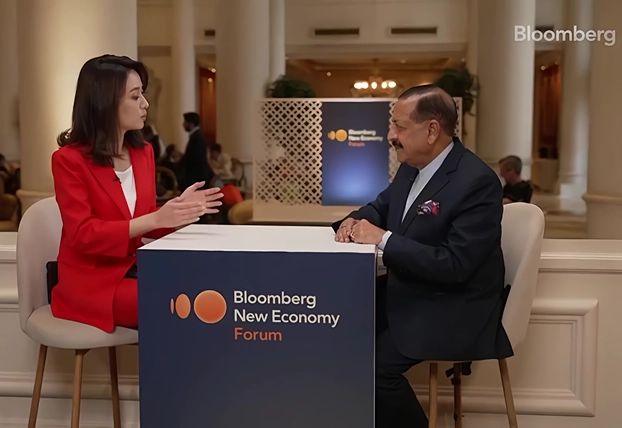
India is positioning nuclear energy as a major component of its future electricity infrastructure, with a target of achieving 100 gigawatts (GW) of nuclear power capacity by 2047. The expansion is expected to strengthen energy security, support industrial development and provide reliable electricity for emerging technologies, including Artificial Intelligence (AI) and large-scale data centres.
Union Minister of State (Independent Charge) for Science and Technology Dr. Jitendra Singh outlined these priorities during an interaction on the sidelines of the Bloomberg Economy Forum 2026 on 20 October. He emphasised that India’s nuclear programme remains committed to peaceful applications and national development, continuing the vision established by Dr. Homi J. Bhabha.
Nuclear Energy to Meet India’s Growing Electricity Requirements
India’s expanding economy, industrial infrastructure and digital ecosystem are creating substantial demand for dependable electricity. Nuclear power offers an important advantage by generating electricity continuously, complementing renewable energy sources such as solar and wind.
Dr. Jitendra Singh said nuclear energy would play an increasingly important role in meeting these requirements while supporting India’s long-term clean energy commitments. The government’s target of 100 GW of nuclear power capacity by 2047 forms part of its broader development ambitions, alongside the national commitment to achieve net-zero emissions by 2070.
Nuclear power can strengthen the reliability of India’s electricity system by providing low-carbon generation that does not depend on daily variations in sunlight or wind conditions. Its expansion would also support the diversification of India’s energy mix and reduce dependence on fossil-fuel-based electricity generation.
Artificial Intelligence and Data Centres to Drive New Power Demand
The rapid development of artificial intelligence is introducing new requirements for India’s electricity infrastructure. AI computing facilities, advanced data centres and associated digital networks require substantial power supplies to maintain uninterrupted operations.
Dr. Jitendra Singh identified nuclear energy as a potential contributor to meeting this growing demand. Unlike electricity sources dependent on prevailing weather conditions, nuclear facilities can provide sustained generation to support energy-intensive technological infrastructure.
As India expands its capabilities in artificial intelligence, high-performance computing and digital services, dependable electricity will become increasingly important for maintaining operational continuity. Nuclear energy is expected to supplement other power-generation programmes and contribute to the development of a more resilient energy system.
The connection between nuclear power and AI also reflects the growing relationship between energy infrastructure and technological competitiveness. Expanding computing capacity requires corresponding investment in electricity generation, transmission and dependable power availability.
Homi Bhabha’s Vision of Peaceful Nuclear Development
Reaffirming the foundations of India’s nuclear programme, Dr. Jitendra Singh recalled the vision of Dr. Homi J. Bhabha, who played a pioneering role in establishing the country’s nuclear research and development capabilities.
The Minister emphasised that India’s nuclear development programme remains focused on peaceful applications and national progress. Civilian nuclear technology contributes to electricity generation, scientific research, healthcare, agriculture and industrial applications.
India’s nuclear establishment has developed significant domestic expertise in reactor technology, nuclear fuel-cycle activities and associated engineering disciplines. These capabilities provide an important technological foundation for the country’s proposed expansion in nuclear electricity generation.
The government’s emphasis on peaceful applications reinforces the role of nuclear science in supporting economic development, energy security and technological self-reliance.
Responsible Use of Artificial Intelligence Across Sectors
Beyond electricity generation, Dr. Jitendra Singh discussed the growing importance of artificial intelligence across scientific and technological disciplines. He described AI as an enabling tool with applications extending across space research, life sciences and several other sectors.
Highlighting the importance of human judgement, the Minister remarked, “One has to be intelligent enough to use Artificial Intelligence.”
His observation underlined the need to combine technological capabilities with responsible decision-making. AI can accelerate research, improve data analysis and strengthen operational efficiency, but its application must remain guided by appropriate human oversight.
Dr. Jitendra Singh also emphasised that preventing misuse requires more than regulatory measures. Individual responsibility, institutional integrity and national commitment are essential to ensuring that emerging technologies contribute positively to society.
Private Sector Participation in Strategic Technologies
The Minister also highlighted the government’s efforts to expand private sector participation in areas traditionally dominated by public institutions.
He credited Prime Minister Narendra Modi’s administration with opening critical and sensitive sectors to non-government participants, creating additional opportunities for technological development, investment and industrial innovation.
Greater industry involvement can help broaden India’s technological ecosystem by bringing specialised manufacturing capabilities, engineering expertise and private investment into strategic sectors.
The policy direction also complements India’s wider objective of strengthening domestic industrial capabilities and encouraging innovation across advanced scientific and technological fields.
Nuclear Power and India’s Vision for 2047
India’s proposed expansion to 100 GW of nuclear power capacity represents a significant long-term infrastructure ambition. Achieving this objective will require sustained development of nuclear generation facilities, supporting industrial capabilities and electricity infrastructure.
The increasing convergence of nuclear energy, artificial intelligence and advanced manufacturing is expected to influence India’s future economic development. Reliable electricity will support technology-intensive industries, while continued investment in scientific research and domestic engineering will strengthen the country’s technological capabilities.
With nuclear power positioned as an important component of its clean energy strategy, India is advancing towards an energy system capable of supporting industrial growth, digital transformation and the broader objectives of Viksit Bharat 2047.
References
- Press Information Bureau, Government of India, Ministry of Science and Technology, 20 October 2026. India’s Nuclear Programme Dedicated to Peaceful Purposes, Says Union Minister Dr. Jitendra Singh; Nuclear Energy to Power AI-Driven Future. Release ID: 2325436.
https://pib.gov.in/PressReleasePage.aspx?PRID=2325436 - Department of Atomic Energy, Government of India — Official information on India’s civilian nuclear energy programme.
https://dae.gov.in/
You may also like
-
India Crosses 300 GW Non-Fossil Fuel Power Capacity, Plans 74 GW Energy Storage by 2032
-
Tulaipanji Rice: West Bengal’s Aromatic Heritage Grain from the Dinajpur Region
-
Profitable Banks, Growing Savings and Timely EMI Repayments: Signs of a Healthy and Alive Indian Economy
-
Oil India Signs Contract for 272 Sq Km Coal Bed Methane Block in Singrauli, Expanding India’s Domestic Natural Gas Exploration
-
CONCOR Facilitates First Liquid Glucose Export from Kanpur to Vietnam, Strengthening India’s Agri-Export Logistics
